
Paid marketing is a quick fix for any industry. The moment you stop paying for paid ads and lead aggregators, your pipeline starts to dry up. You want a reliable, long-term, compounding ROI channel that generates leads for your financial advisory business. That channel is SEO & getting cited/recommended in AI models.
SEO/AI search visibility is NOT a quick fix. It takes time, and you need a roadmap. And once you build your solid foundation, you start getting results (& almost always 100x ROI) long after the original work is done.
After reading this blog, you’ll walk away with exactly what you need to do next.
Why SEO for Financial Advisors is THE Best Lead-Gen Channel?
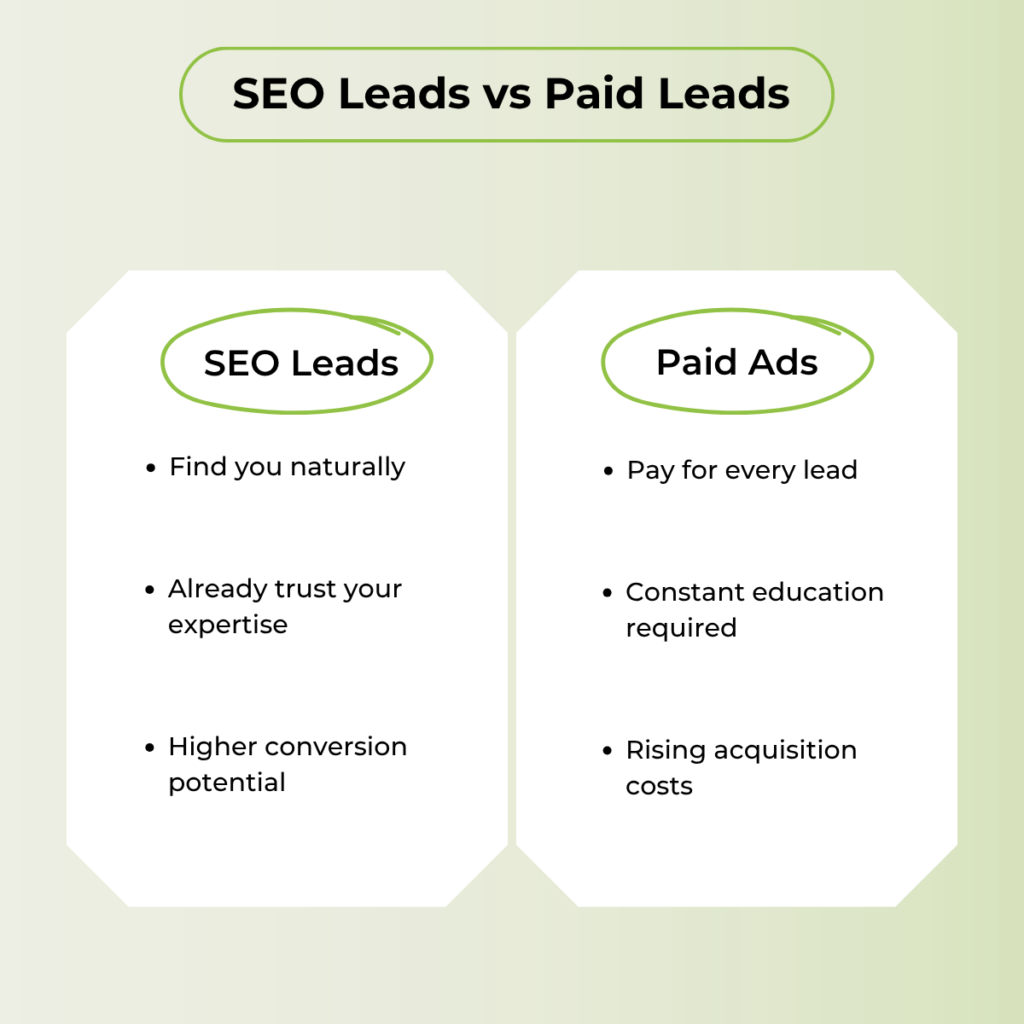
Organic leads convert better because they arrive pre-educated. A prospect who finds your financial firm via SEO content, understands your specialty, and has made a judgment that you might be right for them. When the lead contacts you, you don’t have to convince them.
On the other hand, with paid ads, aggregator, or commission-based leads;
- You have to pay every single time for every single lead.
- The CAC keeps rising because of rising competition. On average, you pay $75 to $150 per lead.
- You have to convince, educate, or explain what you do to every lead you get. It’s a lot of work. And the conversion becomes limited.
In SEO/AI visibility, you invest once and get results for years.
The Best SEO and GEO Strategies for Financial Services Firms & Advisors
If you already have a website that’s not generating leads, or want to start fresh, there’s a roadmap you need to follow. You cannot rank blog posts if your website has no clear topic structure. You cannot dominate local results without a complete Google Business Profile. Your website will fail to generate leads if your content strategy and distribution are not solid.
Here’s the roadmap.
Build The Foundation of Your Financial Services Website
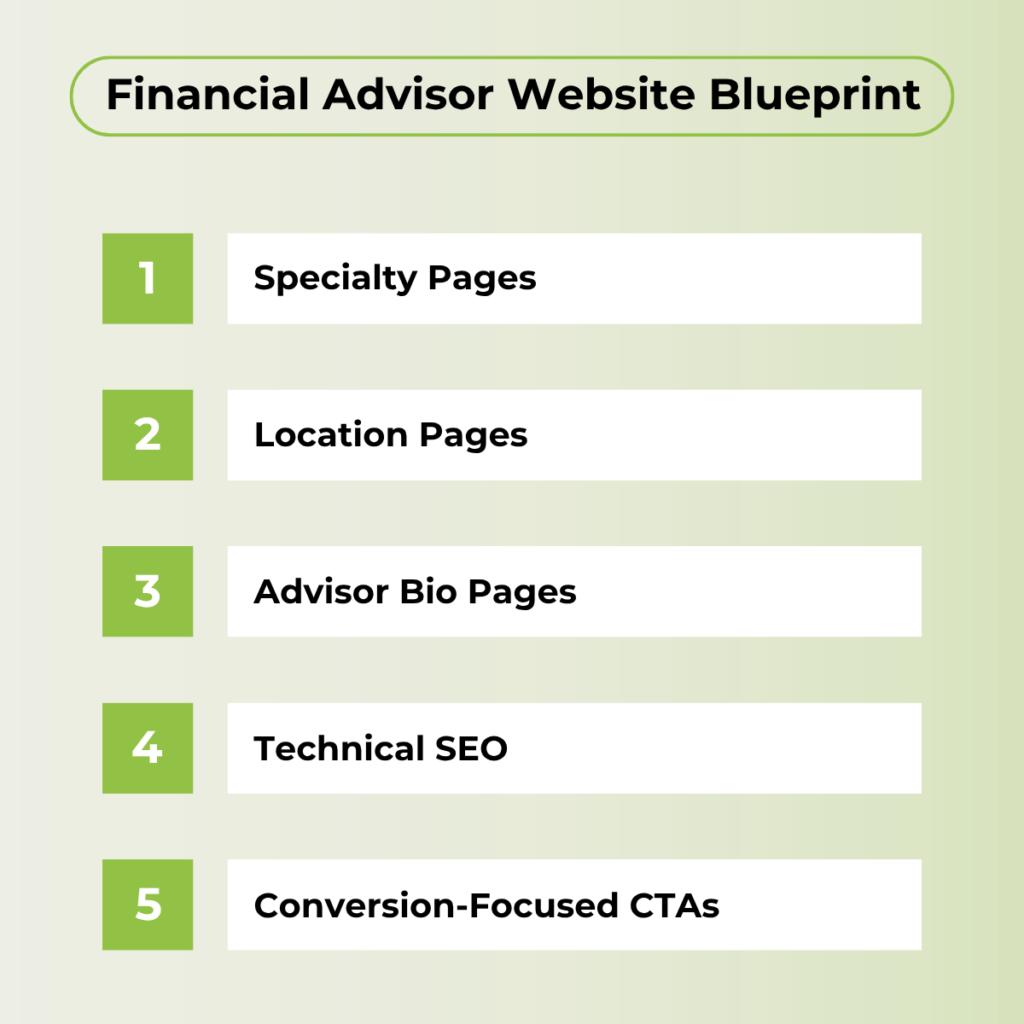
Most financial advisor websites are built like brochures: a homepage, a services page, and an about page. That structure gives Google almost nothing specific to rank beyond your firm name.
Every specialty needs its own dedicated page. If you work with physicians, there should be a standalone page on financial planning for physicians, not a bullet point on a general services list. Google cannot rank a page if it cannot identify a clear topic for it. Neither can a prospect search for that exact service.
Now grab a pen and copy and note down.
- The financial specialties that you offer as a service
You serve different types of clients, and for each type, you have a distinct specialty. For instance, financial planning for physicians, retirement planning for federal employees, and equity compensation planning for tech executives.
Each of these types would be dedicated to a specialty page on your site.
- Locations where you (want to) serve as a financial advisor
If your services are for local clients, you need to be specific about the city. If you offer services at a national or global level, you would want to target states or countries, like a financial advisor in [Utah] or the [UK]. Each location page will have a dedicated page with specific context and info.
- Team bio pages/About page
If you’re an advisory firm, you need team bio pages. If you’re a solo financial advisor, then you need an About page. Put the credentials, CRD number, and niche focus on this page.
This is where EEAT signals (Experience, Expertise, Authoritativeness, Trustworthiness) live on your own site.
And make sure you’re being very specific. If you’re writing something like “John has 20 years of experience helping clients achieve their goals,” it tells Google nothing. Google (& AI models) love a bio page that lists the designation, registration type, niche, and specific client profile.
Important Considerations for Your Website
Once you’re done with the core web content of your site, now
- Take care of your site technically. Mobile friendliness and speed, HTTPS, crawling & indexing issues. Check everything..
- Make sure each page has ONE clear action: a book-a-call button, a contact form, or a downloadable guide. Every visitor needs an obvious next step.
Google Business Profile Is Your Local SEO/AI Visibility Goldmine
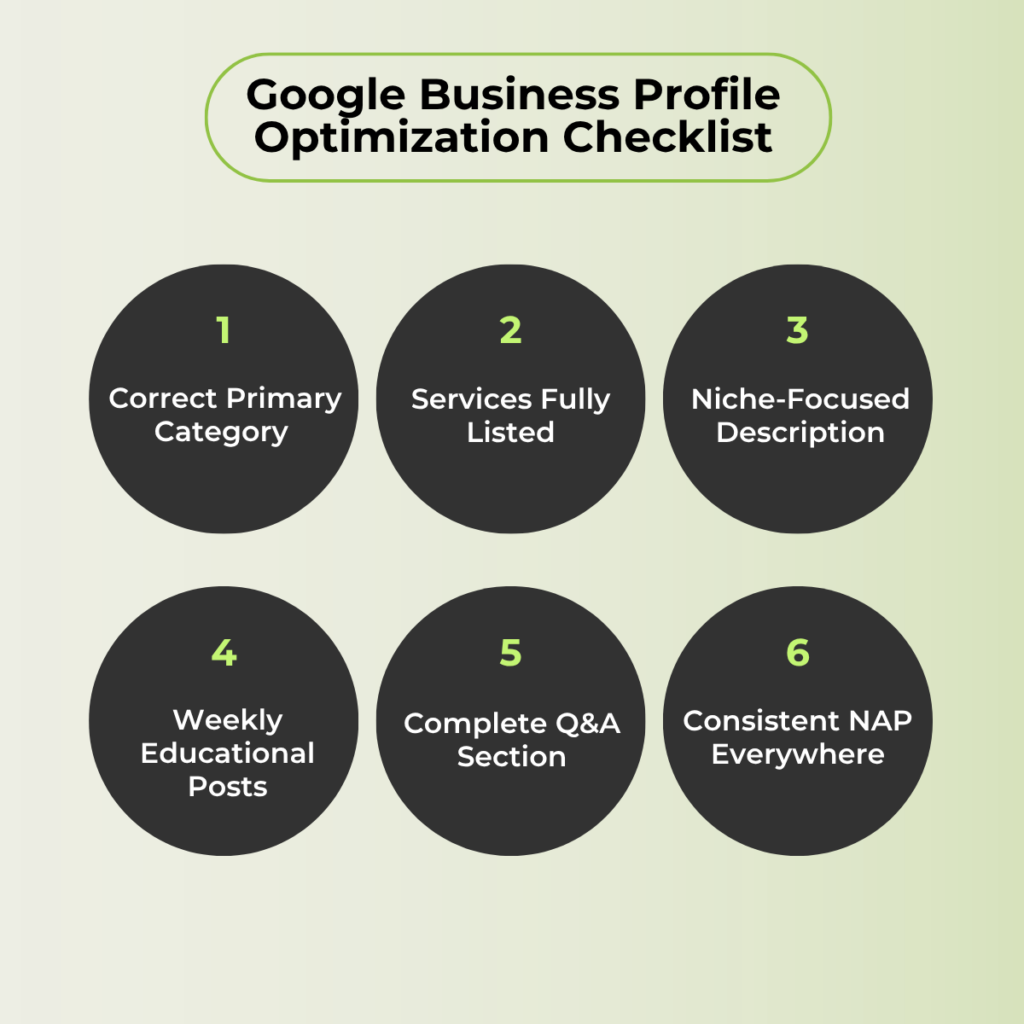
Your GBP (Google Business Profile) is the lever for appearing in Google’s local pack, AI overviews, and in AI search. Most financial advisors underuse it significantly.
Here’s what you need to do to get it right;
- Select Your Primary category: “Financial Planner” or “Financial Advisor.” Not “Financial Services” (too broad) and not “Investment Management” (too narrow for most generalist-within-a-niche firms).
- Fill the Services section: list every service you offer. Google uses this to match your profile to relevant local searches beyond your primary category.
- Write Business description: 750 characters. Write it for your niche and city. “I help physicians in [city] build tax-efficient retirement plans” outperforms any generic firm overview.
- Post Weekly posts: keep the profile active with educational content. FINRA and SEC rules apply to GBP posts exactly as they do to any other public communication.
- Complete Q&A section: answer your prospects’ most common questions before someone else does, or before Google auto-populates it with something you would not choose.
NAP consistency matters for financial SEO across every listing. Your name, address, and phone number must match exactly on your GBP, your website, and every directory listing. One discrepancy fragments your local authority in ways that are hard to diagnose and easy to prevent.
Get Your Business Listed in The Financial Advisor Directories
The directories that matter for financial advisors are not generic business platforms. As a financial advisor or a firm, you should be listed on these directories.
Regulatory registries (mandatory):
- BrokerCheck (FINRA): required for broker-dealers and registered reps. Google reads this as identity and credential verification for your firm.
- IAPD (SEC): for registered investment advisers. Must be accurate, current, and consistent with your website.
Professional membership directories (high priority):
- CFP Board, NAPFA, FPA, XY Planning Network, Fee-Only Network
Prospect-facing matching platforms:
- Wealthtender, Paladin Registry, WiserAdvisor
Niche-specific directories (where applicable):
- CDFA directory for divorce financial planning specialists; designation-specific directories relevant to your niche
Google treats these listings as authoritative verification sources for your profession, where credentials, registration standing, and professional membership are confirmed. Complete listings across these categories often produce faster results than publishing new blog content.
Strategize & Create Blog Content Around Your Specific Financial Advisory Services
There’s a lot of competition in the financial space. But most of the financial content is AI crap. You can easily win if your strategy is strong and the content is high-quality.
You, as an experienced financial advisor or a firm, already have a competitive advantage: your niche expertise, practitioner voice, and local knowledge. You just need a strategy to capture all of this.
Three types that help you win despite high competition;
- Niche-and-scenario content
“How a physician finishing residency should structure loan repayment, disability coverage, and first retirement contributions” is content that Investopedia cannot write with real depth. You can, because you have worked through it with dozens of clients in that situation. A prospect who finds that article has found the advisor who understands their life. That is a pre-qualified lead.
- Local-specific content
Topics like “Retirement planning for Texas teachers in the TRS pension system” require local knowledge that a national publisher cannot produce with genuine utility. You can write the piece a Texas educator actually needs when deciding whether to take an early retirement option.
- Life-event content:
Your prospect does not make decisions impulsively; they begin their search long before they need an advisor’s help. That’s where you can earn their trust. And it’s easy if you cover topics like Inheritance, business sale, RSU vesting event, early retirement buyout, etc.
Some Tips for AI Visibility (GEO) and How to Get Your Firm Recommended by AI Search Tools
Google I/O 2026 keynote speech made it obvious that Google search is now AI search. And it changes almost everything we know about traditional SEO. There is no doubt that high-quality, unique, helpful content that benefits your prospects is all you need. But now you need to widen your content strategy.
AI models cite & recommend brands that are present beyond their websites.
How to build GEO presence:
- Publish niche content consistently: repetition builds the name-to-specialty association that GEO recommendation signals run on.
- Get cited in financial media: Get yourself mentioned in CNBC, Forbes Advisor, local business journals, and niche financial publications.
- Appear on podcasts and contribute expert quotes: every authoritative mention of your name within your niche contributes to the signal.
Now, this does not mean that you need to do all of it. 90% of your competitors aren’t even strategic about their site content. If you get your site content right + are active on social media, you’re beating 90% of the competition. If you have got the budget, then do some PR, and you’ll be good to go.
Distribute Your Website Content On Social Media & Forums
Social media platforms like LinkedIn and forums like Reddit and Quora are the primary platforms for financial advisor SEO and AI search visibility.
What works:
- Post consistently in your niche: three to four times per week on the specific decisions and situations your target client faces. Not market commentary that any advisor could write. Content that demonstrates you specifically understand this client type.
- Build your network around your target client: your connection network shapes where your content reaches.
- Publish long-form LinkedIn articles: indexed by Google and cited by AI tools more reliably than short posts. A library of long-form articles on your niche builds durable authority.
The content creation for social media and forums is easy. You just need to repurpose your blog content.
The Compliance Rules Financial Advisors Must Follow Before Publishing Any Content Online
Financial content is one of the most sensitive YMYL (your money, your life) niches. Somehow, the same rules apply for this niche as for law firms’ content writing. Every piece of public content you publish as a financial advisor is a regulated communication. A compliance violation in a blog post carries real regulatory risk.
These are the frameworks that govern it.
- FINRA Rule 2210 (broker-dealers and registered representatives)
FINRA rule states that all public communications must be fair, balanced, and factual.
“Public communications” includes blog posts, website copy, LinkedIn posts, and GBP posts. Key restrictions:
- No performance guarantees or projections without required disclosures
- No misleading statements or material omissions
- Past performance references require specific disclaimers
- Retail communications require principal approval before publication at most broker-dealer firms
- SEC Marketing Rule, Rule 206(4)-1 (RIAs)
Updated in 2020, this rule now permits client testimonials and endorsements with required disclosures, and performance advertising under specific conditions. All marketing must be truthful and cannot omit material information.
- Here is what you can do to abide by this rule:
Keep a record of every published piece with approval dates. For broker-dealers, get an OSJ review before anything goes live. For RIAs, build a review process that accounts for the Marketing Rule conditions before testimonials or performance data appear in any content.
How You Can Stand Out When Every Other Financial Advisor Offers the Same Services
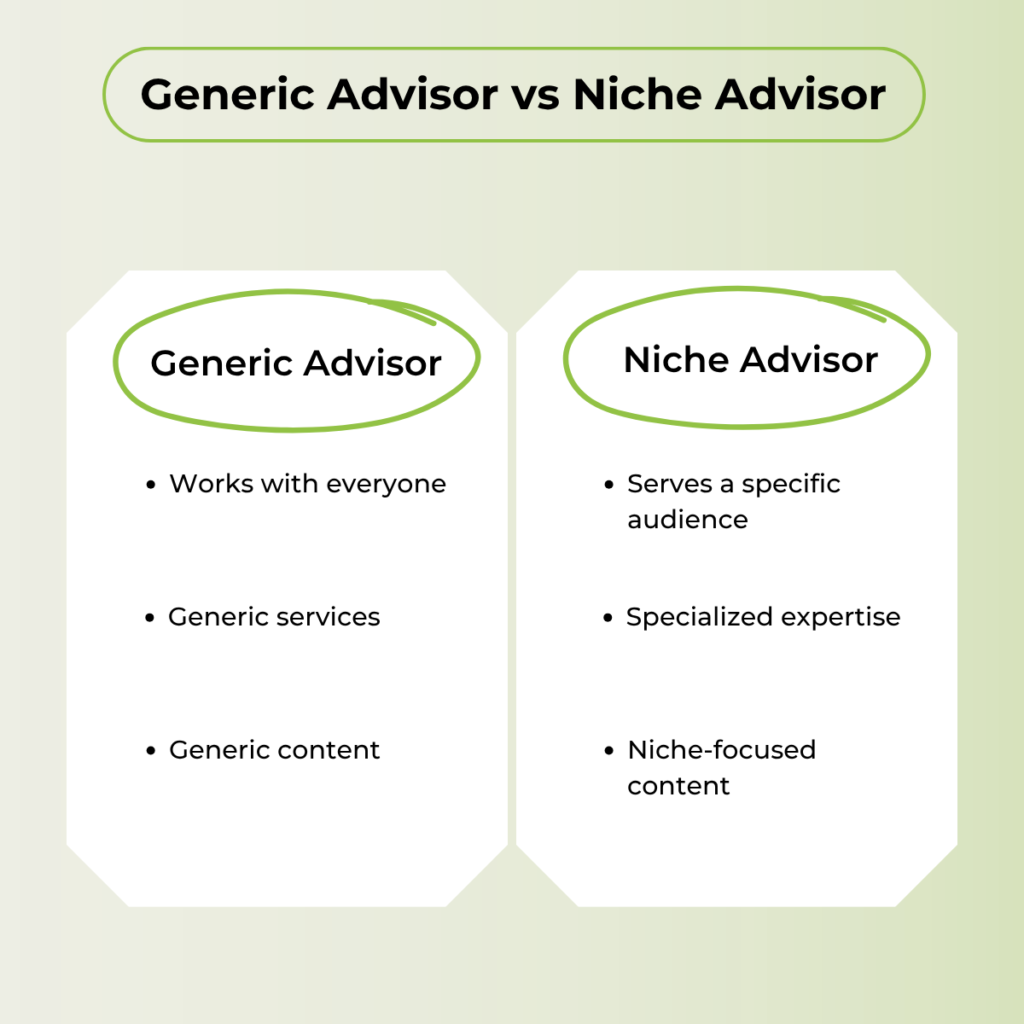
An RIA in Boston and an RIA in Austin can offer virtually identical services, carry comparable credentials, and charge similar fees. Their website copy is often indistinguishable. Differentiation does not come from being better at the same thing. It comes from being visibly specific about who you serve.
Here are some check boxes that help you stand out;
- Name your niche precisely
Do not position yourself as “I work with business owners” but “I specialize in financial planning for business owners within five years of a planned exit.” Specific niches are searchable. Vague preferences are not.
- State your fee model publicly
Fee-only, AUM, flat-fee, and subscription models attract different clients. Stating your model filters for fit before the first call builds immediate trust with prospects who specifically search for a fee-only advisor.
- Name your planning process
“Here is exactly what working with me looks like” removes the uncertainty that stops prospects from reaching out. A named process also makes your content more specific and more credible.
- Publish content that demonstrates depth in your niche
A prospect who finds three substantive posts written specifically for physicians has a materially different experience from one who lands on a generic homepage listing services.
- Make your professional background part of your story
A former military officer who became a CFP for military families carries authentic authority. A former physician who advises physicians is already an expert before they open their mouths. Prior career experience in your target niche is one of the most underused differentiators available.
- Get visible in your niche’s professional community
Speaking at the conferences your target clients attend, contributing to their trade publications, and being active in their associations builds recognition that no SEO tactic can produce. It also generates the citations and mentions that feed GEO signals.
- Use public reviews where permitted by your registration
Under the updated SEC Marketing Rule, RIAs may use client testimonials with proper disclosures. Check what applies to your registration type and put it to use.
The advisors who generate the most organic leads tend to be the most specific about who they serve, not the most polished in how they present it.
You Might Have These Questions About SEO for Financial Advisors
Expect 3 to 6 months for initial ranking movement on low-competition niche terms and 12 to 18 months for consistent organic lead flow. A clearly defined niche, complete directory, GBP listings, and consistent monthly publishing could help you get results faster.
A financial services SEO agency would prioritize the niche and trust-graph foundation before any content work begins, because those are the conditions everything else depends on.
Yes. Referrals do not scale or compound. One article that ranks generates inquiries for three to five years with no additional investment. Referrals are the ceiling of your current network. SEO and GEO expand the floor.
Long-tail, niche-specific terms combining audience, service, and location: “financial advisor for federal employees in [city],” “retirement planning for physicians in [state],” “business exit planning advisor in [metro].” Avoid broad educational terms that large publishers own by default. The more specific the keyword, the more qualified the prospect behind it.
Aggregator leads are cold and cost $75 to $150 each [PLACEHOLDER: confirm current pricing]. An organic lead has already read your content, understood your niche, and decided you might be right for their situation before they ever contact you. The cost per organic lead at scale approaches zero. The quality difference is not marginal.
If All Of This is A Lot To Do, Hire a Financial Services SEO Agency
You’re a brilliant financial advisor, but SEO is totally a different job. It still takes a hell of a lot of brain cells and time to set the foundation and then scale it. The better alt is to get help. You’re into finance, so you’ll know that it’ll be a worthy investment.
Get in touch with Saiqic and let’s discuss your financial SEO.
