
No doubt that AI writes faster and cheaper. If your firm only cares about pages produced per dollar, go use AI. But that’s not apparently the case; that’s why you’re here.
Most law firm owners are concerned about whether AI-generated legal content will comply with bar rules and regulations, whether it is credible, whether it will rank, etc. And most importantly, can it convince/satisfy someone who’s dealing with a $300k worth of case?
This blog post will look at AI Legal writing Vs professional legal content from three lenses;
- Compliance exposure.
- Search credibility.
- And the workflow you actually want your content team to operate, AI included or not.
AI Legal Writing Vs Professional Legal Content Writing At a Glance
Here’s how AI legal content writing and professional human legal content writing compare to each other;
| Dimension | AI Legal Content Writing | Human Legal Content Writing |
| Jurisdictional accuracy | National model. No state-specific legal knowledge unless heavily prompted, and unreliable even then. | The writer knows your state’s rules before they draft the headline. |
| Hallucination risk | 58% to 88% percent on general legal queries. (Source mentioned below) | Near zero when paired with standard attorney review. |
| Citation quality | Often generic (“studies show,” “experts agree”) or fabricated case names. | Cites the rule, the case, or the bar opinion by name. |
| State advertising compliance | Cannot reliably handle state-by-state rules on testimonials, outcome claims, and disclaimers. | Built around your state’s rules and your firm’s disclosure standards. |
| EEAT and YMYL alignment | Fails Experience and Authority by default. No first-party perspective. No named source. | Built on attorney interviews and named SMEs. Clears all four EEAT thresholds. |
| Search intent matching | Writes for the keyword. | Writes for the prospect one phone call away from hiring you. |
| Confidentiality and data exposure | Free-tier prompts may be retained or used in training under default settings. | No client-identifying material leaves the firm. |
| Speed per article | Minutes for a first draft. | Days to one week, depending on SME availability. |
| Cost per article | Near zero in tool subscription, plus internal review time. | $150-400 per article |
| Liability when something goes wrong | Sits with the firm. ABA Formal Opinion 512 does not transfer responsibility to the tool. | Sits with the firm, with a workflow built to prevent failure in the first place. |
This clearly shows that;
- If you’re directly involved in the process while generating content with AI, you will get a good enough piece to publish.
- If you hire a professional legal SEO writer, you’ll get polished, high-quality pieces, but the investment is high.
- If you have the budget, go with professional human content. If you have time but a tight budget, go with AI.
Why More Law Firms Are Seriously Considering the Switch to AI Legal Content Right Now
There are three reasons that I can think of;
- Professional/expert human content prices have climbed. A serious legal content writer charges over $300 per article. Most firms publishing weekly are already over budget.
- The SEO bar has moved up. Ranking for “personal injury lawyer [city]” in 2023 took six well-written posts. Now, it takes 30+ in-depth pieces that are woven into a solid content strategy.
- The AI output has significantly improved. A Claude or ChatGPT first draft on a topic is far better & polished than a mediocre writer’s first draft who knows nothing about style and tone. This gap is making the shift feel obvious.
The #1 Problem Law Firms Face With AI Legal Content Writing: The Compliance and Credibility Issues
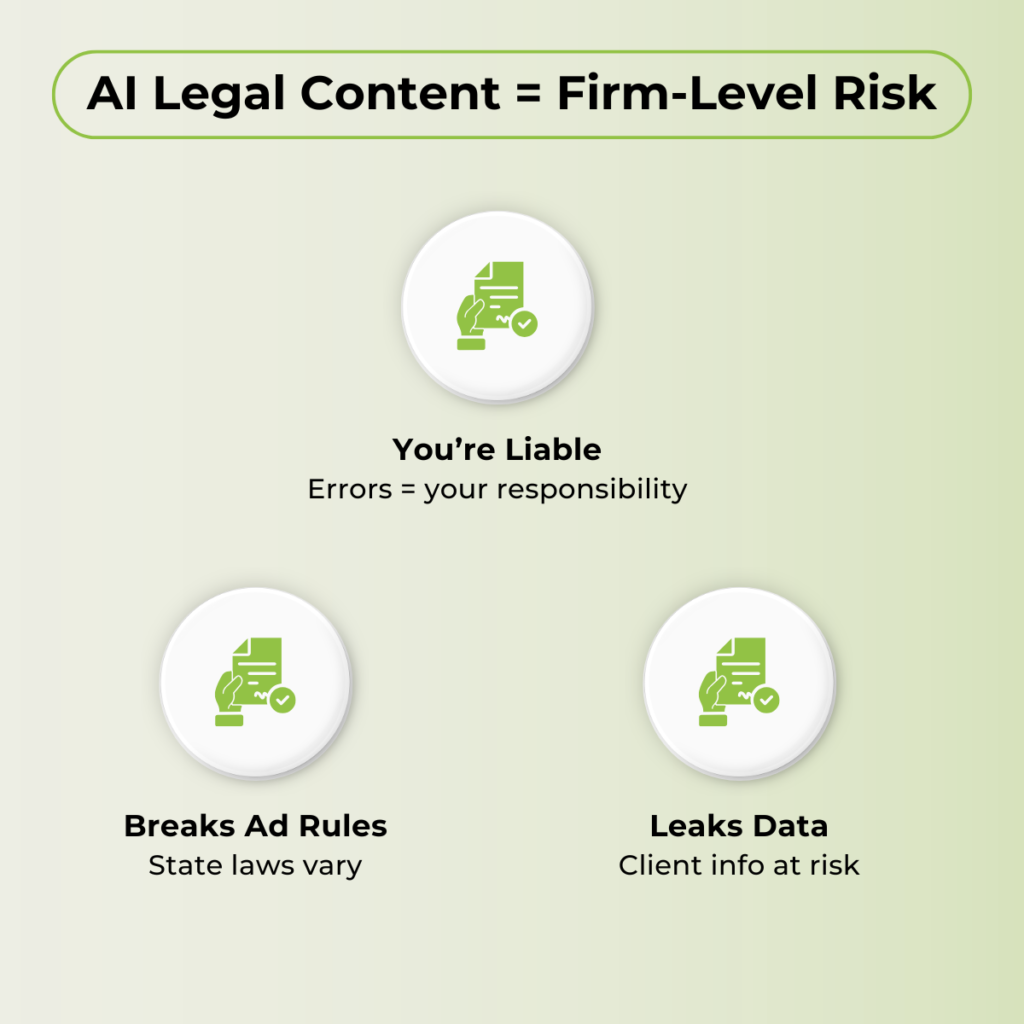
Content for a law firm is not blog content. It is published statements made by a regulated profession. The moment AI drafts that content, three categories of risk attach to your firm name regardless of who presses publish.
- Hallucinations For Which Your State Bar Still Holds You Personally Responsible For
You & your firm are responsible for ANY bar policy violation.
Stanford’s Human-Centered AI group benchmarked general-purpose AI on legal queries. The hallucination rate landed between 58 and 88 percent, depending on the model and query. That number is not specific to court filings. It applies to any legal content the model writes, including the practice area page sitting on your website right now.
The American Bar Association’s Formal Opinion 512, issued in July 2024, states that an attorney’s professional responsibility for accuracy does not transfer to the tool. Model Rule 7.1 makes you personally responsible for any false or misleading communication about your services, including marketing content.
- Advertising Rule Violations That Change by State and Trigger Ethics Complaints
Attorney advertising is governed state by state. If you’re over-reliant on AI-generated content, you’re going to face trouble.
California, Florida, and New York each have distinct rules on testimonials, comparative claims, outcome language, and required disclaimers. A national model cannot reliably keep up with that. It will produce an unverifiable success-rate claim, a prohibited testimonial format, or a missing disclaimer without flagging any of it.
- Confidentiality and Data Leakage From Free-Tier AI Tools
You might know that whatever you feed to AI, it saves it and uses it for ‘training’ their models. So if your associate/SEO writer pastes a case summary and other credentials in a prompt to write a piece of content, the information will be saved in the model’s database. That text can be retained or used in training under the default settings of consumer-tier accounts.
The solution is NOT to ban AI, but to be careful and use paid plans for AI models that allow zero-data-retention configurations. Also, set an internal rule that no client-identifying content goes into a prompt.
What Professional Legal Content Actually Delivers That AI Cannot Replicate
I’m not advocating here that humans are better. But I know that there are 3 specific aspects that NO AI can replicate in legal SEO content writing.
- Jurisdiction-aware writing
- Search intent matching (NOT keyword intent matching)
- Original perspectives
Let’s have a look at them in a bit of detail.
Jurisdiction-Aware Writing That Respects Your State’s Bar Rules
A senior legal content writer knows your state’s rules before they write a word. They know that Texas allows what Florida does not. They know that California’s testimonial language reads nothing like New York’s. AI does not.
Jurisdictional literacy is the baseline competence of any legal content engine. If your current writer cannot tell you which states allow comparative outcome statements, you do not have a legal content writer. You have a generalist with a vertical landing page.
Search Intent Matching That Brings Qualified Prospects, Not Just Traffic
A professional writes for the person who is one phone call away from hiring you. AI writes for the keyword. The two outputs look similar at the headline level and feel completely different by paragraph three.
A practice area page that ranks but does not convert is worse than no page at all. It eats your budget and your slot in Google’s index. You’ll not get any conversions, inquiries, etc.
Original Perspective That Clears Google’s EEAT and YMYL Criteria for Legal Content
Legal content sits inside Google’s Your Money or Your Life (YMYL) category. That is not marketing language. It is in Google’s Search Quality Rater Guidelines, the same document that tells human raters to apply higher accuracy and trust thresholds to legal pages than to almost any other niche.
EEAT is the framework Google uses to score it. Experience, Expertise, Authoritativeness, Trustworthiness. Generic AI output routinely fails on Experience and Authority. It has no first-party perspective and no source it can credibly call its own. Professional content built on a thirty-minute interview with the supervising attorney clears all four thresholds in one pass. The experience is real. The source is authentic.
Why Most “AI Legal Content at Scale” Providers Are the Same Problem in New Packaging
A growing share of the “legal content writing” market is ChatGPT with a markup. The pitch is professional. The output is not. Your firm hires what appears to be an agency. What shows up in the CMS is a thinly edited model draft your associate could have produced in twenty minutes.
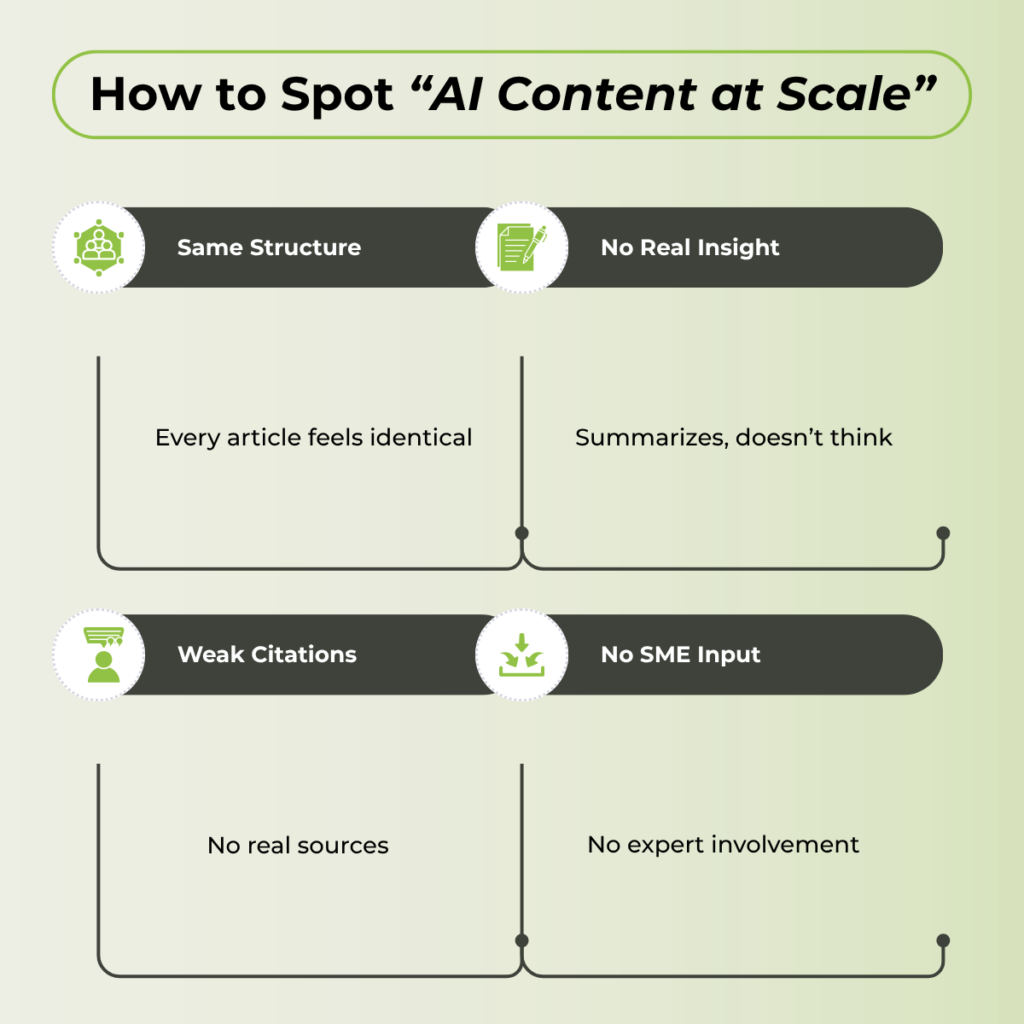
There are four signals that clearly indicate AI-slop;
Fourth, a request for an SME-quote interview with one of your attorneys gets pushed back, redirected, or buried. The provider’s workflow does not include that step because the prompt is the workflow.
First, every article on every client’s blog reads in the same rhythm. Same H2 cadence. Same five-bullet list halfway through. Same closing call to action.
Second, the writer cannot give you a substantive opinion on a current case in your practice area without prompting. They are not following the niche. They are summarizing it.
Third, citations are either absent or boilerplate. Real legal writing cites the rule, the case, or the bar opinion by name. AI-padded writing cites “experts agree” and “studies have shown.”
If three of those four tell fit, you are already paying for AI content. The decision in front of you is not whether to switch to AI. It is a question of whether to switch back to human.
Where You CAN Use AI To Write Legal Content?
This is where the conversation usually breaks open. AI is not the problem. Unsupervised AI on substantive legal claims is the problem. I’m NOT against using AI. It really does speed up the process and produce high-quality content efficiently.
But AI should always sit on the BACK of the workflow, not at the front.
Where AI can help:
- SERP summarization (collapse twelve ranking pages into a competitive map)
- Based on SERP research and analysis, create outlines that the writer then polishes based on the client’s outputs.
- Readability audits on a finished human draft
- Schema and structured data suggestions
- Internal linking gap analysis across the existing blog
Where AI can NOT help you;
- Substantive statements of law
- Jurisdiction-specific procedure language
- Case or statute citations
- Anything a client will read and treat as guidance
- Anything that will be quoted, screenshotted, or republished
AI handles the work that a junior researcher or analyst would handle. A licensed attorney or trained legal writer handles the work that puts the firm’s name on a regulated statement. The line is the same line your firm already draws between research and advice.
The Framework We Give Law Firms Before They Commit Their Content Strategy Either Way
Save this table and bring it to the next partners’ meeting.
NOTE: The “AI role” column is what you can automate without any risk.
The “human role” column is what your firm is paying to put behind its name. Anywhere a row leans toward “Writer plus attorney,” removing the human is removing the reason that page exists at all.
| Content type | Stakes | AI role | Human role |
| Practice area pages | High. Drives qualified intake. Read by prospects under stress. | Outline first pass. Headline variants. | Writer plus attorney review. SME interview required. |
| Blog posts on substantive law | High. Cited by prospects. Eligible for EEAT scrutiny. | Research summary. Internal linking suggestions. | Full draft by a legal content writer. Attorney sign-off on substantive claims. |
| FAQ and how-it-works pages | Medium. Conversion-supporting, not conversion-leading. | First-pass draft for editing. | Writer rewrites. Attorney spot-checks. |
| Client-alert pieces (new ruling, new statute) | High. Time-sensitive and citation-heavy. | Initial summary of the ruling. | Writer plus attorney. Always. No exceptions. |
| Landing pages and ad copy | High. Triggers state advertising rules. | Variant generation for testing. | Writer plus partner approval. State-specific compliance pass. |
You Might Have These Questions About AI Legal Writing for Your Firm
You can, and many firms are doing it as well. But what AI can ‘review’ for you is a quick read of the tone, not a verification of every claim, citation, and jurisdictional rule. That is the step where the model’s confident wrong sentences slip through and end up live on your website.
Google does not penalize AI content as a category. It penalizes content that fails its quality and EEAT thresholds, and generic AI output for legal queries often fails those thresholds more than human-written content. The penalty is that you do not rank.
Ask the writer for a thirty-minute interview with one of your attorneys before the next article. A real writer will treat that as standard. A ChatGPT-with-a-markup operator will redirect, pad the timeline, or quietly stop responding.
Zero percent of substantive legal claims, citations, and jurisdiction-specific advice. Up to one hundred percent of internal research summaries, outline drafts your writer rebuilds, and readability checks on finished work. The percentage is not a number. It is a workflow boundary.
Often, yes. Sophisticated prospects (corporate counsel, repeat plaintiffs’ clients, anyone who has hired counsel before) read your content as a signal of how you think. Generic AI prose reads as a generic firm. In a trust-based industry, that read costs you cases you never knew you had a shot at.
Legal Content is Not a Formality. It’s Your Reputation.
The end goal of any legal SEO content piece is to;
- Educate your target audience or solve their problems
- Establish your firm’s reputation in front of your target customers
- Get you qualified leads
It does not matter which tool you use or whose writing your content, as long as you are fulfilling your objectives.
But 9/10 times, the AI-generated legal content is not credible. No credibility = no trust = no leads. If you understand SEO nuances and have time to stay in the loop, then save money and use AI. If not, then don’t waste your energy and hire a professional legal content writer. Saiqic can help you write high-quality, credible, and rankworthy legal content. Book a call to discuss your content needs.
