
A broker I spoke with last month paid $600 to a freelancer for a batch of twelve listing descriptions. The drafts came back calling a two-bed condo “ideal for a young family starting out” and a waterfront property “perfect for Christian retirees looking to downsize.” Every one of them needed a full rewrite before going live, not because the prose was clunky, but because the phrases were Fair Housing violations waiting to be reported. The broker ate the fee and wrote the listings himself.
That’s the story most brokers, team leads, and marketing managers have either lived or are trying to avoid. Here’s the evaluation filter they wish they’d had the first time around.
The Difference Between a Copywriter Who Writes About Real Estate and One Who Actually Works in the Niche
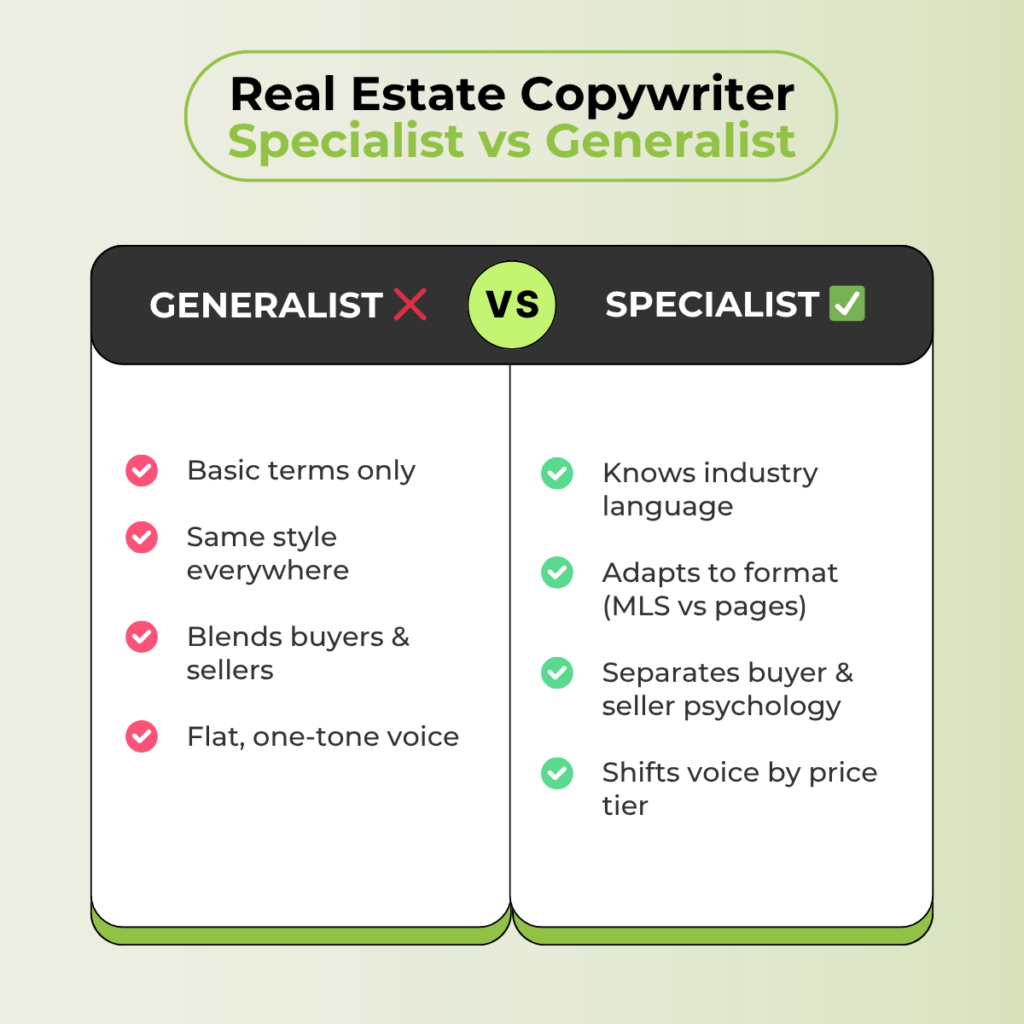
A copywriter who’s written one listing description is not a real estate copywriter. They’re a generalist with a sample. The gap between the two shows up the moment you hand over a brief that assumes industry fluency.
Their Vocabulary Tells You Everything on the First Page
A real specialist uses vocabulary that signals they’ve sat in on broker meetings. They know what DOM means, what a pocket listing is, how comps shape a price narrative, and why dual agency gets a different disclosure line than straight buyer representation. A generalist uses “home,” “property,” and “neighborhood” on rotation and calls it done.
They Know Listing Copy Plays by Different Rules Than Landing Page Copy
Listing copy is constrained. MLS character limits, compliance exposure, and a buyer who’s already scrolling a list of fifteen properties. Landing page copy has room to breathe, build a narrative, and layer a call to action. A specialist writes each format on its own terms. A generalist writes every format like a mid-length blog paragraph.
They Write Differently for Buyers Than for Sellers
Buyer copy sells a life inside the property. Seller copy sells your brokerage as the team that will move the property. The psychology is not the same, the proof points are not the same, and the emotional register is not the same. If a candidate’s buyer and seller samples read the same way, they haven’t considered either audience.
They Shift Voice Across Price Tiers Intentionally
A buyer reading a luxury estate page needs a different register than a first-time buyer reading about a starter condo. Three tiers, three voices. A generalist flattens all three into the same “stunning and move-in ready” template. Ask for samples at a luxury tier, a mid-market tier, and an investment tier. If the voice shifts intentionally across all three, you’ve found someone who works the niche. If the voice is identical, they’ve written about it.
What a Real Estate Copywriter’s Portfolio Should Actually Show You
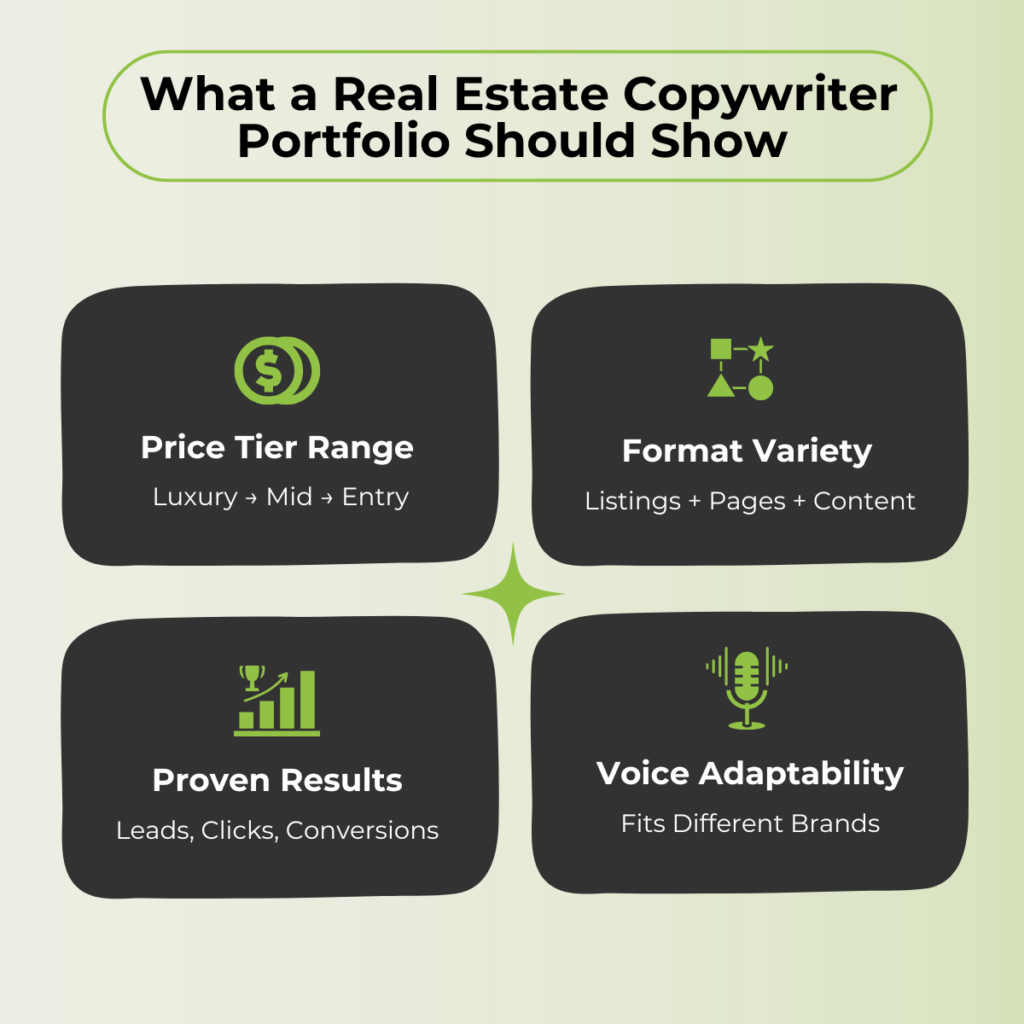
Asking for samples is table stakes. The real skill is reading the portfolio as a basis for a hiring decision, not as confirmation that they’ve put pen to paper. A good portfolio tells you what this writer can do for your brand. A weak portfolio shows you what they once did for someone else.
Listing Descriptions Across Multiple Price Tiers
One polished luxury sample proves nothing. Luxury listings are often the easiest to write because the property sells itself. Ask to see a mid-market family home, a starter condo, and an investment property alongside the luxury piece. If the voice shifts intentionally across tiers, you’ve found a writer with range. If they all read the same, you’ve found a writer with one register and four copies of it.
Non-Listing Work That Shows Range
Listings are a small slice of what a real estate brand actually needs. Your business also runs on agent bios, team pages, neighborhood guides, buyer and seller email sequences, landing pages for lead magnets, and long-form blog content. A copywriter whose portfolio is 90 percent listing descriptions may freeze when you hand them a homepage brief or a nurture sequence. Ask to see at least two non-listing formats before you commit.
Evidence That the Copy Actually Performed
“Here’s what I wrote” is a sample. “Here’s what I wrote, and it drove 37 inquiries in the first week” is a case study. The second is worth ten of the first. Ask for metrics like leads generated, time on page, open rate, conversion lift, or open-house attendance after a marketing push.
A senior real estate copywriter will have at least 2 performance stories to walk through on a call.
Range of Voice Within the Same Writer
This is the subtlest and most important check. Look at two or three samples from the same copywriter written for different clients.
Does the voice actually shift to match each brand, or does every piece sound like the writer? If the copywriter can only write in one tone, they’ll impose that tone on your brand.
You don’t want a copywriter with a voice. You want a copywriter who can adopt yours.
Fair Housing Compliance Is a Hiring Filter, Not a Nice-to-Have
This is the section most ranking content skips, and it’s the one that protects your brokerage from the single most expensive copy mistake you can make. A compliance failure here isn’t a typo. It’s a complaint filed against your brand.
What the Fair Housing Act Actually Restricts in Listing Copy
The Fair Housing Act prohibits discrimination in real estate advertising on the basis of race, color, national origin, religion, sex, familial status, and disability. The violation isn’t in the intent. It’s in the language. A copywriter who calls a listing “perfect for young families,” or “ideal for Christian retirees,” or “walkable for seniors” has exposed you to a complaint, regardless of what they meant.
The restriction applies to the copy as published, not to what the writer intended to do.
For the specifics on what the Act restricts in advertising, read this guide.
Why Generalist Copywriters Miss Fair Housing Language Constantly
Generalists lean on descriptive shortcuts that feel warm and specific, and most of those shortcuts are exactly what the Act restricts.
- “Safe neighborhood” implies something about the people currently living there.
- “Great for a growing family” implies a familial status.
- “Walking distance to churches” is religion-based.
A specialist knows the difference between describing a property and describing its ideal occupant, and they write only the first.
How to Evaluate Local Market Knowledge When the Copywriter Isn’t Local
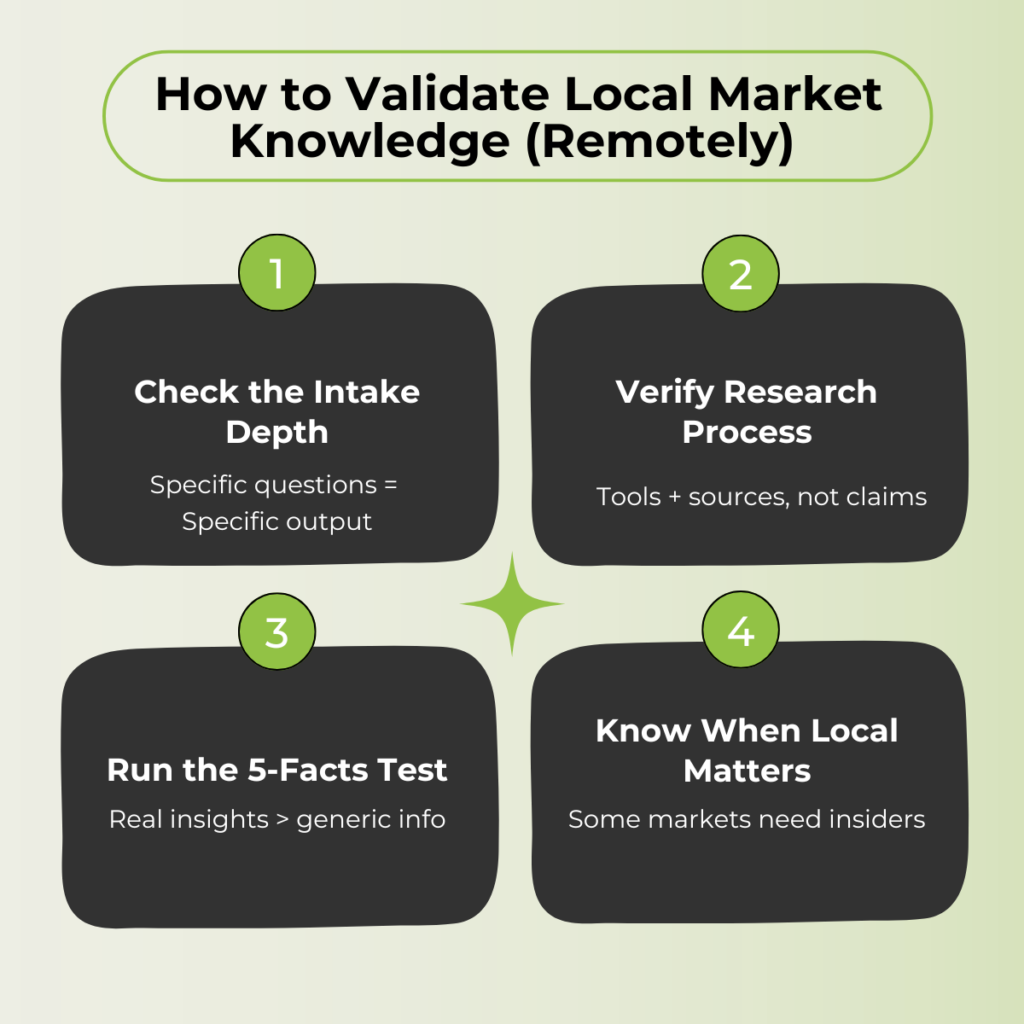
Most real estate SEO copywriters work remotely and serve clients across multiple markets. That isn’t automatically a problem. A copywriter in Austin can write credible Miami condo copy if they have a disciplined research process. The problem is hiring someone who claims to have a process but is just generalizing about it.
Read Their Intake Questionnaire Before You Read Their Samples
A specialist’s intake asks about comps, neighborhood boundaries (which can shift block by block), the buyer profile at the target price tier, seasonality in your market, and any micro-trends worth mentioning. A generalist’s intake asks you for “a paragraph of background” and calls it a day. The depth of the intake tells you how much local specificity will end up in the final copy, long before a single sentence is written.
Ask Them to Describe Their Local Research Workflow
You want to hear specifics, not adjectives. A specialist will name the exact tools and sources they pull from.
- MLS access, yours or via a broker contact
- Zillow and Redfin cross-reference for comp ranges and DOM trends
- Local news sources skim for zoning, development, and market sentiment
- HOA documentation for properties where it matters
- Neighborhood subreddits and local Facebook groups for the real-talk layer
If they can’t describe the workflow, they don’t have one. They generalize and hope you don’t notice.
Run the Five-Facts Test Before Any Copy Gets Written
Ask every final candidate to surface five specific, current, non-obvious facts about your market before they write a word of copy. Not “the schools are good” or “the area is growing.” Facts like “the new Whole Foods groundbreaking pulled three investors into the 97206 zip in Q1” or “the county just approved an ADU ordinance that changed what this property can legally become.” If they come back with generic Chamber-of-Commerce bullet points, they’ll write generic Chamber-of-Commerce copy.
Know the Markets Where Local Experience Is Non-Negotiable
There are markets where remote research isn’t enough. Hyper-local luxury. Small-town markets where the buyer pool is a hundred people who all know each other. Specialized communities like golf or equestrian developments, where the vocabulary is coded, and the buyer profile is narrow. For those, prioritize writers who’ve worked the specific market before or who plan to subcontract research to someone who has.
Use a Paid Trial Project to See Who They Really Are Before Signing a Full Engagement
There might be cases when you will find a really good candidate, super fast communication, great work ethic, good writing, and everything…but they won’t have the exact portfolios you’re looking for. That’s when you can ask them to write a paid assignment.
This is where you will find out exactly whether the copywriter is an ideal fit for you.
Structure the Trial as Two to Four Hours of Real Paid Work
A clean trial project includes one listing description at your typical price tier, one landing page section, one agent bio, and one short blog intro. Pay them their full rate. The moment you ask someone to work unpaid, you filter out the specialists and attract candidates desperate for portfolio fodder. A paid trial signals that you’re a serious client, which also brings out the writer’s best work instead of their spec work.
Watch the Questions They Ask More Than the Copy They Deliver
A senior writer wants to know your brand voice references, your target buyer, your top competitor’s tone, whether past copy has underperformed, and what specifically you liked or hated about it. Turnaround matters too. Did they hit the deadline? When you requested a revision, did they push back thoughtfully or fold immediately? Does the final draft actually sound like you, or does it sound like the writer’s house style wearing your name on a badge? The draft is one data point. The process around it is five.
Treat These Trial Red Flags as Disqualifiers
Some signals surface only inside a trial, and any one of them is a pass.
- A refusal to do a paid trial in the first place
- A draft that uses Fair Housing-banned language
- A draft that’s obviously AI-generated and handed over without disclosure
- Zero questions asked upfront, followed by a draft that still “seems fine.”
- Missed deadlines on a four-hour project
The last one matters more than brokers assume. If a writer can’t deliver a short trial on time, they won’t deliver a full month’s content on time either.
Pass on a Fine Draft if the Process Felt Wrong
If the writing is passable but the process felt off, pass anyway. The process is what you’ll be buying over the next 12 months. The first draft is what you’re buying today.
Pricing, Scope, and Engagement Structure You Should Expect (Updated Table Only)
Typical Ranges by Scope
| Scope | Typical Range | When It’s Worth It |
| Single listing description | $70 to $100 (varies with detail requested) | Listings are your top lead channel, and you publish 5+ per month |
| Agent bio | $100 to $150 (varies with depth of information provided) | The bio anchors a team page or a personal lead funnel |
| Neighborhood page | $80 to $140 | You’re building local SEO around specific zip codes or communities |
| Monthly blog retainer | $500 to $800 for 4 pieces, all-in | You need consistent long-form content to support listings and email |
Prices under the low end of these ranges usually buy you a generalist or an AI-assisted draft with light editing. Prices above the top end usually buy you agency overhead rather than better copy.
What to Lock Into the Contract
A fair real estate copywriting contract covers
- Ownership (a work-for-hire clause, so the copy becomes yours on delivery),
- Revision rounds (typically two included, additional rounds billed hourly),
- Turnaround windows and compliance responsibility (who’s on the hook if a listing triggers a Fair Housing complaint),
- AI-use disclosure (whether the writer used AI tools, how, and whether the final copy is human-edited),
- And a kill fee if you cancel mid-project.
If any of these are missing from the contract they sent, ask for them. If the writer pushes back on all of them, you’ve learned something.
When to Hire a Retainer Copywriter, and When the Project Work Makes Sense
A retainer is worth it when you have predictable content needs. Multiple listing descriptions per month, a blog cadence, and recurring email flows. The retainer buys you a writer who learns your brand voice once and applies it forever, which compounds value.
Project work is better when your needs are lumpy. A homepage refresh here, a listing burst during peak season there. Paying a retainer for flat months wastes money.
You Might Have These Questions About Hiring a Real Estate Copywriter
Per-listing rates typically range from $70 to $100 with a specialist, depending on how much detail the client wants included. Rates well below that usually signal a generalist or AI-assisted draft. Rates well above what is usually bundled in brand voice development, comp research, or photo coordination.
Technically, yes, but rarely well on the first engagement. A generalist will write prose that reads fine but misses the vocabulary, compliance, and market specificity that make real estate copy convert. If you hire one, plan for longer onboarding, heavier review, and at least one major rewrite before the voice settles.
No. A license is almost never required for copywriters. What matters is that they understand licensed professional workflows, disclosure language, and Fair Housing rules. A licensed copywriter is a rare find, not a standard hiring requirement.
Send them your brand voice references, your target buyer profile, three competitor examples (what you like, what you don’t), the specific deliverable, the market context, and any compliance sensitivities. Include a sample of past copy you were proud of and a sample you weren’t. The contrast teaches faster than any written description.
Look for overused AI phrasing, sentences that open with verb-ing patterns, flat tone across samples, and a lack of market-specific detail. Ask directly. A professional copywriter will disclose AI use in their intake and their contract. If they won’t give you a straight answer, that’s your answer.
A listing copywriter specializes in property descriptions, which are short, constrained, and compliance-heavy. A real estate content writer handles long-form marketing assets like blog posts, neighborhood guides, and email sequences. The best hires can do both, but many specialize in one side and subcontract the other.
Hire the Right Real Estate Copywriter and Your Listings Start Converting Instead of Blending In
The cost of hiring the wrong real estate copywriter isn’t the fee you pay them. It’s the lost deals and broken brand voice. Finding and hiring the right copywriter is not impossible, but it sure is difficult. If you’d rather skip running the whole filter yourself, get in touch, and we’ll walk you through how Saiqic vets copy for real estate brands from listings to long-form.
