
“We provide tailored solutions to help you achieve your financial goals.” UGHH!!!
That line is on thousands of financial services websites right now. It could belong to a wealth manager in Connecticut, a fintech startup in Austin, or an insurance brokerage in London. It says nothing about any of them.
And if your firm’s copy reads like that, your prospects are clicking away before they learn what you actually do. Not because they don’t need help. Because your copy gave them no reason to believe you’re different from the last five firms they looked at.
This post breaks down what financial copywriting actually needs to do, why most of it fails, and what the firms with the best copy do differently.
Most Financial Copy Sounds Like It Was Written by the Same Person Or an AI Bot 🙂
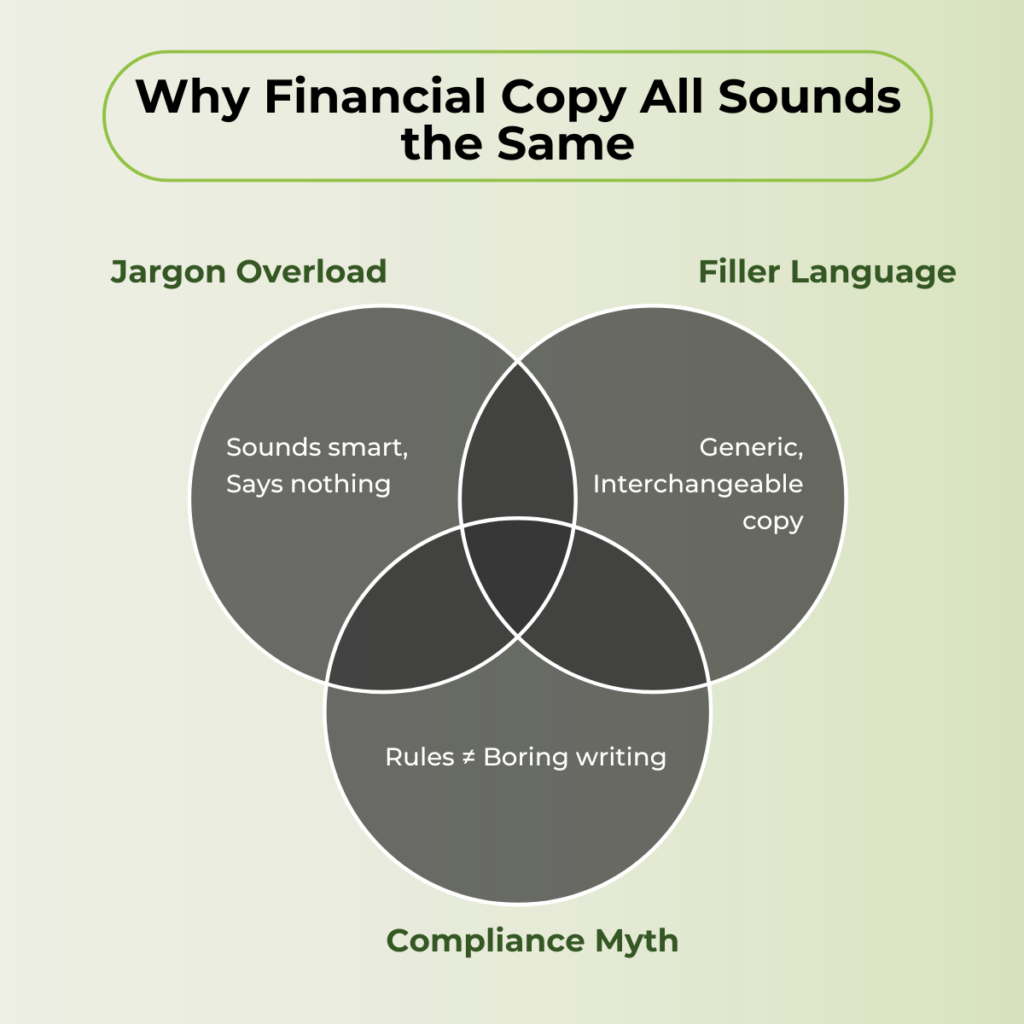
Open ten financial services websites in a row. You will struggle to tell them apart. “Holistic approach.” “Tailored strategies.” “Comprehensive financial planning.” “Trusted partner.” The same phrases, on nearly all of them. Dull. Dry.
There are (probably) two reasons behind this soulless financial copy (and mind you, both have nothing to do with finance compliance rules);
- Writers Who Don’t Understand Finance Default to Jargon and Filler
Generalist copywriters hide their lack of financial knowledge by stuffing copy with jargon they don’t fully understand, or padding with filler that sounds professional but says nothing.
The copy would include jargon such as ‘fiduciary-aligned portfolio’, ‘risk-adjusted returns’, etc., and fillers such as ‘cutting-edge solutions’, ‘Client-centric approach’, etc.
A writer who knows finance says what needs to be said without either crutch. The copy gets specific, gets clear, and the reader can actually tell what makes your firm different.
- The Compliant Rules Gwets Blamed for Boring Copy (It Shouldn’t)
I asked a financial advisor why your website homepage copy is so boring. And he replied, “I’d love to have better copy, but compliance won’t let me say anything interesting.”
I know rules. FINRA Rule 2210, SEC advertising rules, and FCA financial promotions rules …all of them only prohibit misleading claims, unsubstantiated promises, and cherry-picked performance data…they DON’T prohibit clarity, warmth, or specificity.
The difference between boring compliant copy and compelling compliant copy is the writer, not the regulation.
The firms with the best financial copy are not the ones with the loosest compliance departments. They are the ones whose writers knew what the rules actually say.
The 3 Jobs Financial Copywriting Must Do Before a Prospect Ever Picks Up the Phone
Most firms evaluate copy by asking, “Does it sound professional?” Wrong question.
The right question is whether the copy does three specific jobs before the prospect ever contacts you.
- Build Pre-Call Trust With Skeptical, High-Stakes Decision Makers
Financial decisions involve real money and real risk. Your prospect’s trust threshold is higher than in almost any other industry.
Your copy is the first due diligence checkpoint. Before a prospect calls, they read your website, scan your service pages, and check your blog. They judge your credibility from the words on the screen. If the copy reads as if it could belong to any firm, the prospect concludes your firm is like any firm.
Specific copy builds trust. “We manage concentrated stock positions for tech executives during RSU vesting schedules,” tells the prospect exactly who you serve.
“We help high-net-worth individuals grow their wealth” tells them nothing.
- Handle the Objections Your Sales Team Hears Every Day
If your sales team keeps answering the same five questions on every introductory call, your copy is not doing its job.
Good financial copy preemptively addresses what prospects worry about. Fees. Risk. Track record. Regulatory standing. Whether you have experience with their specific situation.
When the copy answers these before the prospect asks, the prospect arrives on the call already informed and partially sold. The sales team spends the call on deeper conversations instead of repeating the basics.
- Rank on Google and get cited when prospects ask AI for recommendations.
Google is not the ONLy search engine anymore. Now your prospects are asking ChatGPT, Gemini, and Perplexity questions like “best wealth managers for tech executives” or “what should I look for in a financial advisor.”
Copy that ranks and gets cited in AI answers is not just “well-written.” It is structured around the queries your prospects actually type. It demonstrates EEAT (Experience, Expertise, Authoritativeness, Trust) signals that both Google and AI models use to decide which sources to surface.
If your financial copywriting and SEO strategy are not built together, you are invisible in both channels where prospects start their research.
The Compliance Rules Your Financial Copy Must Follow (And What They Actually Say)
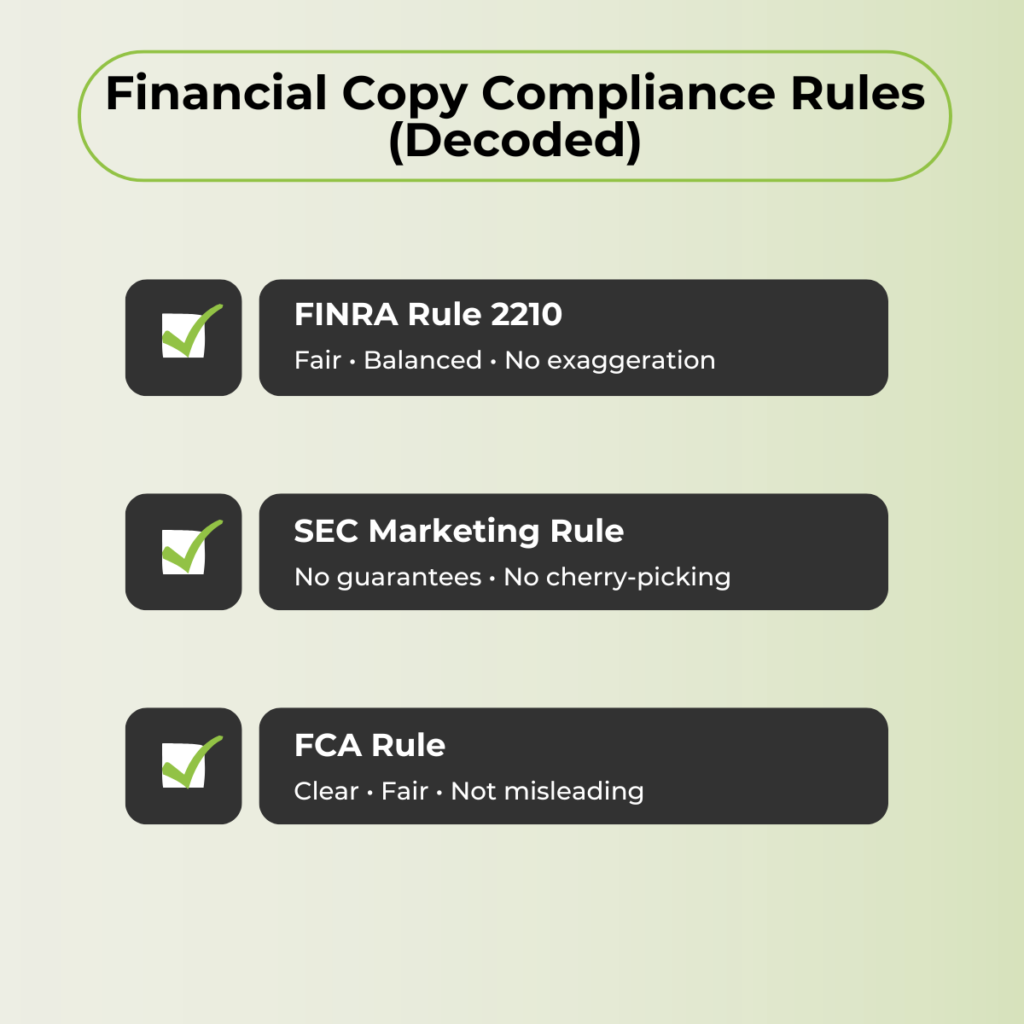
Most marketing directors at financial firms know compliance exists. Fewer know what the rules actually require at the sentence level.
Understanding them yourself lets you evaluate copy, brief writers accurately, and stop accepting “compliance made us boring” as an excuse.
FINRA Rule 2210 and What It Means for Your Finance Marketing Content
FINRA Rule 2210 governs all public communications by broker-dealers.
The core requirements:
- communications must be fair and balanced,
- The content should not contain exaggerated or promissory claims
- The content cannot omit material facts and must have a reasonable basis for any claims made.
If your content fulfills these three main requirements, you pass FINRA. Yes, you can inject your personality, tone, style & voice into the content.
The line between “compelling” and “misleading” is not as thin as most people assume.
SEC Advertising Rules for Investment Advisers
The SEC’s Marketing Rule (Rule 206(4)-1) governs advertising for registered investment advisers. Overhauled in 2022, it covers websites, emails, social media, podcasts, and one-on-one communications that meet the rule’s definition of an “advertisement.”
The prohibitions that matter most for marketing copy:
- No guaranteeing returns,
- No cherry-picking performance data,
- No unsubstantiated claims and required risk disclosures when discussing returns.
Your content must build trust through evidence and honest framing, not promises. That is not a creative limitation. It is a higher standard of persuasion that makes your firm more credible to sophisticated readers.
FCA Financial Promotions Rules for UK-Regulated Firms
The whole FCA can be summarized in three words: Clear, fair, and not misleading. Every financial promotion must meet this standard on its own, without needing supplementary material.
What Separates Financial Copy That Converts From Copy That Just Fills Pages
The difference between financial content that generates calls and copy that sits there doing nothing comes down to three craft-level decisions.
Clear Copy Is ALWAYS Better Than Jargon-filled Copy (Even With Sophisticated Readers)
Wealth managers, CFOs, and fintech founders do not want to decode your copy. They want to understand it instantly.
Compare these two sentences:
- “Asset allocation strategies tailored to your unique risk tolerance profile”
- “We spread your money across investments that match how much risk you are comfortable with.”
Both sentences are trying to convey the same thigng but the first one is jargon-filled and the second one is clear.
Clarity is not dumbing down. It is the mark of a writer who understands the topic well enough to explain it simply. Your most sophisticated readers will appreciate direct language more than anyone, because they have the least patience for copy that wastes their time.
Money Decisions Are Emotional, and Your Copy Should Reflect That
Financial decisions are driven by fear, ambition, security, and legacy. Not spreadsheets. A prospect choosing a wealth manager is thinking about whether their kids will be okay. A retiree rolling over a 401(k) is thinking about whether they will outlive their savings.
Copy that only speaks to logic misses the actual decision trigger.
This doesn’t mean manipulation. It means acknowledging what is at stake.
When your copy recognizes that financial decisions carry real weight, the reader feels understood. Feeling understood is the first step toward trusting your firm.
Fintech copywriting is a different discipline, not a variation of wealth management copy
A fintech app targeting millennials needs copy that is completely different from a wealth management firm targeting high-net-worth retirees. The compliance rules differ. The emotional triggers differ. The vocabulary differs.
Fintech copy tends to be faster, more product-specific, and often needs to explain something new to an audience that includes both financial professionals and first-time users. It rewards brevity and precision over depth. A 23-year-old scanning a budgeting app on their phone is not the same reader as a 62-year-old reviewing a family office website on a desktop.
Generic financial copywriting that ignores sub-niche differences produces generic results. When you evaluate a financial copywriter, the first thing to check is whether they asked about your specific audience. If they didn’t, they plan to write the same copy they used for the last financial client.
Where Financial Brand’s Copy Matters Most On Your Site
Not all copy carries the same weight. Knowing which pages do the most trust-building work helps you prioritize where to invest in quality first.
Website copy: the first trust checkpoint
Homepage, about page, and service pages form the credibility foundation. This is what prospects check after they find you on Google, hear your name from a referral, or see your firm mentioned in an AI answer.
- The homepage has roughly five seconds to answer one question. “Is this firm for someone like me?”
- The about page needs to show real people, credentials, and philosophy.
- Service pages need to explain what you do in specific, jargon-free language that tells the prospect whether you handle their exact situation.
These three pages determine whether a prospect stays long enough to learn anything else about your firm.
Blog content: the channel that brings the right people in
SEO-driven blog content targets the queries your highest-value prospects type. “The content that solves problems relevant to the services you offer. This is the best way to establish trust. The blog brings qualified traffic through search. The service pages convert that traffic into calls. Thought leadership posts build the EEAT signals that Google and AI models weigh heavily for financial content. A consistent publishing cadence under named, credentialed authors is the most effective long-term visibility strategy for a financial brand.
You Might Have These Questions About Financial Copywriting
Copywriting persuades and converts (website pages, ads, emails). Content writing educates and builds authority (blog posts, thought leadership, whitepapers). Most financial brands need both to work together as one content system, not as separate efforts.
Specialist financial copywriters typically charge $150 to $500+ per page for website copy and $500 to $800+ for long-form content. Rates vary by compliance complexity and the writer’s depth of financial knowledge.
AI can produce a first draft, but it doesn’t understand the nuances of compliance. It may make promissory claims, miss disclaimers, or cite statistics that don’t exist. For anything client-facing, a human writer with regulatory awareness is essential. AI assists. It doesn’t replace the judgment.
Not certified, but competent. A financial copywriter should understand FINRA, SEC, or FCA rules well enough to produce copy that doesn’t create compliance headaches. The best ones write with the compliance review in mind from sentence one, which cuts revision cycles in half.
Website copy improvements can affect conversion rates within weeks. SEO content typically takes 8 to 12 weeks to gain traction. The compounding effect of both working together builds meaningfully over 6 to 12 months.
Don’t Sleep On Financial Copywriting If You Want To Grow Your Firm Organically.
Every qualified prospect does the same thing before they call your firm. They read. They scan your website, check your blog, and look at how you explain what you do. And they make a judgment. And decide whether you’re a good fit.
SEO financial copywriting always gives 100x ROI, if done right. If you are looking for someone who can take care of all of your firm’s SEO content needs, Saiqic is your go-to team. Book a call with and we will show you what your prospects actually need to read. Or explore the finance content writing service to see how we build copy and content systems for financial brands that want to be found, read, and trusted.
