
“I’m paying a vendor four figures a month for content, and I still can’t tell you what they actually ship me.” That’s a managing partner at a midsize litigation firm who was on a call with me last quarter. He wasn’t angry. He was tired. He had invoices, Slack threads, and a drive folder full of articles with his firm’s name pasted on them. His objective was simple: to grow his legal practice. But this didn’t happen because the vendor was randomly throwing blog posts at him.
If your goal is the same and you’re confused, too, this blog post is for you. You’ll know what a professional legal content writer actually delivers and what it should cost.
Why You Need SEO Content Writing For Your Law Firm
Content writing for your law firm should be the #1 priority of all your marketing strategies. Legal content writing for law firms is the production of SEO-optimized practice area pages, blog posts, pillar guides, and landing pages written for two simultaneous audiences: search engines that need to rank the content and prospective clients who need to trust the attorney behind it. Done right, it compounds. Done wrong, it burns budget and creates bar compliance risk.
This is the only way you can get long-term results, and it compounds over time. The blog posts, practice area pages, pillar guides, and landing pages continue to yield results for years. A good writer builds those assets to fit the firm’s marketing goals, not to hit a word count.
Legal Content Writing Is Different From Any Other SEO Writing You’ve Bought
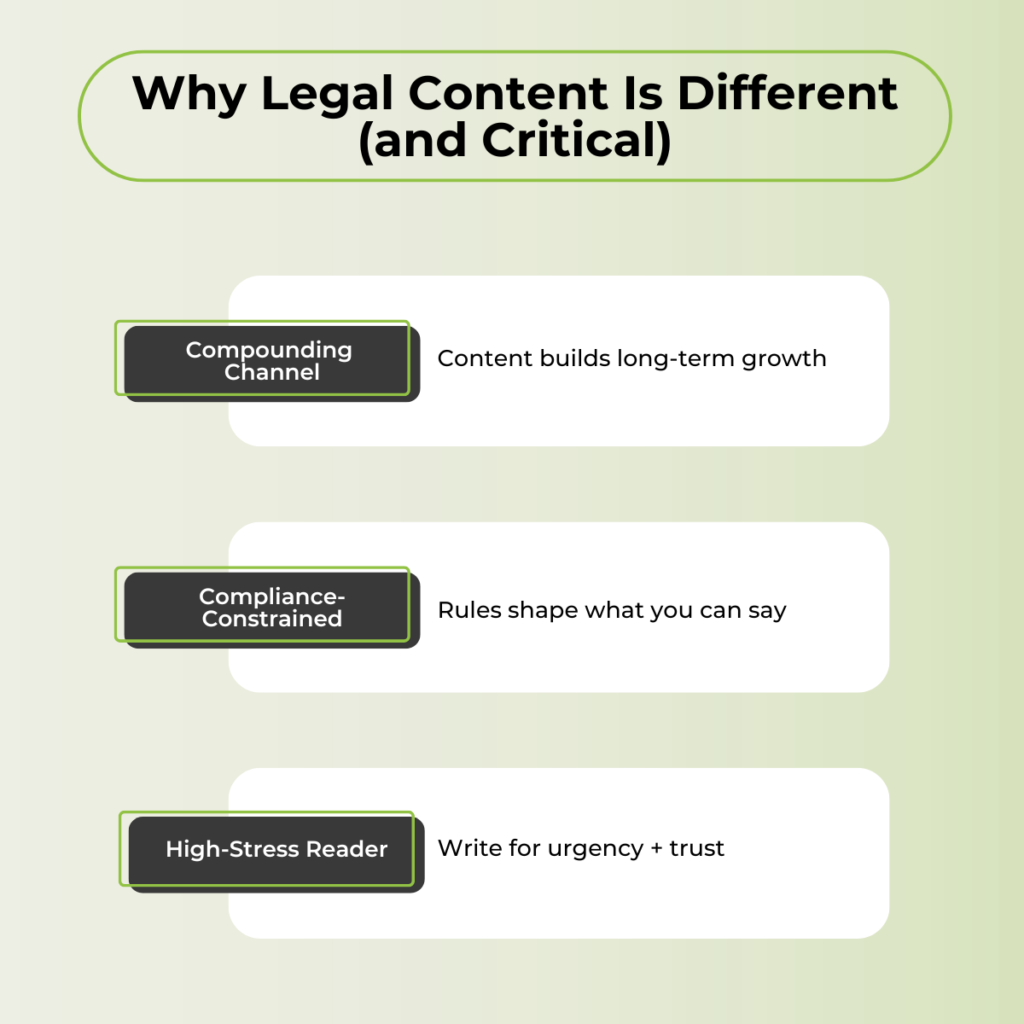
Content writing for your law firm carries two constraints that general SEO writing doesn’t.
- First, regulatory weight. State bar advertising rules, unauthorized practice of law (UPL) concerns, and disclaimer requirements all shape what can be said and how. A generalist writer who doesn’t know your bar’s advertising code is a compliance risk, not a content asset.
- Second, the emotional context of the reader. Someone searching “what happens if I miss a court date” isn’t browsing. They’re scared. General SEO copy optimizes for a curious reader. Legal copy has to work for a reader who’s scared, skeptical of lawyers, and making a decision that affects their livelihood, their custody arrangement, or their freedom. That’s a different writing job.
The blog posts, practice area pages, pillar guides, and landing pages a good legal writer builds continue compounding for years. A bad legal content investment doesn’t just underperform. It creates liability.
The Core Deliverables You Actually Get From a Professional Legal Content Writer
The core deliverables depend on your services and on what stage you are at in SEO content. But here’s what is generally included in a proposal.
| Deliverable | Typical Word Count | Primary Purpose |
| Practice area page | 800 to 1,500 | Conversion for a specific service |
| Legal blog post | 1,200 to 2,000 | Educate, rank, feed intake over time |
| Pillar guide | 2,500 to 4,500 | Own topical authority in a practice area |
| FAQ page | 600 to 1,200 | Capture PAA and voice-search queries |
| Landing page | 400 to 900 | Convert paid traffic |
| Lead magnet | 1,500 to 3,500 | Capture email in exchange for a resource |
Practice Area Pages
The practice area pages fall under the core web content and are the most important deliverables in the stack. When someone searches “family law attorney Dallas,” this is the page that has to answer who you are, what you handle, and what happens if they call. A good legal SEO writer knows how to structure this page to satisfy your ideal clients.
Legal Blog Posts and Articles
Legal blog posts serve two audiences at once.
- Google (for topical authority and long-tail rankings)
- And real prospects (who read one post while deciding whether to call).
That’s where you must have a solid SEO content strategy that maps to a real client question your intake team hears on the phone.
Pillar Guides and Long-Form Resources
A pillar guide is the 3,000+ word deep dive on a core topic your firm wants to own. For example, “The Complete Guide to Texas Divorce.”
These pieces anchor topical clusters, attract backlinks, and give the firm something to point to when journalists or referral partners ask for a resource.
FAQ Pages and PAA-Targeted Content
FAQ pages capture long-tail queries. Voice search, Google’s People Also Ask box, and AI answer engines all lean on a clear question-and-answer format. A legal writer who knows the craft pulls questions from your intake calls and from live SERP features. Many BOFu clients come from a single FAQ answer they found at 11 p.m.
Landing Pages and Intake-Focused Pages
A landing page exists to convert one specific source of traffic. PPC, LSA, paid social, email. The copy is tighter, the CTA is louder, and everything above the fold earns its place. A legal writer working on a landing page is really a copywriter wearing a content writer’s hat.
Lead Magnets, Checklists, and Downloadable Guides
Lead magnets are the best way to get email signups. A free “Estate Planning Checklist,” a “Post-Accident Evidence Guide,” or a “Small Business Compliance Tracker.” You only need to create these once, and they keep giving you the results. The ROI math gets good fast, especially for firms running any kind of email follow-up.
Optional Extras Like Press Releases, Case Studies, and Newsletter Copy
Press releases, case studies, email drafts, and newsletter copy round out the stack. Most firms don’t need all of them every month, but a full-service legal content writer should be able to switch hats without dropping the voice.
What a Good Legal Practice Area Page Actually Contains, Section by Section
You’re competing within a local market, so you must stand out. Practice area pages make or break a firm’s organic pipeline. They’re the page that has to work when intent is highest, when a prospect is 15 minutes from the next search result. Here’s what’s inside one that converts, section by section.
| Section | Function | Word Count |
| H1 and above-the-fold | Anchor the promise | 40 to 80 |
| Trust and proof layer | Reduce risk perception | 100 to 150 |
| Procedural and outcome section | Inform without advising | 250 to 400 |
| Objection-handler section | Address cost, time, worst case | 150 to 250 |
| Client-voice FAQs | Capture long-tail, handle doubt | 150 to 300 |
| CTA placement | Convert intent to action | 60 to 120 |
The H1 and the Above-the-Fold Promise
The H1, or the page title, should not be generic, such as “Family Law Services.” It’s the one-sentence version of what you do and who you do it for. So it should be “Dallas Family Law Attorneys Helping Parents Keep Custody Without the Courtroom Fight.”
A good H1 is always specific, outcome-focused, and geography-tagged. Below it, a short subhead validates that the visitor is in the right place. These 40 to 80 words decide whether the scroll happens.
The Trust and Proof Layer
Credentials, case results (where bar rules allow), jurisdictional coverage, reviews, and recognizable logos all live here. No, you don’t need to look like a big OG. You just need to be honest and reduce the reader’s risk perception when deciding whether to trust you with something serious. Proof has to be specific. “Over 200 custody cases handled in Dallas County since 2018″ works. “Decades of experience” doesn’t.
The Procedural and Outcome Section That Informs Without Advising
This is where the writer needs to be very crafty & smarty. This section explains what happens in the reader’s situation (the process, likely outcomes, and decisions they’ll face) without crossing into legal advice. A skilled legal writer knows that the best way to build this section is by drawing on primary sources and attorney interviews.
The Objection-Handler Section Most Firms Skip
This section contains the cost, timeline, and worst-case scenarios. These are the questions the reader has and will not ask on the form. Address them on the page.
“How much does a divorce actually cost?” “What happens if my case goes to trial?” “Can I afford not to hire an attorney?”
A paragraph apiece, plain English, no hedging. Firms that address objections on the page close more calls than firms that wait until the consult.
FAQs Answered the Way Real Clients Ask Them
This is the section where your ideal prospect finds answers to their most pressing questions about your practice area page.
A good writer pulls the second version from intake logs and Reddit, then builds the answer in plain English. Voice search optimization is a happy byproduct. The main payoff is a reader who feels understood.
The CTA Placement Most Firms Get Wrong
Most practice pages have one CTA, a form at the bottom. That’s where conversion goes to die.
The better pattern is three CTAs, placed at predictable moments. One near the top for the reader who’s already decided. 2nd, after the proof section for readers who need reassurance. 3rd, at the end, for the reader who needed the full picture. Also, remember that a meaningful CTA like “Talk to a Custody Attorney Today” performs way better than a generic “Contact Us” button.
How a Legal Content Writer Turns Attorney Knowledge Into Client-Facing Copy
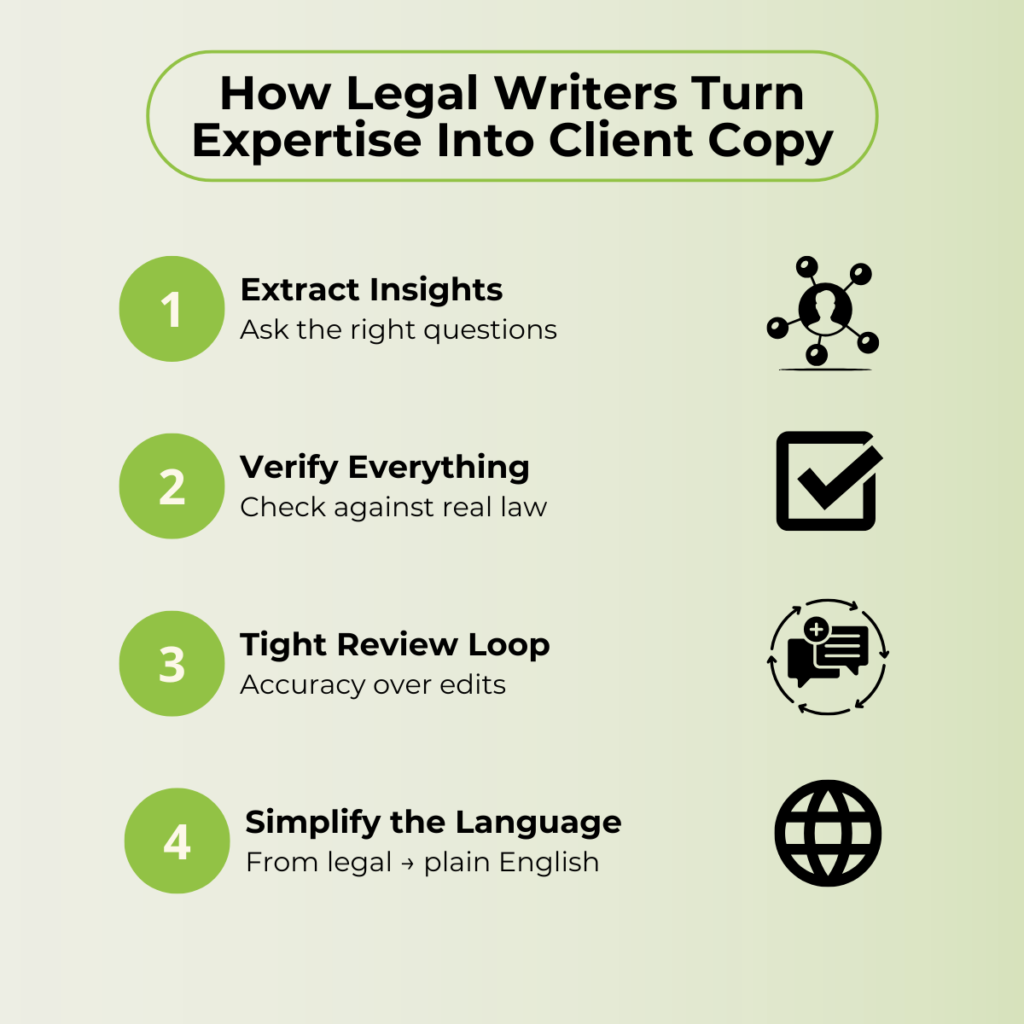
The best legal content writers aren’t lawyers. They’re good listeners, smart researchers, and strategists. Their job is to pull expertise out of an attorney’s head and render it in language a scared, skimming, non-lawyer reader can use. A good legal SEO writer is the one who knows how to translate complicated stuff into plain words.
Here’s what a smart legal content writer does;
The Writer Will Get You on the Call &/OR Send You a Questionnaire (if needed)
In the call, the writer will try to suck the best legal knowledge from you about your practices and target customers. The first 30 minutes of the call decide the quality of the final piece. A good writer shows up with specific questions.
Be prepared to answer questions like;
- ”What’s the most common thing new clients misunderstand about this process?”
- “What’s the one mistake clients make before they call?”
General questions produce general copy. Specific questions produce lines you couldn’t have written without the interview.
The Writer Fact-Check The Page Against Primary Legal Sources
Every legal claim in the draft gets checked against a primary source, statute, rule, case law, or bar opinion. Not “some blog said.” Either the writer can cite the source, or the line gets cut.
This is where AI-assisted writers routinely fail (hallucinated statutes and fake cases are now a known bar-complaint risk) and where a human writer earns the fee.
The Writer Keeps You In the Loop
The loop is short and structured. Writer submits draft with inline source citations. You review the page for legal accuracy only (not style, not word choice). The writer incorporates legal corrections. Two rounds max. If a firm is running five rounds on every piece, either the writer is missing the mark or the attorney is editing voice instead of accuracy.
The Reading-Level Translation From Graduate-School Sentences to 8th-Grade Paragraphs
The average US adult reads at an 8th-grade level. Lawyers write at a graduate-school level and lose customers because, at the end of the day, your customers are everyday Joe and Jordi. The gap is the job. If your writer is writing sentences like “Plaintiffs seeking recovery under Texas DTPA must establish reliance on an actionable misrepresentation,” they don’t know how to write for real people.
Bar Compliance and the Rules That Shape Every Deliverable
Every state bar has advertising rules that apply to law firm content. Most writers ignore them. That’s how firms end up with grievances over a single word on a landing page.
Why “Best,” “Expert,” and Testimonials Get Firms in Trouble
“Best” and “expert” are comparative superlatives that most state bars restrict unless backed by an objective third-party credential. Some states require specific disclaimers on testimonials. Others restrict testimonial use entirely. A writer who doesn’t know this pulls language from a marketing template, costing the firm a grievance. A writer who flags it and suggests compliant alternatives.
Disclaimers, Results-Not-Guaranteed Language, and Jurisdiction-Aware Copy
Case results usually need disclaimers. “Past results do not guarantee future outcomes,” or the state bar’s specific language. Some states require it on every page that mentions a result. Others require it only in certain contexts. Content referring to a practice area in which the firm isn’t licensed requires its own disclaimer. A good writer builds these in, not bolts them on after review.
Where the UPL Line Is and How a Writer Stays on the Right Side of It
The unauthorized-practice-of-law line is subtle. General legal information (“here’s how Texas divorce typically proceeds”) is fine. Specific legal advice applied to a reader’s unnamed situation (“if your spouse did X, you should do Y”) can create an attorney-client relationship or encroach on UPL, depending on the state and context. Writers who’ve never worked in legal trip over this. Writers who know how to deliver value without crossing the line.
Why AI-Generated Legal Content Fails Most Of the Time
I’ve audited practice pages, blog posts, and FAQ sets from firms paying three- and four-figure sums a month to vendors running everything through a prompt.
The output is what attorneys in the 2026 market are calling “AI garbage,” and it’s costing firms money in ways that don’t show up on an analytics dashboard.
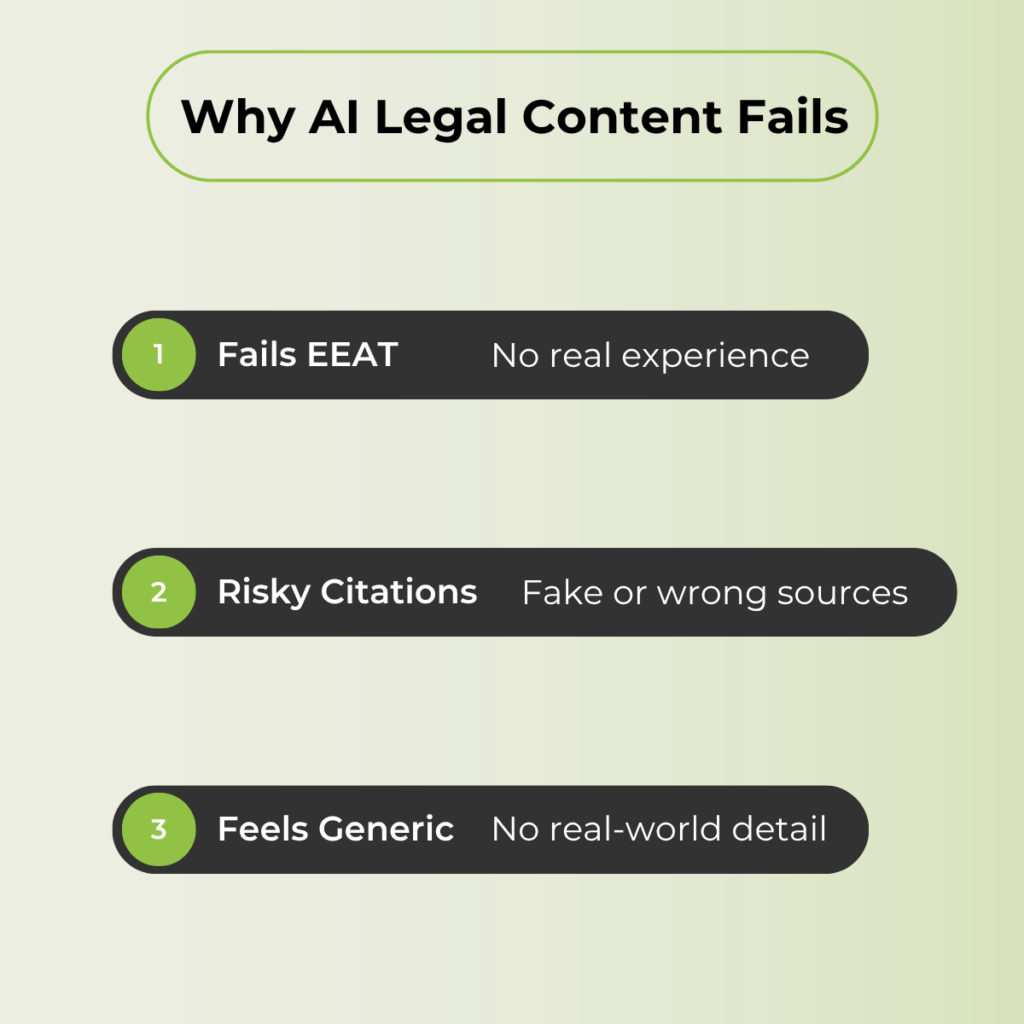
How AI-Generated Legal Content Fails the EEAT Test Even When It Looks Fine on the Page
Google’s EEAT framework prioritizes experience, expertise, authority, and trustworthiness, and legal content falls within the YMYL (Your Money or Your Life) category, where those signals carry extra weight. AI copy fails on experience, especially. It can imitate the structure of an expert, but it can’t surface the lived detail (the specific client misunderstanding, the thing the attorney sees every Monday morning). Readers can feel it even when they can’t name it.
The Citation and Hallucination Risk That Can Trigger Bar Complaints
There are now documented cases of attorneys submitting AI-drafted filings with hallucinated case citations and getting sanctioned. The same risk lives in content. An AI-written blog post that cites a fake case or misquotes a real statute is a bar-complaint vector waiting to happen. The ABA’s 2026 checklist on responsible AI use in law firms treats this as a primary risk rather than an edge case. Any vendor running content through a model without human verification is assuming liability.
The Three Signals I Use to Tell AI-Spun Legal Content From Human-Written Work
Whenever I’m reviewing a page, there are three easy signals that tell me whether its AI slop;
- First, the copy reads like an outline. Topic sentence, three supporting sentences, restatement, move on. No asides, no sharp lines, no practitioner detail.
- Second, every section has the same word count, give or take fifteen words. Models hit averages. Humans don’t.
- Third, the examples are generic (“a business owner” instead of “a roofer who took on a subcontractor mid-storm-season”). Real writers have heard real clients. Their examples show it.
This AI-slop does nothing good for the law firm anyway, and the whole content strategy fails.
What Legal Content Writing Services Cost and How to Read a Proposal
The price for a legal content proposal varies by deliverable, writer background, and turnaround time. The numbers below are industry ranges based on publicly available pricing from established legal content vendors, with Saiqic’s rates shown for comparison.
| Deliverable | Price Range (excluding SME interviews/quotes cost) | What Affects the Price |
| Legal blog post (1,200 to 2,000 words) | $250 to $350, | Writer background, research depth, SME interviews |
| Practice area page | $400 to $600 | Conversion focus, custom interview, compliance review |
| Pillar guide (3,000+ words) | $400 to $800 | Topical authority play, multi-source research |
| Landing page | $450 to $600 | Conversion-copy craft, CRO input |
| Monthly retainer (4 pieces) | $800to $2000 | Volume, cadence, and dedicated writer access |
What the Price Range Actually Buys You per Deliverable
The price heavily depends on your objectives, the writer’s background, and the production model. A JD-credentialed writer working solo charges at the top. A generalist working under an editor charges in the middle. A content mill charges at the bottom and ships AI-dressed output that matches the price. The number on the invoice is only part of the story. The deliverable underneath it is the rest.
Why JD-Written Content Costs More and When That Premium Is Worth Paying
JD-credentialed writers cost more because they’re scarce, and they handle legal complexity without an attorney having to rewrite. Worth paying when the topic is high-stakes and highly regulated (securities, healthcare compliance, complex litigation). Not worth paying for when the topic is broad and well documented (DUI basics, family law overviews, personal injury intake). A generalist with good research and attorney review will match the output at half the cost.
Retainer vs Per-Piece and What Saiqic Usually Recommends
Per-piece works if the firm is testing content. A retainer works if the firm has committed to content as a channel. The retainer premium pays for cadence (content shipped on a schedule), voice consistency (same writer across pieces), and dedicated availability (your timeline, not the writer’s queue).
I tell most firms to start on a per-piece basis for two months, then move to a retainer once they know what quality looks like from the writer they picked.
You Might Have These Questions About Hiring a Legal Content Writer
Yes, when they work with primary sources and an attorney review loop. The best legal content writers aren’t lawyers. They’re researchers and translators. The attorney reviews for legal accuracy. The writer handles clarity, structure, and compliance awareness.
Most legal content takes 4 to 9 months to rank competitively. Longer in saturated practice areas (personal injury or criminal defense in major metros). Practice pages in less-competitive niches can rank within 2 to 4 months with proper on-page work and a few solid backlinks.
It depends on the writer. A generalist with strong research will outperform a narrow specialist on most topics. For the heaviest regulatory areas (securities, healthcare, complex litigation) a specialist is worth the premium. For everything else, research and attorney review close the gap.
A good legal writer flags compliance risks in the draft and cites the relevant rule. Final responsibility sits with the firm (the bar cites the firm, not the writer), but the writer should never hand you a draft that silently breaks your state’s advertising rules.
Practitioner examples, client-voice phrasing pulled from intake and forums, and asides that only a human would write. AI content is predictable. Human content has rhythm shifts, sharp lines, and specifics. If a draft reads like an outline with sentences attached, it’s probably AI.
The Right Legal Content Stops Sounding Like a Law Firm and Starts Reading Like an Answer
Most legal content fails for the same reason. It sounds like a law firm. Stiff, hedging, written in the voice of someone protecting themselves from liability while also asking for the sale. Real clients don’t respond to that voice. They respond to the one who sounds like someone who’s handled their situation before and is telling them what to do next.
That’s the whole art of THE best legal content writing.
If you’re auditing your current content stack or about to hire your first legal writer, book a call, and I’ll walk through what you have and what’s missing. Or read our law firm content writing service page to know how we can help you.
