
A real estate team spends eight months and four figures on a content writer. Twenty blog posts go live. Traffic climbs. The lead form stays empty.
The writer wasn’t bad. The content type was wrong.
Generic national real estate advice doesn’t attract qualified buyers or sellers in any local market. It competes with Zillow, Trulia, and realtor(.)com for search traffic that was never going to convert anyway.
This blog post breaks down what a real estate content writer should actually write and how that content differs for buyers and sellers. Keep reading.
Most Real Estate Content Fails Because It’s Written for Everyone and Speaks to Nobody
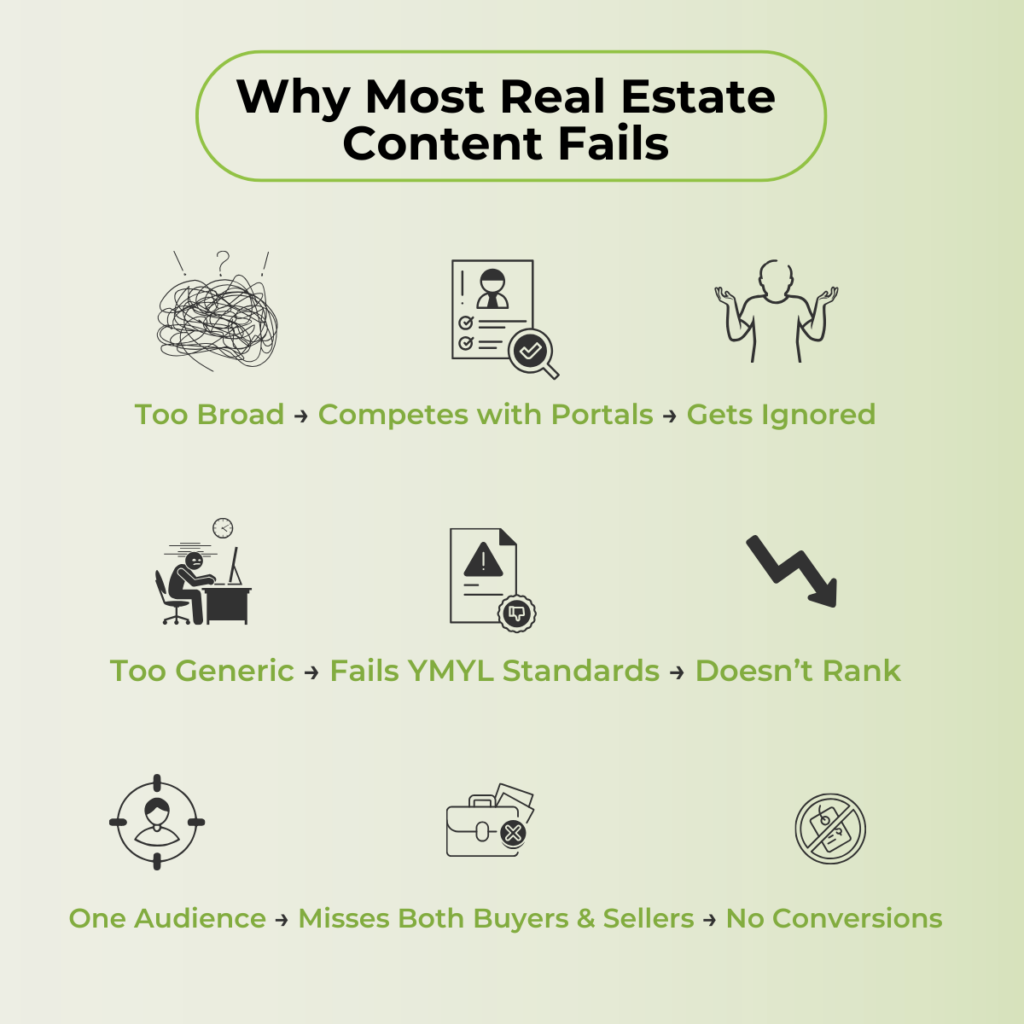
Real estate content that reads like a national magazine article ranks below the portals and doesn’t convert anyone. It speaks to no one’s actual decision.
Two reasons this happens. First, most writers treat “real estate” as one audience when it’s really two. Buyers and sellers move through different emotional states, on different timelines, asking different questions. Second, writers ignore that real estate is YMYL content to Google, which raises the bar for what earns a ranking.
Generic National Advice Loses to the Portals
A blog post titled “How to Stage Your Home” on an agent website is up against realtor(.)com, HGTV, HomeLight, and a dozen similar domains with stronger backlinks and editorial teams. The agent blog doesn’t win that fight.
The winning move is to go where the portals can’t. Hyperlocal. Block-level. Market-specific. A post titled “How Long Homes in [Neighborhood] Actually Sit Before Selling Right Now” has a different audience, a different intent, and a different competition set. That’s where a real estate content writer earns their rate.
Real Estate Is YMYL Content to Google
Google’s Search Quality Rater Guidelines classify real estate as a YMYL (Your Money Your Life) topic. That means Google holds content to a higher EEAT standard than it does for a lifestyle recipe post. Surface-level advice written by a generalist with no local knowledge gets filtered out.
For an agent or brokerage, this changes the hiring math. The writer has to bring research depth, local fluency, and compliance awareness. Not just good sentences.
Your Buyer Content and Your Seller Content Are Two Different Operations
A real estate content writer who treats buyers and sellers as one audience is writing for neither.
Buyers search from curiosity, anxiety, and aspiration. They want to understand the market before they commit. Sellers search for urgency, valuation nerves, and timing pressure. They want to know what their house is worth and how fast it will move.
The content each group needs is different. A competent writer plans two separate content tracks and routes each post to its correct audience. The two sections below show what each track looks like.
The Content Types That Actually Pull Qualified Buyers to Your Listings
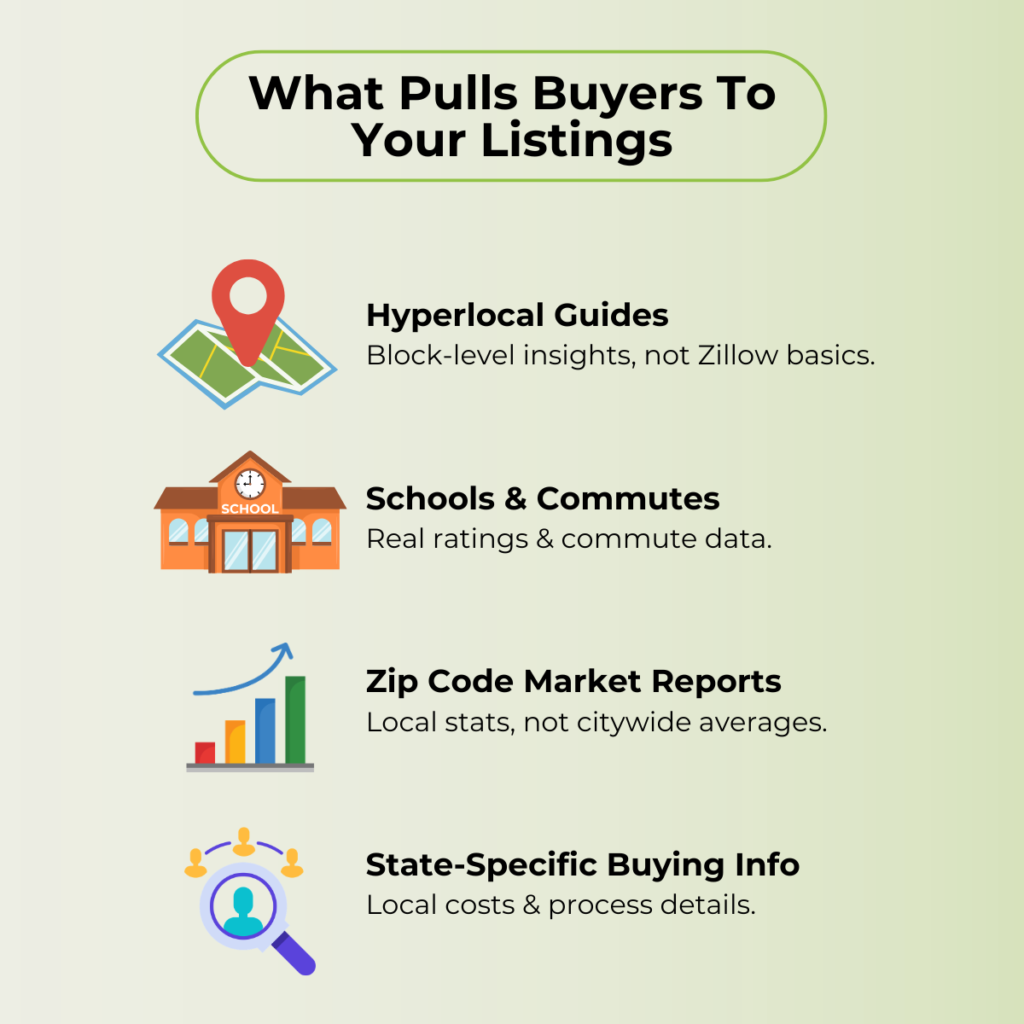
Buyer content isn’t generic. It’s specific, local, and tied to decisions a buyer is actively making.
Hyperlocal Neighborhood Guides That Go Deeper Than Zillow
Zillow lists a neighborhood’s median price. It doesn’t tell a buyer what the parking is like after 7pm, which streets flood during heavy storms, or why the western half of the neighborhood is quieter than the eastern half.
A real estate content writer who lives in (or deeply researches) the market can write a neighborhood guide that covers walkability at the block level, park conditions, traffic patterns, the character of local small businesses, and the honest trade-offs of moving there.
That’s the piece a relocating buyer reads three times before booking a call.
School District and Commute Content Tied to Real Data
Families buying a home filter by school district first. “Best elementary schools in [city]” is one of the highest-converting buyer queries in any market, but it has to be written with actual data.
GreatSchools ratings, standardized test breakdowns, feeder patterns, and commute times to common employer hubs.
Generic “how to choose a school” content doesn’t win this search. Specific, data-backed, locally-verified content does.
Submarket Market Reports, Not Citywide
A citywide market report is the portal’s job. A real estate agent’s advantage is the submarket. Monthly or quarterly reports scoped to a zip code or a neighborhood (median sale price, days on market, inventory, price per square foot, year-over-year change) give the reader something they cannot get from Zillow’s auto-generated data.
Home-Buying Process Content Written for Your Specific State
“How to buy a house” is a saturated national query. “How to buy a house in [state]” with state-specific closing timelines, inspection rules, attorney requirements, and financing quirks is a query the national sites don’t bother to write for.
Every state has its own process. A writer who understands the state’s specific paperwork and timelines produces content that beats the national guides for local intent.
Closing Costs and Mortgage Explainers With Actual Numbers
“Closing costs” is a vague national topic. “Closing costs on a $425,000 home in [city]” with real lender quotes, real transfer tax math, and real title fee estimates gives the reader the concrete number they came for. This is the post that turns a curious visitor into a contact form fill.
The Content Types That Bring Sellers to Your Contact Form
Seller content has a different emotional frame. Sellers want to know what their house is worth, how fast it will sell, and what they have to do before listing.
Home Valuation and Pricing Content Tied to Your Local Comps
Every seller’s first search is some version of “what is my house worth in [city].” A writer who produces a quarterly valuation piece with live comp data, median sale price trends, and a breakdown of price per square foot by submarket captures this intent exactly.
Generic “how to value your home” content doesn’t convert sellers. Local comp analysis does.
Days-on-Market Content Scoped to Your Neighborhoods
“How long does it take to sell a house in [city]” is one of the highest-intent seller queries in any market. Most agent blogs don’t cover it properly. They give a vague national statistic and move on.
The winning version of this post breaks down days on market by neighborhood, by price band, and by season. It tells the seller, with real numbers, what they can expect. That’s the post that ends with “book a call to see what this means for your specific property.”
Pre-Sale Prep Content Tuned to Local Buyer Preferences
Generic home staging advice is everywhere. What’s missing is prep content written for local buyer expectations. A high-end buyer in one neighborhood expects a certain type of finish. A first-time buyer in another submarket prioritizes move-in condition over cosmetic upgrades.
A writer who knows the market writes prep content that reflects what the market’s buyers actually want, not what a staging manual published in 2019 recommended.
What to Expect When Selling in This Market Content
Sellers want a timeline. They want to know which fees are deducted from their proceeds, the tax implications of selling in this state, and the closing quirks that trip up first-time sellers. A single “what to expect” post that answers all of this for a specific market is worth more than ten generic selling guides.
Listing Descriptions Are Their Own Content Category, and Most Writers Get Them Wrong
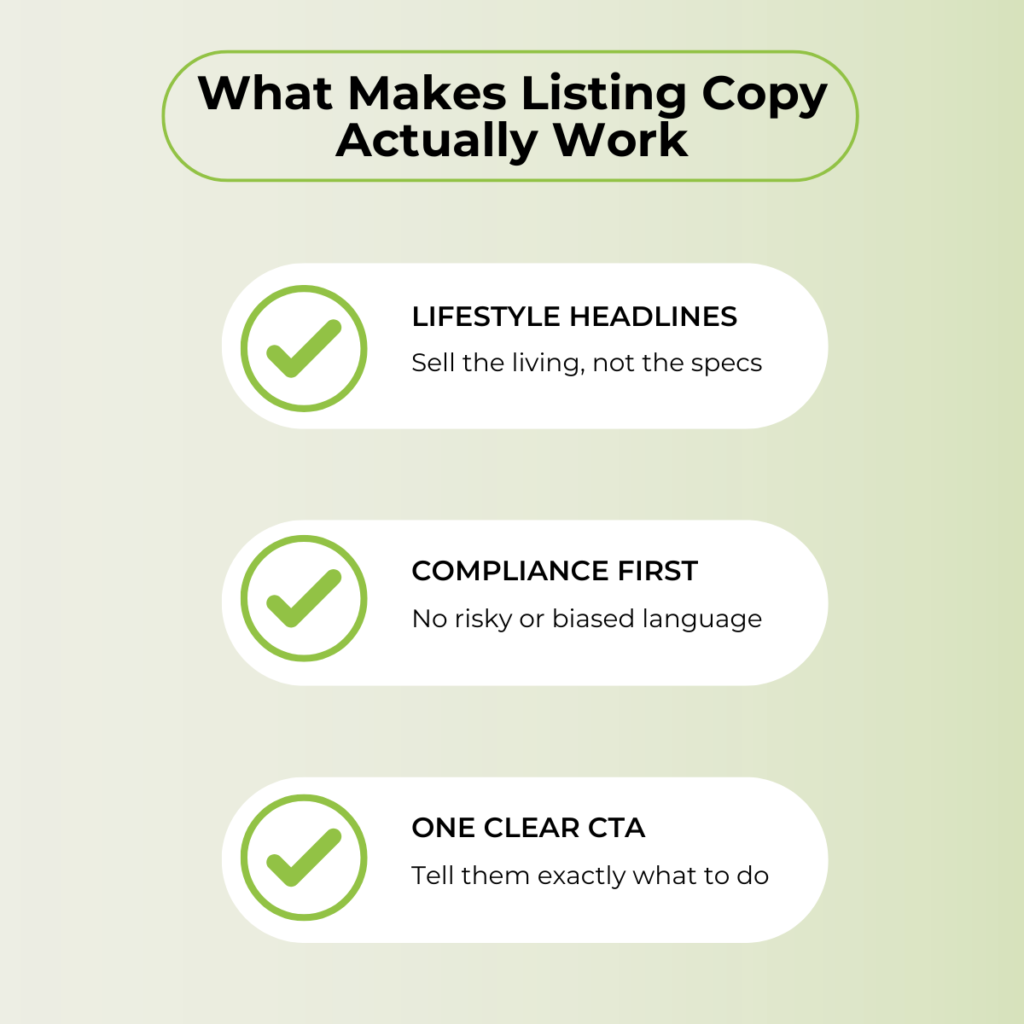
Listing copy is the tightest, highest-leverage piece of writing on a real estate website. A 150-word listing description sees more buyer eyes per word than any blog post will. Most generalist content writers treat it as throwaway work.
It isn’t.
- Headlines Sell the Lifestyle, Not the Square Footage
The MLS data already includes the square footage, number of bedrooms, and number of bathrooms. The listing headline’s job is different. It’s to make the buyer see themselves living in the home, to pull them from a list view into the detail page.
A headline like “Sun-Drenched Corner Unit With Park Views and Original Brick” does work, but the MLS data can’t.
- Fair Housing Act Compliance Is Not Optional
This is where generalist writers get into real legal trouble. The Fair Housing Act prohibits language in real estate marketing that expresses a preference, limitation, or discrimination based on protected classes.
Commonly banned phrasings that look harmless include “family-friendly neighborhood,” “walkable” (when used to imply exclusion of disability), “exclusive community,” “perfect for young professionals,” and anything referencing religion, nationality, or family status. A writer who doesn’t know this list is a liability. A real estate content writer bakes Fair Housing compliance into the first draft, not the final review.
- Every Listing Ends With One Specific Call to Action
“Schedule a private tour.” “Register for the open house on Saturday.” “Get pre-qualified to make an offer.” One call to action, matched to the stage of the buyer’s journey. Not “contact us for more information.”
What a Real Estate Content Writer Needs to Know Before They Write a Single Word
The hiring standard for a real estate content writer isn’t prose quality. It’s whether they know these four things. If the answer to any is no, the content won’t perform no matter how well-written the sentences are.
- Real Estate Is YMYL, So Research Has to Be Deep
The writer’s research pool should include the Bureau of Labor Statistics, NAR reports, Zillow Research, the local MLS, HUD data, state housing authority publications, and local news coverage of the market. Not just other blog posts.
Surface research produces surface content. Real estate is too high-EEAT a topic for that to work anymore.
- Local Market Fluency. Not a General SEO Skill
A writer who understands SEO generally but doesn’t understand the submarket produces content that looks correct and ranks for nothing. A writer who understands the submarket (which neighborhoods are rising, which school districts have openings, what the commuter corridor is doing) produces content that ranks because it’s genuinely relevant.
Hire for market fluency first. SEO skill second.
- Fair Housing Act Literacy Is Baked Into the Process
A writer who runs Fair Housing as a final checklist has already produced drafts that need to be rewritten. A writer who knows the Act writes a compliant copy from the first sentence. The difference compounds across 50 listing descriptions and 20 blog posts a quarter.
- The Writer Understands Buyer and Seller Psychology Separately
Tone, urgency, vocabulary, and structure all shift between buyer content and seller content. A writer who uses the same voice for both is missing half the audience every time.
You Might Have These Questions About Real Estate Content Writing
No. A license is a legal requirement for practicing real estate transactions, not for writing about the industry. A competent writer can produce excellent real estate content through rigorous research, local market immersion, and EEAT-aligned citation practices.
Expect 4 to 6 months before a consistent publishing cadence starts producing qualified organic traffic. Early wins can come from submarket-specific long-tail content that has low competition. Lead generation through SEO content also heavily depends on your content strategy as well.
A real estate copywriter writes conversion-focused short copy (listing descriptions, landing pages, email sequences, ad copy). A real estate content writer writes longer educational content (blog posts, neighborhood guides, market reports, buyer and seller guides) designed to pull in organic traffic over time. Most brokerages need both.
Unedited AI content has poisoned a lot of real estate blogs and Google is increasingly good at filtering it out. AI can assist with research, outlines, and first passes, but it cannot replace the local fluency, compliance awareness, and EEAT depth that a real estate topic requires. The content still has to be written, or rewritten, by someone who knows the market.
Four to eight posts per month is the working range for most brokerages. Lower volumes work if every post is deeply local and well-researched. Higher volumes only help if the quality holds.
Hire a Real Estate Content Writer Who Knows the Market and the Leads Will Follow
Content writing isn’t a side project for a real estate brand. It’s one layer of a content marketing system that has to sit next to website copy, local SEO, and lead capture to actually work. A real estate content writer who understands the buyer-seller split, respects Fair Housing, knows YMYL, and writes hyperlocally turns a blog from a vanity asset into a lead source.
That’s the standard. Hire against it, and your content starts earning its keep.
If you want a team that builds this system end-to-end, content, copy, and the web infrastructure around it, book a call with Saiqic or read the SEO content writing service in detail.
