
Your B2B website is live. The design is clean, the pages are built, and maybe on some pages, you still have ‘Lorum Ipsum”, and some pages have AI-generated generic text. You need copy that clearly describes your business and attracts the ideal businesses you want to work/collaborate with.
Copy is one of the MOST important things on a B2B website. You can spend $54K on the design and have a fancy site, but if the copy isn’t doing its job, everything’s a waste. And for a new site with zero traffic, the copy determines whether your first visitors convert or bounce.
This blog post will walk you through how B2B copywriting works, how to approach it for your specific industry, and how to hire and brief the right copywriter so your website starts generating leads from day one.
Why B2B Website Copy Determines Whether a New Site Generates Leads
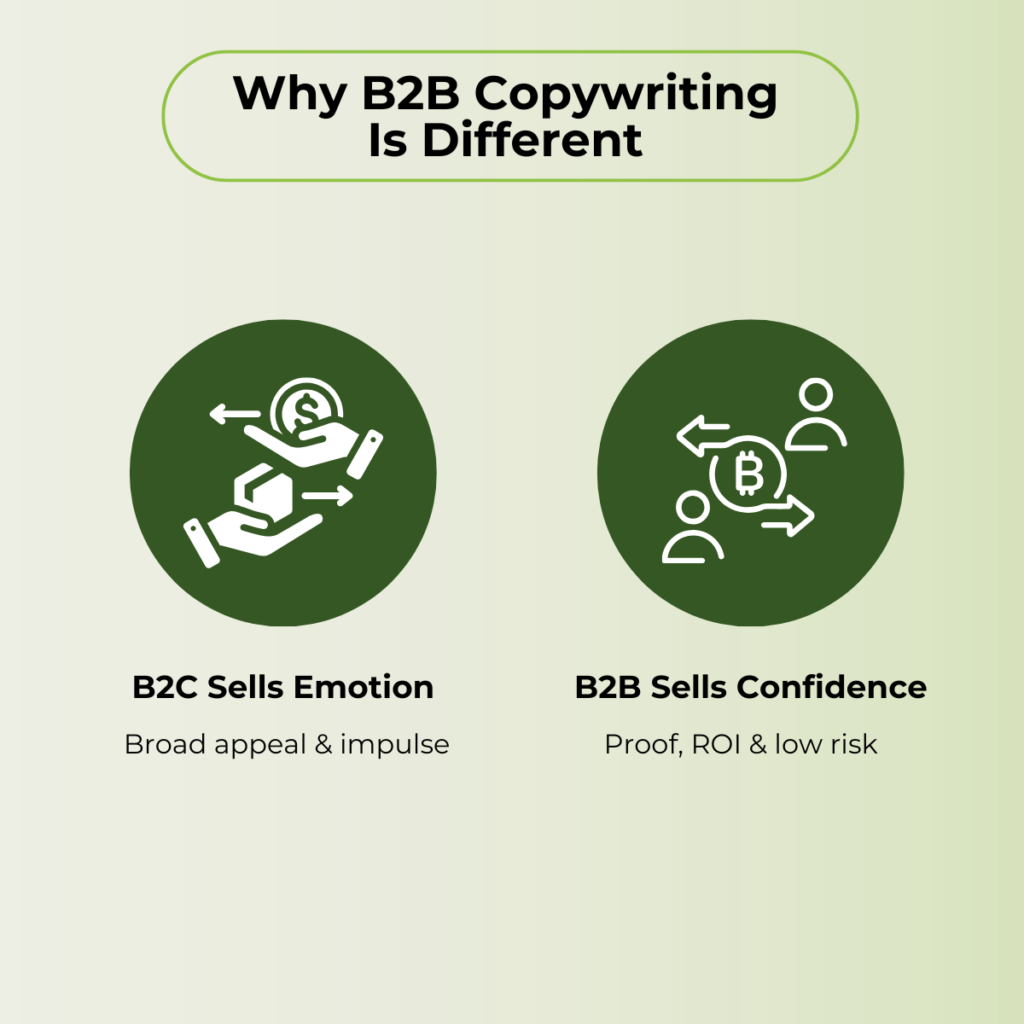
A new site has no SEO authority, no referral traffic, and no brand recognition carrying it. The SEO copy has to lift the heavy weight of getting a visitor your site and then converting that lurker into a buyer/customer. nothing else compensates for it.
Most new B2B websites launch with placeholder copy and a plan to fix it later. Later becomes three months. Then six. In that time, the right buyers have already arrived, scanned language that sounds like every competitor, and left.
B2B Copywriting Is DIFFERENT Than All Other Type of Copy
A B2B reader needs to make a business decision while visiting your website copy.
A B2B buyer evaluates your website content through the lens of their company’s profit, risk, and operational needs. They need:
- Evidence that you’ve solved this problem before (case studies, data, specific outcomes)
- Language that reflects their industry and role
- Proof that reduces the perceived risk of choosing you over a known competitor
They’re not browsing. They’re evaluating. Your copy must match that mindset from the first line.
AI Search Cites Specific Copy, Not Generic Copy
When a buyer asks ChatGPT or Perplexity to recommend a B2B copywriting agency for a new website, the tools cite pages that are specific, structured around the exact situation the buyer described, and clearly authoritative on the topic.
That’s the other reason to get your new site’s copy right from launch. It’s not just about converting visitors who find you today. It’s about being the answer that surfaces when a qualified buyer asks an AI tool for a recommendation tomorrow.
How to Write B2B Website Copy That Speaks to Your Specific Buyer
B2B copywriting for a new website means writing a copy that makes your target buyer feel like the page was written for their exact situation.
That requires knowing three things before you write a single sentence:
Who is reading this page and what decision are they making?
A CFO evaluating vendors reads differently than a marketing director looking for a content partner. Name the role, name the decision, and write to that specific person.
What objection sits between them and contacting you?
Every B2B buyer who doesn’t reach out had a reason not to. On a new website, the most common objection is trust: you have no track record, no client logos they recognize, no proof that you’ve done this before. Your copy needs to address that directly rather than pretend the objection doesn’t exist.
What does this page need to get them to do?
Each page has one job. Your homepage’s job is to get the right buyer to your service pages or contact form. Your service page’s job is to get them to book a call or fill out a brief. Every sentence on the page should serve that one job or be cut.
How to Position Your B2B Website Copy Based on Your Industry
I’ve seen that many new B2B websites have generic copy on their web pages that could belong to any company. Your industry determines what your buyer expects to see, what proof they trust, and what language signals credibility. Here’s how to position your copy depending on where you operate.
If You’re a SaaS or Tech Company
Your buyers are comparison shoppers with multiple tabs open. So you need to position your SaaS content around:
- Speed to value (how fast they’ll see results after implementation)
- Multiple stakeholder concerns on one site (end-user wants ease of use, CTO wants security, CFO wants ROI)
- Social proof from recognizable logos in their space
- Short, clear product descriptions with demo or trial as the primary CTA
Don’t explain what your software does in 500 words. Show what it solves in 50.
If You’re in Manufacturing or Industrial
In manufacturing industries like automotive, the readers are engineers, plant managers, or procurement teams. They don’t want marketing language. Position your copy around:
- Technical specifications, tolerances, and certifications
- Application-based case studies (not “we helped a client” but “here’s how this component performs in X environment”)
- Reliability and supply chain consistency
- Long-form content that respects the 6-to-12-month sales cycle
Every claim on a manufacturing website must be verifiable. Vague performance language loses credibility instantly with this audience.
If You’re in Financial Services or Fintech
In financial copy, compliance and trust shape every word. Position your copy around:
- Security certifications and regulatory awareness (these go above the fold, not in the footer)
- Complexity simplified without being dumbed down
- Track record and institutional partnerships
- Language that speaks to CFOs, treasury teams, and compliance officers specifically
Unsubstantiated claims are a liability in financial services. Your copy must be defensible.
If You’re a Professional Services Firm
When the product is an expert, the copy must prove that expertise on the page. Position your copy around:
- Specificity of client type (not “we serve businesses” but “we serve Series B SaaS companies scaling past 50 employees”)
- Process descriptions with concrete steps
- Results with numbers, not adjectives
- Authority and thought leadership are baked into the writing itself
Every professional services firm claims “decades of experience.” Your copy needs to show what that experience produced.
What to Include on Each Page of a New B2B Website
A new website doesn’t need 30 pages. It needs the right five pages with copy that actually works. Here’s what each one needs to do.
Homepage.
One clear statement of who you serve and what you help them achieve. Supporting proof (one or two client outcomes or recognizable logos). A CTA that takes the right buyer somewhere useful, not a generic “learn more.”
Service pages.
One page per service, not one page for all services. Each page speaks to the buyer who needs that specific thing. Lead with the outcome, describe the process, address the main objection, end with a specific CTA.
About page.
Not a company history. A credibility page. Who built this, what they’ve done before, and why that matters to the buyer. Specifics only.
Contact or Book a Call page.
Short. Remove friction. Tell them what happens after they submit the form. “We’ll respond within 24 hours with a 15-minute call to discuss your project” is better than a form with no context.
Case studies or proof section.
Even one specific result beats ten vague testimonials. “Helped a SaaS company increase demo requests by 40% in 60 days” is a proof point. “Great to work with, highly recommend” is noise.
What Mistakes to Avoid When Hiring a B2B Copywriter for Your New Website
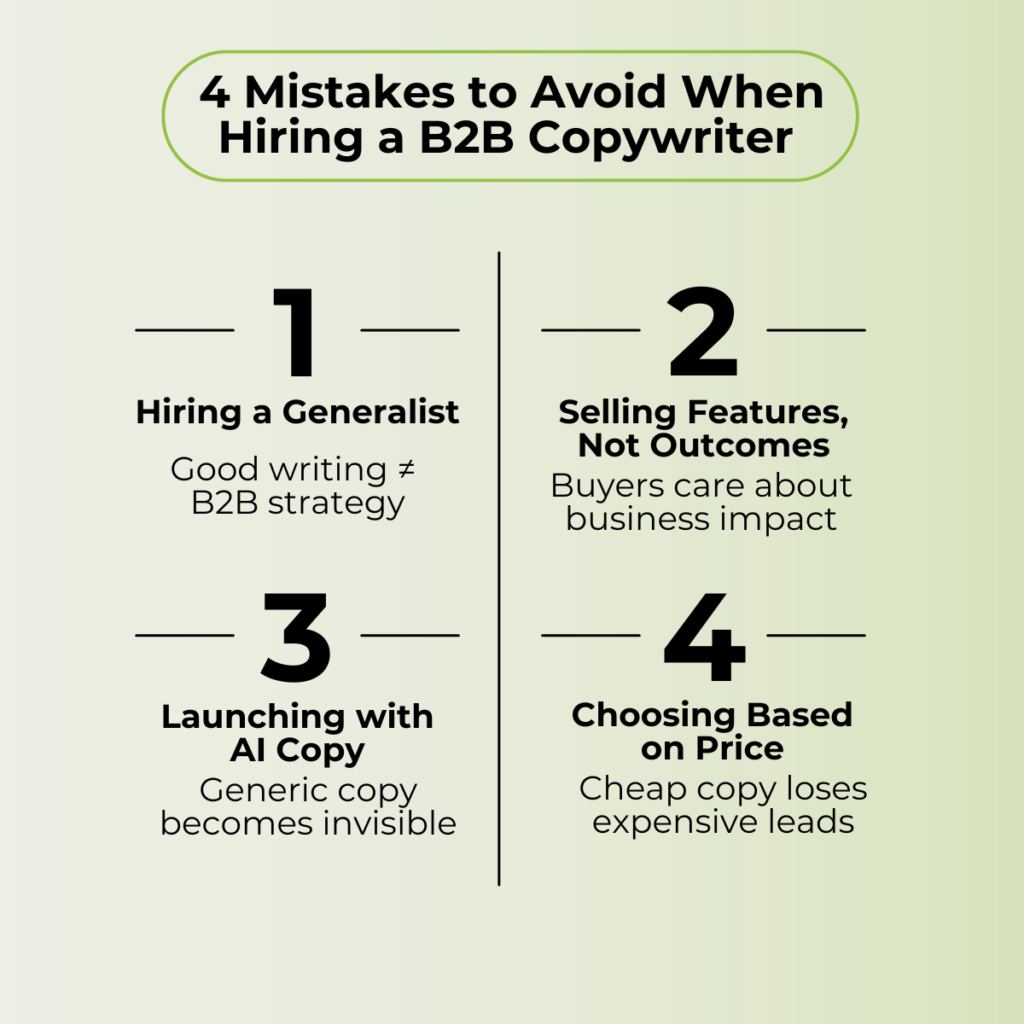
If you’ve just launched a website and are looking for a B2B copywriter, never ever make these 4 mistakes;
- Don’t Hire a Generalist Writer Who Has Never Written for B2B Buyers
B2B copy requires someone who understands business decision-making, not just someone who writes well. A generalist will produce polished content that doesn’t speak to the specific concerns of a procurement director or a CFO evaluating vendors. The writing quality isn’t the problem. The strategic thinking behind it is.
- Never Accept a Feature List When You Need Outcome-Driven Copy
Writers who don’t understand B2B buyer psychology would naturally write what you do and list features of your business. “We offer real-time analytics dashboards” is a feature. “Your ops team catches margin leaks before they hit the quarterly report” is an outcome. New websites built entirely on feature descriptions generate traffic but not inquiries.
- Using AI-Generated Copy as Your Launch Copy
Many B2B businesses launched with AI-generated website copy in 2024 and 2025 (and it still is very much happening in 2026:). The copy is grammatically correct, reasonably structured, and completely indistinguishable from that of every competitor who did the same thing. AI cannot research your specific buyer’s objections, interview your sales team, or inject the industry nuance that makes a decision-maker think “these people understand our situation.” Launching with an AI copy means launching invisible.
- Hiring Based on Price Instead of Industry Fit
Cheap copy costs you more than expensive copy because you lost so many potential leads because of it. A $200 website page that converts at 0.1% costs infinitely more than a $2,000 page that converts at 3%.
When evaluating a b2b copywriter, ask for samples from your industry or an adjacent one. Ask them to describe your buyer’s decision-making process. If they can’t, the price doesn’t matter.
How to Brief Your B2B Copywriter So They Deliver Copy That Actually Converts
Hiring the right person is half the job. The other half is giving them what they need to write copy that works. Most new website projects fail at the briefing stage because the business owner assumes the writer will “figure it out.” They won’t. Not without context.
Give Them Your Full Business Context
Your copywriter needs to understand:
- What you sell and to whom (specific industries, company sizes, job titles)
- Your value proposition in plain language (not your internal jargon)
- How your sales process works (what happens after someone fills out the contact form)
- Who your direct competitors are and how you differ from them
- What objections your sales team hears most often
The more specific you are here, the more specific the copy will be. Vague briefs produce vague websites.
Define Your Tone and Voice Expectations
Don’t assume that the copywriter will ‘adjust’ to your tone. Tell your writer:
- Whether you want formal, conversational, or somewhere between
- Examples of brands or websites whose tone you admire
- Words or phrases you never want associated with your brand
- Whether first person (“we”) or third person (“the company”) is your preference
A simple tone guide (even a few bullet points) prevents three rounds of revisions and a website that sounds nothing like your team.
Share Your Buyer’s Language
The best brief includes real language from your customers. Pull from:
- Sales call recordings or notes (what questions do buyers ask?)
- Email threads with prospects (how do they describe their problem?)
- Reviews or testimonials (what words do satisfied clients use?)
- Industry forums where your buyers discuss the problem you solve
When your copywriter uses the same language your buyers use, the copy feels like it was written specifically for them. Because it was.
Be Clear About What Each Page Needs to Accomplish
Don’t just hand over a sitemap. For each page, specify:
- The one action you want the visitor to take after reading
- The one objection that page needs to overcome
- Where in the sales cycle this page sits (awareness, consideration, decision)
- What your competitor’s version of this page looks like (so your writer can differentiate)
A homepage has a different job than a service page. A service page has a different job than an About page. Your copywriter needs to know the strategic purpose of each one before writing a single sentence.
Include Your Sales Team’s Insights
Your sales team knows things your marketing team doesn’t. They know which questions come up on every call, which objections kill deals, and which phrases make prospects lean in. Feed this directly to your copywriter.
If you don’t have a sales team yet, use your own conversations with early customers. The patterns in how people describe their problem are the raw material for copy that resonates.
You Might Have These Questions About B2B Copywriting
Freelance b2b copywriting rates range from $50 to $200 per hour. A full website (5-8 pages) typically runs $1500 to $5,000 depending on research depth and industry complexity. The investment pays back through conversion rates your generic placeholder copy would never achieve.
A full website of 5-8 pages typically takes 2 to 4 weeks when research, drafts, and revisions are included. The research phase alone (buyer interviews, competitor analysis, industry context) often takes a full week. Rush timelines sacrifice the research that makes copy convert.
You know your business better than any writer will. But translating that knowledge into persuasive, structured web copy that speaks to your buyer’s psychology is a distinct skill. If your website is your primary lead generation channel, the specialist investment typically pays back within the first quarter of being live.
You can. But “later” usually means months of lost leads while your website sits with undifferentiated copy. The longer generic copy runs, the more qualified visitors bounce without converting. If budget is tight, invest in copy for your two or three highest-value pages first and expand from there.
Copywriting is the conversion layer (website pages, landing pages, emails that drive action). Content writing (blogs, articles, guides) is the long-term organic growth engine. Both sit under content marketing as a discipline. They work together, not separately. For a new website, the copywriting comes first. Content follows once the site converts.
Launch With the Right Copy and Your New B2B Website Pays for Itself Faster
Most B2B websites launch with placeholder copy and a vague plan to “fix it later.” Later becomes three months. Then six. Then a year. A year of traffic that arrived, scanned generic language, and left without converting. A year of marketing spend pointing to pages that don’t do their job.
The investment in proper B2B copywriting at launch is the single highest-ROI decision you can make for a new website. Everything you build on top of it (SEO, ads, content marketing, outreach) compounds faster when the pages those efforts point to actually do their job.
Book a call to discuss B2B copy for your new website, or read our b2b copywriting service page for the full scope of how this works.
