
You need a lifestyle content writer who has the ability to ‘waoh’ your target audience, and can help you stand out in the ocean of lifeless and AI-generated content. But the challenge is that you’re unable to screen that rare gem.
Portfolios, samples, and ranking proofs from GSC only tell half the story. Your brand is unique, and you can’t judge someone based on what they’ve done for another brand. So what’s the criterion?
That’s exactly what we’re going to discuss in this blog post.
A Lifestyle Content Writer Has Taste, Tone & Personality
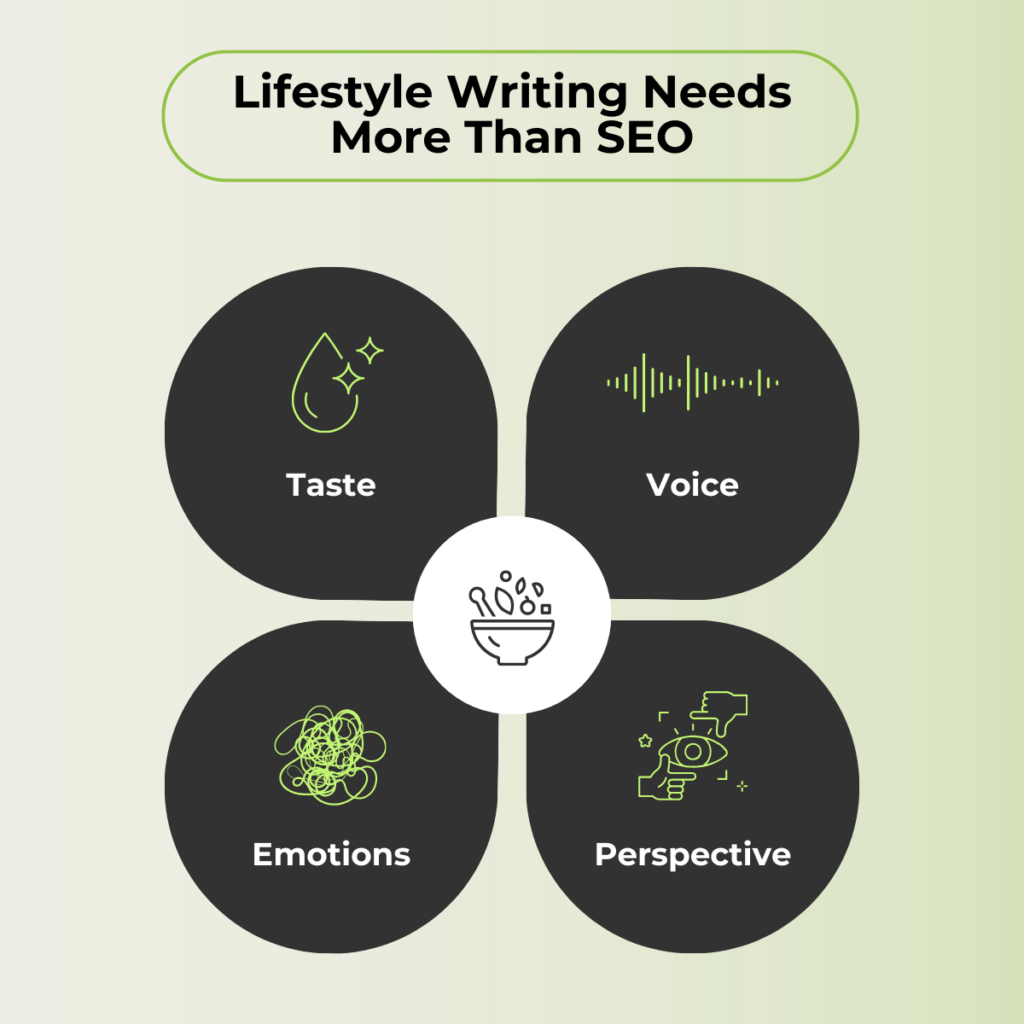
I have seen 100s of SEO writers who can’t even define their own writing tone and taste. Lifestyle is the ONLY niche, in my POV, that requires an SEO writer to adopt a specific tone. Because the reader is not reading a content piece to gather some information.
They’re looking for a voice that reflects how they want to live, spend, and feel.
In other words, a lifestyle content writer should have this set of qualities:
- Taste and cultural awareness. They understand aspiration, comfort, luxury, and the emotional triggers behind lifestyle purchasing decisions.
- A distinct voice. Lifestyle readers follow voices, not topics. If the content has no personality, it has no reader.
- Emotional range. A wellness piece needs warmth. A fashion piece needs edge. A travel piece needs wonder without cliché. The writer adjusts without being told.
- Audience empathy. They feel the difference between “affordable minimalism” and “budget basics,” because the audience absolutely does.
- Point of view. They take a stance instead of summarizing what everyone else already said.
Why Most Brands Hire the Wrong Lifestyle Content Writer
Many brands usually make three mistakes while hiring a lifestyle content writer;
- They pick the wrong type of writer
- They don’t know what they need (yes, that’s true).
- They don’t know their brand’s USP + buyers.
Let’s explain each one a bit in details;
- They Hire a Generalist and Expect Specialist Results
They hire ajack of all trades, master of none. One writer, all topics, lower cost. But generalist writers produce surface-level, generic, and dull content. They research the topic, hit the keywords, structure it cleanly, and deliver something that reads like a Wikipedia summary with better formatting.
Lifestyle audiences don’t respond to that. They’re emotionally invested in the content they consume. A reader browsing a wellness blog isn’t looking for clinical accuracy alone. They want to feel understood. Generic copy doesn’t make them feel, it just ‘educates’ them.
- They Haggle Over Price Without Understanding The Worth Of The Content
Cheap writers produce cheap content. Cheap content = surface-level, shallow, worthless, (often) AI-crap.
Cheap content is expensive in a sense that you need revisions and rewrites that eat up your time. And still you’ll get content that would never perform. So a cheap piece you get at $50 for which you’ve to do two rounds of edits and still doesn’t engage readers is more expensive than a $300 piece that publishes clean and actually builds brand affinity.
But that does not mean that expensive content is ALWAYS good content. I’ve reviewed portfolios from writers charging premium rates whose lifestyle samples still read like they were assembled from the top three Google results.
- They Skip the Brand Voice Conversation Entirely
This one is surprisingly common. The writer gets a brief with topics, deadlines, and maybe a few keywords. But nobody walks them through the brand’s tone, personality, or emotional register. Nobody shares examples of “this is what we sound like” versus“this is what we don’t sound like.”
The result is technically fine and SEO-friendly lifestyle content that sounds nothing like the brand. And in lifestyle content, where readers develop loyalty to a voice, that’s a dealbreaker. If a reader can’t tell your blog apart from three competitors, you haven’t built a brand. You’ve built a content library.
What Separates a Great Lifestyle Content Writer From an Average One
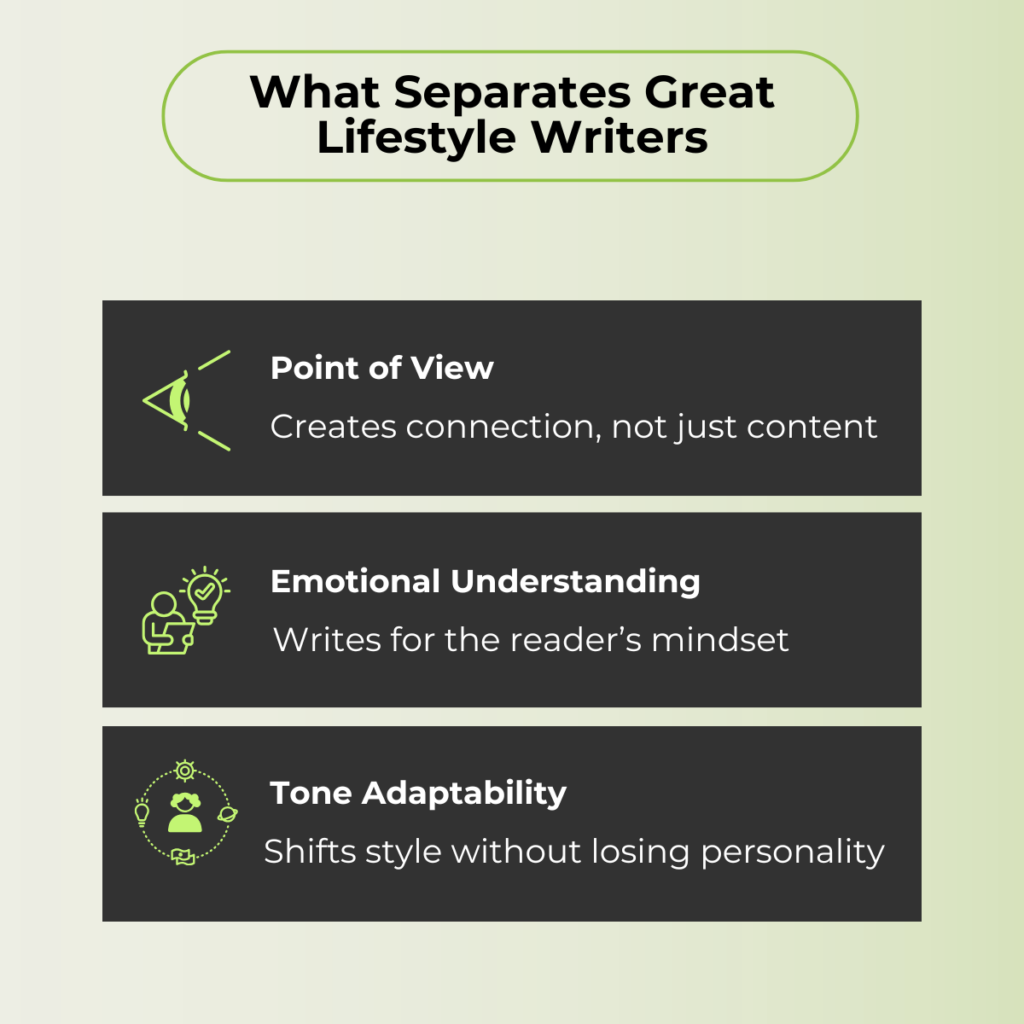
An average lifestyle content writer can produce clean, publishable work. A great one produces content that readers remember, share, and come back for. The gap between the two shows up in three areas that most hiring managers overlook.
They Write With a Point of View, Not Just Information
Lifestyle readers don’t want Wikipedia entries about wellness trends or travel destinations. They want a voice that resonates with them. The content that taps into their emotions, removes their fear, and makes them trust you.
A lifestyle SEO writer knows how to win your prospects’ trust. They know what POV to use. And the point of view is what turns content into something the reader comes back for.
They Understand the Reader’s Emotional Context
A great lifestyle content writer puts themselves in the reader’s world before writing a single word. They ask what the reader is feeling, what they’re aspiring to, and what would make this piece feel like it was written for them specifically.
Empathy drives everything in lifestyle content. A writer who doesn’t understand why someone reads a luxury travel blog differently than a budget backpacking blog will produce content that misses the mark on both.
They Can Shift Tone Without Losing Personality
A piece for a luxury wellness brand sounds nothing like a piece for a budget travel blog. The vocabulary is different. The content flow, the emotional density, the structure, everything is uniquely different. But both should feel like a real person wrote them.
The ability to adapt tone while keeping personality intact is the mark of a professional lifestyle content writer. It’s also one of the hardest things to evaluate from a portfolio alone, you need to test the writer before hiring.
How to Actually Evaluate a Lifestyle Content Writer Before You Hire
Portfolios and rates tell you very little about whether a lifestyle content writer can actually write for your brand. The real evaluation happens when you look at their work through the right lens and test them on something specific to your audience.
Read Their Samples & Try To Extract Their Tone and Voice
Grammar, clean writing, proper sentence structure, on-page SEO practices, all of this is basic stuff and any SEO writer should deliver on that. What you’re looking for when you review lifestyle writing samples is whether the writing has a pulse.
Do you hear a person behind the sentences? Does the piece make you want to keep reading, or does it feel like you’re checking boxes? Could this have been written for any brand, or does it feel specific to the audience it’s targeting? If the writing is correct but interchangeable, that’s your answer.
Give Them a Paid Test Assignment With a Real Brief
If you don’t get specific samples and think that the candidate could be a strong choice but you’re still confused, assign them a PAID trial post. Give them your brand guidelines and brief them on other important parameters and ask them to finish the task. If they deliver well, hire them.
Then evaluate three things. Did they capture your voice? Did they bring something original to the topic? Did the piece make you want to keep reading past the first two paragraphs? If the answer to any of those is no, you’ve saved yourself months of mediocre content.
Ask About Their Research Process
Great lifestyle writers research like journalists. They look at trends, read community discussions, and understand what’s actually happening in the niche. They know what Reddit threads say about the topic. They know which angles have been covered to death and which ones haven’t.
If their “research process” is reading the top three Google results and rewriting them in a slightly different order, that’s not research. That’s content assembly. And the audience will feel the difference, even if they can’t articulate why.
Generic SEO Content Writer vs. Lifestyle Content Writer (Side by Side)
I’ve seen some generic writers who write absolutely killer content for any niche. But you must look for the traits that make a writer worthy of writing about your lifestyle brand. The table below shows you how a lifestyle content writer compares to a generic writer.
| Area | Generic SEO Content Writer | Lifestyle Content Writer |
| Voice | Neutral, interchangeable across brands | Distinct, adapted to the brand’s personality |
| Research | Top Google results and keyword tools | Trends, forums, cultural context, audience psychology |
| Reader Understanding | Targets a keyword query | Targets a person with desires, taste, and emotional triggers |
| Content Goal | Rank and inform | Rank, resonate, and build brand affinity |
| Emotional Depth | Surface-level or absent | Woven into every section |
| Final Output Feel | Correct but forgettable | Has a voice you’d recognize if you read it again |
You need content that resonates with your target audience and also ranks in Google and appears in AI search. At the end, it all boils down to your choice of hiring the right fit.
Although it’s rare but sometimes a generalist writer has more diversity and variety in their writing, and they can absolutely nail your brief. So always look up for the traits.
You Might Have These Questions About Lifestyle Content Writers
They create blog posts, articles, newsletters, and web content for lifestyle brands across niches like wellness, travel, fashion, food, and personal finance. The work goes beyond writing. It includes audience research, trend awareness, SEO alignment, and brand voice calibration.
Lifestyle writing demands more personality, opinion, and emotional connection than most other content types. It sits closer to magazine writing than to standard SEO blog production. The reader is investing in a voice, not just consuming information.
Rates vary widely. Freelance lifestyle writers typically charge anywhere from $0.10 to $1.00+ per word or $100 to $500 per piece, depending on experience, niche depth, and project scope. Agency rates are higher but usually include strategy, SEO, and editorial oversight as part of the package.
Technically, yes. Practically, depth matters. A writer who covers everything from fashion to finance at a surface level won’t deliver the same quality as one who specializes in two or three related sub-niches. The “nicheless niche” problem is real. Lifestyle is so broad that writers who claim to cover all of it often lack depth in any of it.
It depends on volume and strategy needs. A freelancer works well for individual posts or short-term projects. An agency or full-stack content partner handles the strategy, SEO, editorial calendar, and content production as one operation. If your lifestyle content is part of a larger content marketing system (and it should be), the integrated approach usually performs better long-term.
Hire for Voice. Everything Else Follows.
Skills can be taught. SEO can be learned. CMS workflows are a matter of onboarding. But voice is either there or it isn’t. When you find a lifestyle content writer whose voice fits your brand, the content stops being a task on a production calendar and starts being an asset that compounds.
Getting this wrong costs you months of rewrites, flat engagement metrics, and a blog that nobody reads.
If you’re building lifestyle content as part of a broader content marketing strategy (and not just publishing blog posts for the sake of it), the writer you choose shapes everything downstream. Get the voice right first. The rankings, the traffic, and the reader loyalty follow.
Book a call with Saiqic to see how we build lifestyle content as part of a full-stack content marketing system.
