
Your accounting firm offers the same services as the firm two blocks away. Same homepage structure, identical practice area pages, same Google Business Profile setup, and a blog content inventory that follows the same SEO strategy.
That’s a loose SEO setup for any accountant looking for organic leads. It won’t get you into the map pack ahead of the firms that already dominate it, and it won’t get your firm mentioned when someone asks an AI search tool to recommend an accountant, either.
Almost every SEO playbook for accountants looks the same because almost every SEO follows the same playbook. Here’s what actually separates a firm that both Google and AI search choose to surface from the ten that look just like it.
Why the Standard Local SEO Checklist Leaves Your Firm Invisible to Google and AI Search Alike
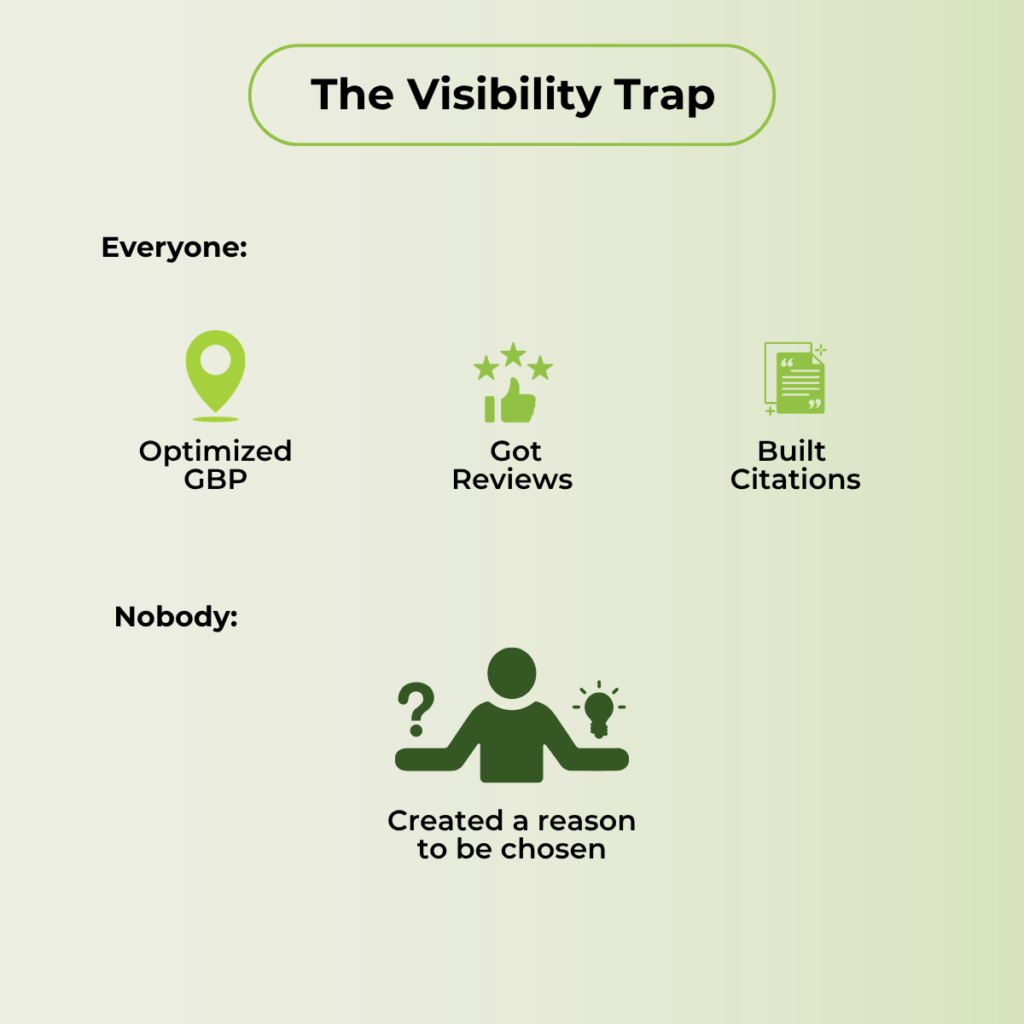
You’ll read these five moves in almost all the guides to SEO for finance & accountants:
- Claim your Google Business Profile
- Build local citations and keep your name, address, and phone number consistent
- Collect reviews
- Publish blog content around relevant keywords
- Clean up technical basics like page speed and schema markup
All 5 are important, and you must get them right if you want to build a solid foundation. But the problem is that these are now very basic, and every Nick and Joe knows them, so it’s NOT a stand-out local SEO strategy anymore. You need to do more.
If ten firms in your city have done the same five things, and you’re also feeling done doing the same 5 things, it won’t get you any edges. It keeps you level with everyone else.
The same underlying logic applies to AI search (getting citations and mentions in AI models like ChatGPT and Perplexity). These systems pull answers from pages that contain specific, verifiable information. A page that reads like every competitor’s gives an AI model nothing to pick you over the next firm with.
Get Your Local SEO Foundation Right Before You Compete on Anything Else
If your firm is starting from zero, you need to get these three done right away.
Fix Inconsistent NAP Data Before You Touch Anything Else
As I mentioned, the basic local SEO setup is important… that’s the entry point. So you need to put consistent name, address, and phone number data across your website, directories, and social profiles.
Claim and optimize your Google Business Profile, verify your address, and make every listing match exactly.
Turn Reviews Into a System Instead of an Afterthought
Reviews are the next lever once your NAP and Google Business Profile are sorted. Ask every satisfied client for a review, ideally right after a tax season wrap-up or a successful filing, when the experience is still fresh in their mind.
A standing ask built into your client offboarding beats an occasional reminder email.
Benchmark Your Review Count Against the Firms Already in the Map Pack
When you’re done with the basic setup, benchmark your review count. Open your Google Business Profile and count your reviews, then count the reviews for the three firms currently sitting in the map pack for “accountant near me” in your city.
If your firm has fewer than 20 reviews and three competitors have 80, that gap is part of why you’re not showing up, regardless of how good your content is.
This foundation work matters. But it’s also where the checklist runs out of road. Everything from here is about what makes your site different and readable to both people and machines, not about what makes it compliant.
Why Your Service Pages Look Like Every Other Accounting Firm’s and How to Fix It
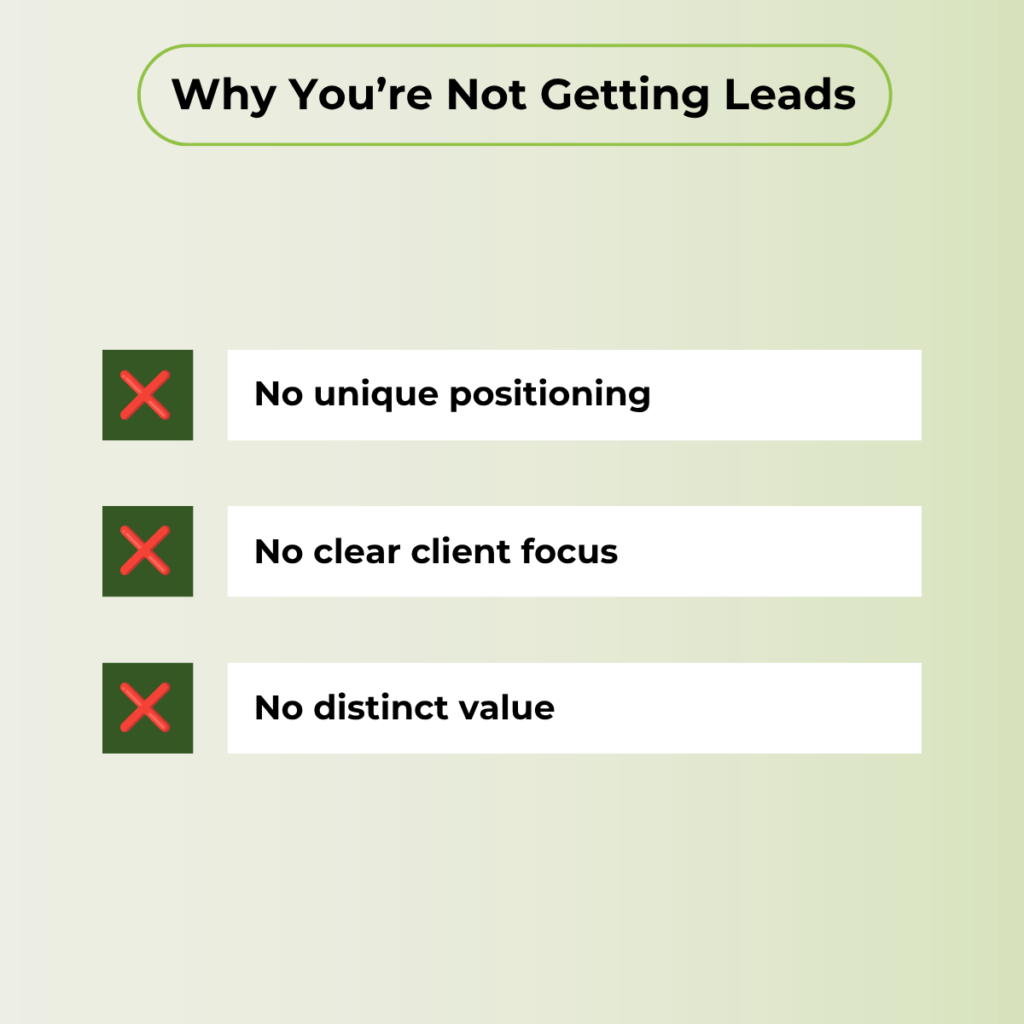
Open your “Tax Preparation Services” page next to a competitor’s. There’s a good chance they read almost the same. You don’t have any UVP (unique value proposition), no specific process mentioned, nothing is explaining your unique expertise that no other accountant in your area can claim.
That sameness is the major reason you’re not showing up in front of your ideal customers and not getting any leads. This is 30% an SEO problem, and 70% content and copy problem. 30% SEO because you’ve not got a proper SEO strategy. 70% content and copy problem because you’ve not positioned yourself uniquely enough.
The consequence is that you’re not ranking on Google and not appearing in AI search.
How to Fix the Sameness Issue
Build pages around a client type, not a service category.
Instead of a single generic “Tax Preparation Services” page, a firm that works with software companies might build a page titled “Tax Planning for SaaS Founders.”
A firm with restaurant clients might build “Bookkeeping and Payroll for Restaurant Owners.” These pages target searches with less competition, read as written for the person searching, and give AI systems a clear answer to point to.
How to Map Your Accounting Firm’s Pages So Each One Has a Distinct Job
Each service page MUST be unique on your website.
Here are the three page types that cover most firms, and the SEO content on each has a different job.
- Your Homepage Should Route Visitors, Not Try to Sell Everyone
The homepage’s job is to state who you serve and what sets the firm apart on the first screen, then direct visitors to the right niche or service page. A homepage trying to be the answer for every possible client ends up being a strong answer for none of them.
- Niche and Client-Type Pages Carry the Real Differentiation
This is where the differentiation lives. Each niche page speaks to one type of client, their specific tax situations, common pain points, and the language they actually use to describe their problem, whether that’s “tax planning for SaaS founders” or “bookkeeping for restaurant owners.”
- Location Pages Only Earn Their Place for Multi-Office Firms
A location page makes sense when an office serves a distinct local area and needs its own address, team, and location-specific notes. A firm operating from a single office doesn’t need one, and adding one anyway just gives Google an extra page with no reason to rank.
If your site only has the generic version of these pages, the create path is the same as the fix path: pick your two or three highest-value client types and build a dedicated page for each before adding anything else.
What AI Search Tools and AI Agents Need to Find on Your Site Before They Recommend You
A growing share of “accountant near me” research now happens through AI Overviews, ChatGPT, and AI agents browsing on a user’s behalf, not just a Google results page. Showing up there runs on different mechanics than the map pack, and most accounting firm sites aren’t built for it yet. Three things matter most:
- Structured data that states facts plainly. LocalBusiness schema for your firm’s name, address, and hours, Service schema for each practice area, and FAQPage schema for your FAQ section give AI systems a machine-readable summary instead of forcing them to guess from layout.
- Direct, extractable answers. AI Overviews favor content that states a clear answer in the first sentence or two of a section. The same BLUF approach that makes a page scannable for a person also makes it quotable for a model.
- The specificity of an agent can match a query. An AI agent comparing “bookkeepers for e-commerce sellers” against local firms is matching the query against page content. A page titled and structured around that exact phrase has something to match against. A generic “Our Services” page doesn’t.
None of this replaces the niche pages and clear writing covered above. It’s the same work, made readable to a wider set of readers, some of whom aren’t human.
The SEO Content Strategy For Accountants that Makes Google, AI Search, and The Prospects Trust Your Expertise
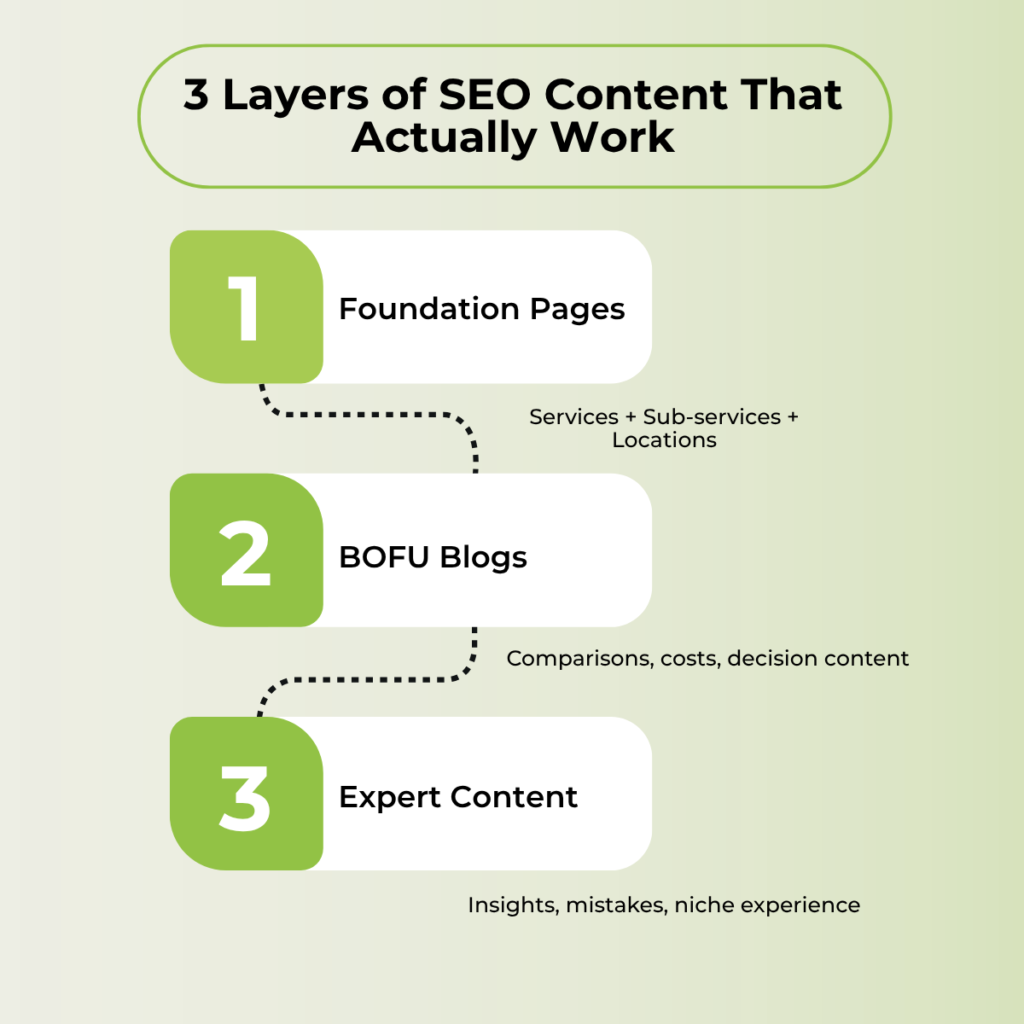
You’re in a niche service industry, and that works in your favor. So if you strategize your content properly, you’ll get 100x ROI in a matter of months. Here’s the 3-phase strategy for you if you’re just starting your accounting firm’s site, whether you are just starting or not, and for getting results from the old one.
Phase #1: Create the Main Service, Sub-Service, and Location Pages the Firm Needs
This is your most important and core content on your site.
And it’s totally not rocket science to strategize these pages. You can do it without any SEO expert help. Just think about your main services, and what sub-services you can put under each main service.
For example, if Tax Preparation is your main service, then sub-service pages could be;
- Personal Tax Return Preparation
- Federal Tax Return Filing
- State Tax Return Filing
And so on…
Phase #2: BOFU Blog Posts for Every Service and Location Page
Once you’re done with the core content, each service and location page needs backup content to gain enough authority to start ranking on Google and appearing in AI search. For this, you’ll need to strategize two to three bottom-of-funnel posts that further solve a searcher’s problem, educate them, or provide clarification…
For example, if you have a service page on Bookkeeping for Restaurant Owners, the BOFu blog topics will be;
- Restaurant Bookkeeper vs. General Bookkeeper
- Bookkeeping for Restaurants Cost
etc.
Phase #3: Publish Thought-leadership or SME Blog Posts
Once the core pages and their supporting blogs are live, the next layer is content that addresses real client pain points and shares the kind of insight most firms treat as proprietary. This is where a firm’s actual experience becomes the differentiator, the specific mistakes it sees in client books, the niche-specific deductions clients don’t know to ask about, the judgment calls that come from years of filings in one industry. This content is harder for competitors to copy because it isn’t generic advice; it’s earned.
What Makes Accounting Firm SEO Harder Than SEO for a Typical Local Business
Accounting, finance, and law are hyper YMYL niches. You can’t just publish anything you want. You need to adhere to certain rules and regulations.
Regulatory Limits Shape What Your Content Can Say
A plumber can write “same-day service, lowest prices guaranteed” and mean it. An accounting firm can’t promise “guaranteed maximum refund” or “save thousands on your taxes” the same way, because professional standards and advertising regulations limit the claims firms can make. That constraint pushes the differentiation toward demonstrated expertise and specificity rather than bold claims.
Many Of Your Prospects Prefer A Referral To Hiring An Accountant Online
Choosing an accountant isn’t an impulse decision. Most prospects research for weeks, compare a handful of firms, and lean heavily on referrals from people they trust. Your content isn’t just competing with the firm down the street’s website; it’s competing with “my brother-in-law uses someone, I’ll just ask him.”
This is exactly the dynamic that mortgage brokers and financial advisors deal with, too. Both professions are trust-heavy, both face real limits on what they can claim, and both compete with referral networks as much as with other websites. If you operate in both spaces, or advise clients who do, the content strategy that closes this gap for one largely transfers to the other. The content that wins isn’t the loudest; it’s the content that reads like it was written by someone who understands the prospect’s specific situation, because that’s what referrals, and increasingly AI recommendations, are built on.
What Determines How Fast Your Firm Ranks in an Already Crowded Market
For a firm starting from a reasonably solid foundation, four to six months is a realistic average before niche pages and supporting content begin showing measurable movement in a competitive market. That average shifts based on a handful of factors, and knowing which ones apply to your firm matters more than the average itself.
- How saturated your specific market already is.
A city with three dominant firms that have years of content and hundreds of reviews takes longer to break into than a market where the top results are thin or outdated.
- Your current review count relative to the map pack leaders.
A large gap (see the benchmark above) means foundation work needs to happen alongside, not before, the content work.
- How thin your existing site is.
A site with one generic services page and no niche content has more ground to cover than one that already has some specific pages, even unoptimized ones.
- Whether your structured data is in place.
A site with schema markup already implemented gives AI search systems a head start, which can shorten how long it takes for niche pages to start surfacing in AI Overviews once published.
- Publishing consistency.
A firm publishing one well-researched niche piece a month builds topical authority faster than one publishing sporadically, even if the sporadic posts are individually longer.
Author Note: None of the above factors will guarantee you any kind of fix results. There are several variables, and almost all of them depend on your SEO strategy and content quality.
You Might Have These Questions About SEO for Accountants
Yes, but the starting point matters. A small firm gets more from one well-built niche page targeting a specific client type than from a broad campaign covering every service. Focus the budget on the pages most likely to convert, not the widest coverage.
AI Overviews and AI assistants pull answers from pages that state facts clearly and use structured data. The work is the same, niche pages, clear writing, and a strong foundation, but now it also needs schema markup and direct, extractable answers so AI systems can read and cite the site accurately.
The mechanics are similar. Both face advertising restrictions on the claims they can make, both involve long consideration cycles, and both compete with referral networks. The content strategy that works for niche-specific, expertise-led pages transfers well between the two professions.
Yes, if each office serves a distinct local area and has its own searchable presence. Each location page should have that office’s address, team, and any location-specific notes. A single firm operating from one office doesn’t need this and shouldn’t create extra pages just to look bigger.
Content and Copy Are the Real Differentiation Strategy in a Crowded Market
Once every firm in your market has the basics covered, the basics no longer decide who ranks, who gets cited by AI Overviews, or who an AI agent suggests when a prospect asks for a recommendation. What’s left is what your site actually says, who it says it to, how specifically it says it, and whether it’s structured so machines can read it too.
Building niche pages, supporting content, and the structured data that make a site legible to AI search takes more than a checklist, and it’s where SEO for financial services firms tends to need the most hands-on help.
If your firm has the foundation in place and is ready to build the content and site structure that actually separates you from the firm down the street, get in touch with Saiqic, and we’ll map out where to start.
