
Google is rolling out core updates like a madman. Every month, there’s a new core update, and the hardest hit are almost always YMYL niches, especially legal, finance, and health. The May 2026 broad core update was one of the most powerful in months, and YMYL sites felt it early.
This makes sense because Your Money Your Life (YMYL) niches are the ones that directly impact a person’s life. And there’s no rocket science involved in understanding whether your site will get drowned or float when a core algorithm update comes. For instance, if you’re a lawyer and you know your thing and publish content that really helps your audience, you’re almost safe.
You just need to know a few best practices for how and where to best present your content. This blog will make you understand this thoroughly.
What Recent Core Updates Reveal About E-E-A-T for Legal Content
Two core updates that highly impacted YMYL niches were the December 2025 and May 2026 updates. Glenn Gabe, an SEO consultant at G-Squared Interactive, shared that the May 2026 update brought significant volatility to the YMYL niche. Interestingly, his breakdown showed that not all sites saw a drop… some surged.
That means;
A core update hitting your law firm site doesn’t mean an automatic drop
As I mentioned, if you’re genuinely publishing helpful content that benefits your target audience, then a core update won’t hurt your site. Every Google core update brings some kind of volatility in rankings. Volatility could mean a surge in rankings, too. If you’re following all the best Search Quality Rating Guidelines (SQRG), then you’re safe.
After auditing 100s of YMYL niche sites and witnessing the spikes and drops after a core update, I can tell you what works on a lawyer website;
What, in terms of E-E-A-T, gets rewarded on a lawyer’s website
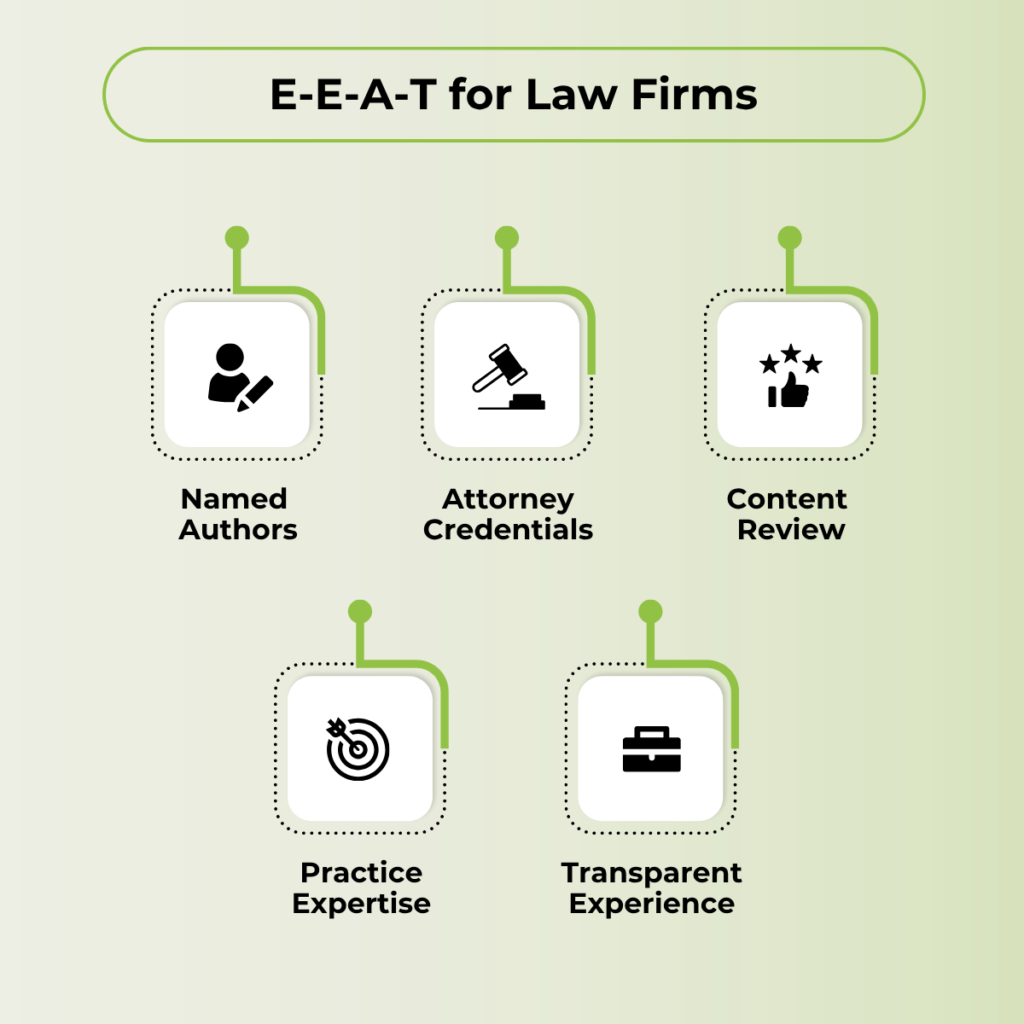
- Named, credentialed authorship. Pages written or reviewed by a licensed attorney, with that attorney identified, held up better than pages with no visible author.
- Editorial oversight. Sites with a visible review process, not just a publish date, were treated as more trustworthy sources for legal questions.
- Transparent credentials. Bar admissions, practice focus, and years of experience are stated on the page, not buried in a separate “About Us” link three clicks away.
Is this YMYL E-E-A-T criteria for lawyers important for AI Overviews and AI search tools?
Yes. Websites that have credible law firm content, have named authors, and have the right credentials get cited in AI overviews and appear in AI search more often.
A legal website that cannot demonstrate expertise, authority, and trust is less likely to be cited or used as a source, even if it ranks well in traditional search.
Every Page on a Law Firm Site Counts as YMYL Legal Content
Most firms assume YMYL applies only to obviously sensitive content, a bankruptcy guide, an article on a new statute, maybe the criminal defense practice page. Everything else feels exempt. That assumption is wrong, and it’s the biggest reason firms misallocate their effort.
YMYL isn’t a topic list. It’s a consequence test: could bad information on this page lead someone to a decision that harms their finances, legal standing, or safety?
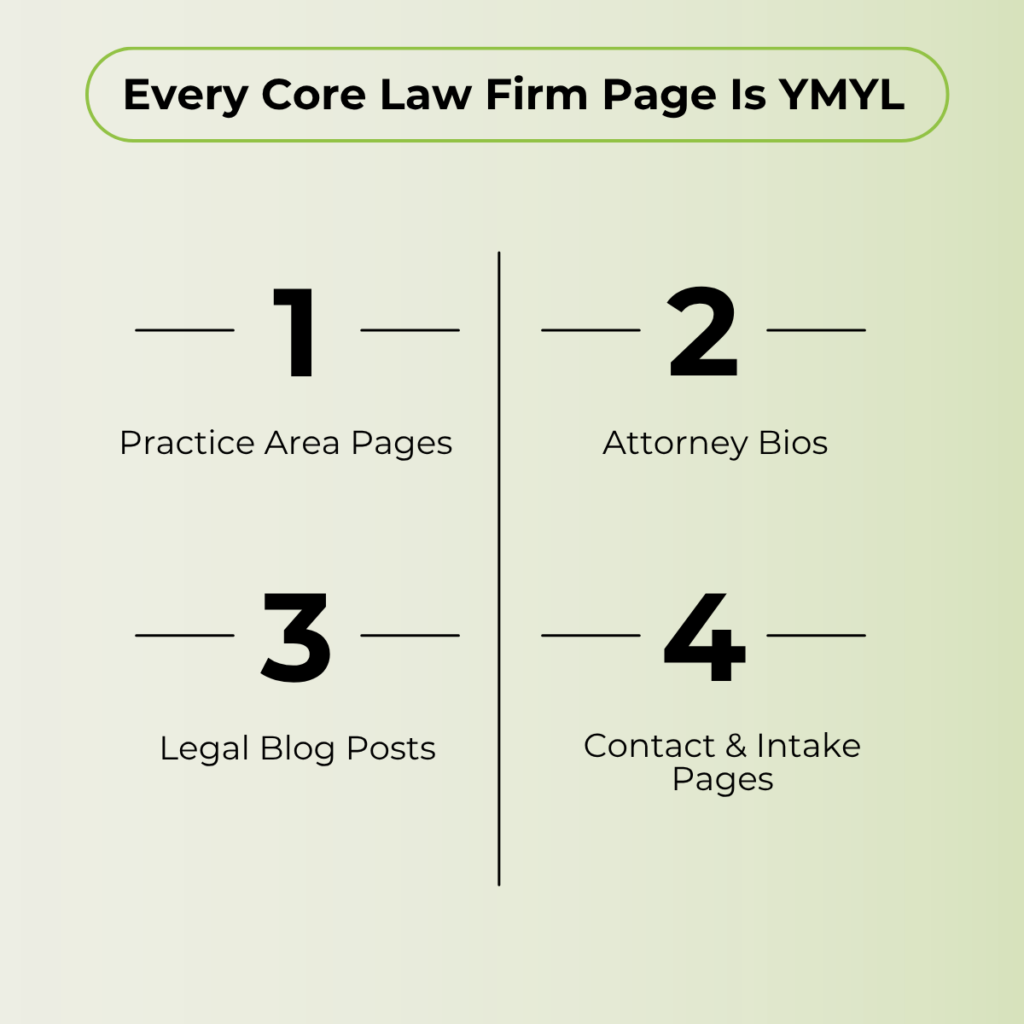
Pages that carry YMYL weight on every law firm site
- Practice area pages. A description of what a divorce attorney handles shapes whether someone hires them.
- Attorney bio pages. The credentials listed are exactly what a prospective client relies on to judge trustworthiness.
- Blog posts on statute or procedure changes. A reader may act on outdated or incorrect information.
- Contact and intake pages. Case eligibility descriptions shape whether someone reaches out at all.
Some firms prioritize the less important pages for E-E-A-T
I have seen that some law firms put real effort into the blog. They’d hire a legal content-writing expert and invest their entire budget in blogs. But their core content, such as practice area pages, would carry no attribution. No named author, no reviewing attorney, nothing. Blogs are necessary, but first, you should always prioritize your core content because that’s where you get the most conversions.
E-E-A-T Elements for Lawyers’ Websites That Google and Clients Both Check
You might have read somewhere that “Add an author bio” is the most important E-E-A-T factor for lawyers. It’s not wrong, but it’s one signal among several that Google’s quality raters, and the people reading your site, check independently.
Here’s what you should take care of;
| Element | What It Signals | To Whom |
| Named, credentialed attorney byline on every substantive page | A real person stands behind this content | Reader and quality rater |
| Linked attorney bio (bar number, jurisdiction, practice focus, case experience) | This person is verifiably qualified to write this | Quality rater (verification), reader (trust) |
| Person and ProfessionalService schema markup | Machine-readable link between author and firm | Search engines and AI crawlers |
| Visible last-reviewed or last-updated date | This reflects current law, not a stale draft | Reader (recency), quality rater (maintenance) |
The review date matters for better visibility
A blog post on a 2019 statute that’s never been touched since reads as abandoned or unreliable, to both a quality rater and a reader. A “Reviewed by [Attorney Name], [Date]” line at the top of any page covering law, procedure, or filing requirements costs little and directly answers the question every YMYL page raises: is this still true?
Why the schema row matters for AI search
A human reader can scroll to find an author bio even if it’s buried. An AI tool summarizing dozens of pages for one query generally can’t, and skips pages where authorship isn’t machine-readable.
The Person and Professional Service schema is what makes a page eligible to be pulled into an AI Overview or cited by ChatGPT in the first place. So it’s not just a technical nice-to-have for traditional rankings.
Building the stack in
If you’re starting from zero, build all four elements into your page templates before publishing the first page. Retrofitting across fifty pages later is a far bigger project than building it in from page one. On an existing site, apply it first to the practice area and bio pages identified above, where it pays off fastest.
How To Present, Write, and Cite Regulations, Case Law, and Statistics in Legal Content
AI legal content writing tools produce confident sentences like “courts have generally held that…” or “studies show most personal injury cases settle within…” without citations to back them up. Whether the underlying claim is true or not, if a reader, a quality rater, or a web agent can’t trace it to a source, it reads as unverifiable, which is exactly what YMYL evaluation flags.
A citation standard for every page, not a cleanup pass
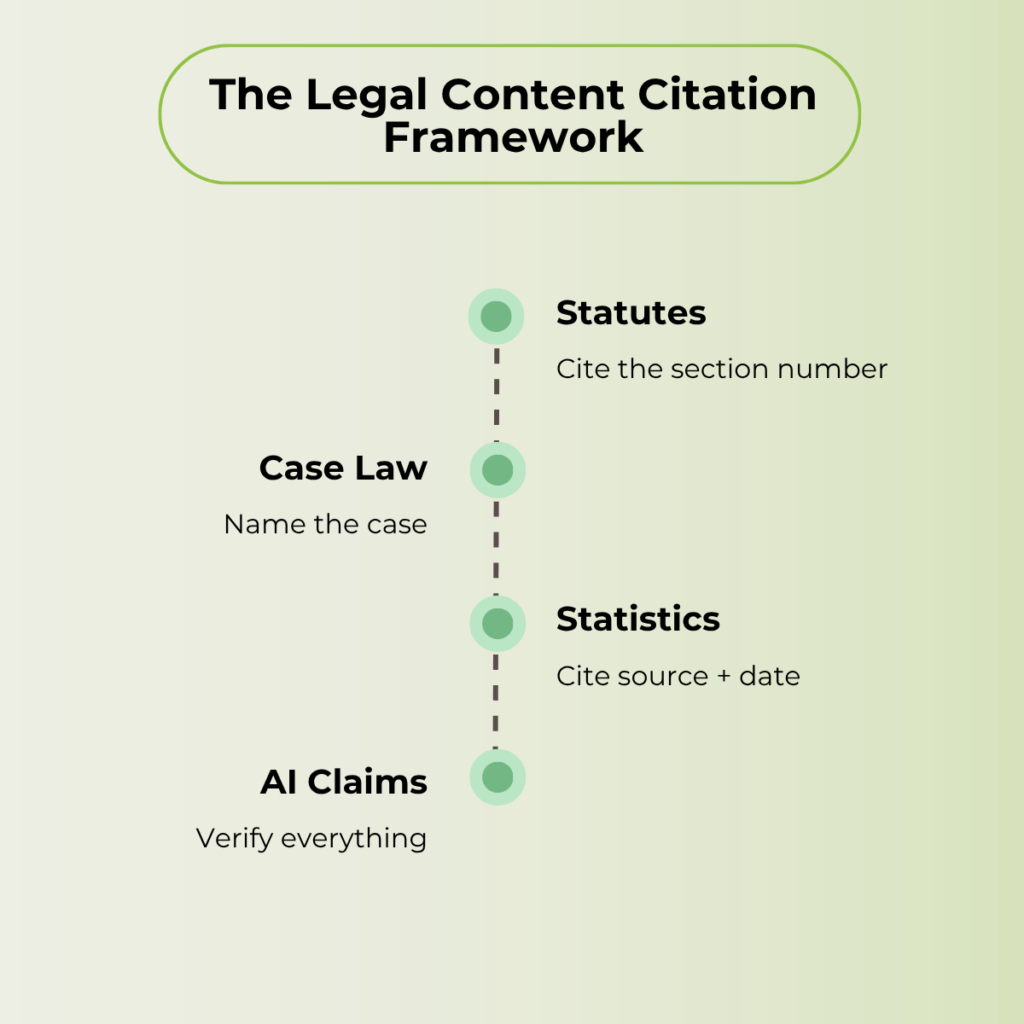
- Statutes (Rules/Regulations) get section numbers. “Under state law, you have a limited time to file” is unverifiable. “Under [State] Code § [X.XX], the statute of limitations for [claim type] is [Y] years” is checkable and shows command of the provision.
- Case law gets named. “Courts have ruled that…” has no anchor. “In [Case Name v. Case Name], the [Court] held that…” gives the reader something real.
- Statistics get sourced to origin, date, and method. “Studies show most cases settle out of court” could mean anything. But when you tie it back to its source and year, the methodology can be checked or flagged until it can be.
A FINRA-reviewed financial article doesn’t get one compliance pass and run forever unchanged. Treat legal citations the same way: a standard every page follows by default.
How E-E-A-T and YMYL Apply to Wealth Management and Investment Firms
YMYL isn’t an industry classification; it’s Google’s answer to whether bad information on a page causes real harm if someone acts on it. Legal, financial, medical, and safety content all trigger that question, just with different specifics. Incorrect investment guidance can damage someone’s retirement as surely as incorrect legal guidance can damage their case.
The same stack, different credentials
- Attribution: a named advisor with a CFP designation, Series 65 license, or RIA registration, linked to a bio stating those credentials, with the same Person and ProfessionalService schema.
- Citations: market data, regulatory figures, and historical performance numbers sourced to their issuing body, date, and methodology, the financial equivalent of citing a statute by section number.
- Compliance overlap: content reviewed against FINRA’s fair-and-balanced standard and content built to satisfy E-E-A-T are aiming at the same target, naming who’s accountable and backing every claim.
This criterion applies to almost all YMYL niches. If someone is a financial advisor and wants to publish E-E-A-T-aligned content, the same regulations apply.
Why AI Search Raises the Stakes Instead of Lowering Them
Traditional search is slowly dying, and AI search is emerging. AI search is more advanced and hyper-personalized. Google’s results pages increasingly rely on AI-generated summaries, and tools like ChatGPT and Perplexity are capturing a growing share of legal questions before a search engine is even opened.
Both paths run on the same underlying check. An AI system answering “what’s the statute of limitations for X” needs a reason to trust one source over another, and a named attorney, linked credentials, sourced citations, and a recent review date give it that reason. A page without those signals isn’t penalized on purpose; it simply doesn’t clear the bar for selection.
The attribution stack and citation standard above aren’t a traditional SEO checklist with an AI bonus tacked on. They’re the baseline for visibility across both, which means firms that build to this standard now are positioning for where legal search is going, not just where it’s been.
You Might Have These Questions About E-E-A-T and YMYL
Not directly. Google has stated it doesn’t penalize content for being AI-assisted. The risk is that AI-drafted content often lacks proper attribution and produces unverifiable citations, which is what fails E-E-A-T evaluation. Apply the attribution and citation standard above regardless of how the draft was produced.
Recovery for YMYL sites typically takes six to twelve months. Firms that prioritize attribution and citation cleanup on their highest-traffic pages, especially practice area pages, tend to see movement faster than firms that work through the whole site at once.
Yes, on different terms. Large publishers win on volume and domain authority for broad terms. A small firm wins on depth: an attorney with fifteen years in one practice area writing about a scenario they’ve actually handled, properly attributed, is the experience signal E-E-A-T rewards.
E-E-A-T Satisfaction Means More Trust & Clicks
Forget how technically an algorithm update affects your law firm website. Focus on two things;
- Be very helpful, honest, and clear to your ideal reader/visitor.
- Make your content easily searchable on Google and crawlable by AI models.
And then no matter what type of update hits, your site will be safe.
If you think you’re doing everything right but your pages still aren’t performing well, get in touch with Saiqic. We will help you diagnose the issues.
