
Small businesses have two paths to grow through marketing.
- Paid content marketing (ads, PR, sponsored placements)
- organic content marketing (SEO + content built into the website).
Both have their objective. But only one compound over time, without burning a hole in your budget the moment you stop paying.
80% of businesses waste a significant portion of their digital marketing budget. Nearly half of ad clicks never convert. Meanwhile, organic content marketing returns an average of $7.65 for every $1 invested. And by organic content marketing, I mean website content, SEO content, and social content as one system.
If you own and run a small business, whether local or global, this post will save you thousands of dollars in wasted effort and point you in the right direction.
Here’s the full system.
What’s Included in Small Business Content Marketing
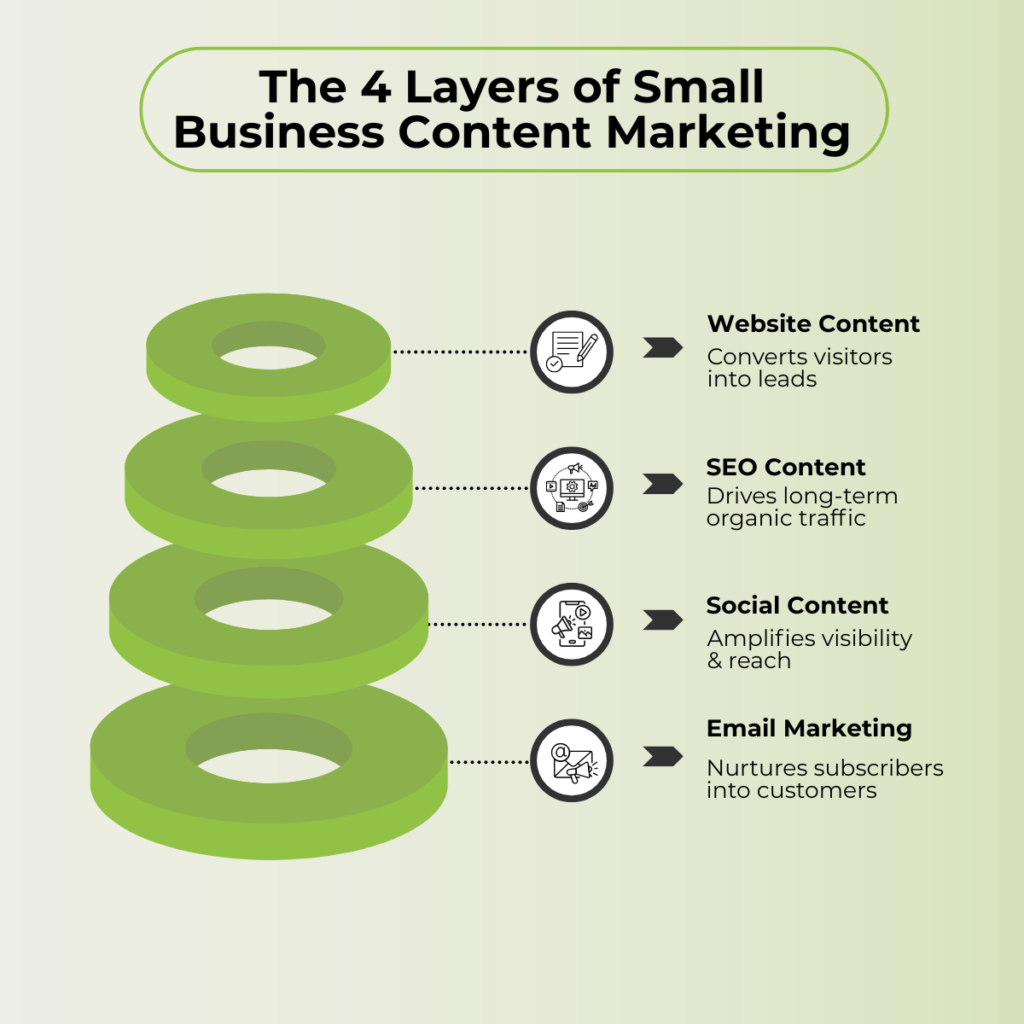
Before building anything, you need to understand the full picture. Small-business content marketing comprises 4 interconnected layers that work together.
- Website Content (The Conversion Foundation)
Service pages, homepage, about page, landing pages, etc., come under website content. This is where visitors become leads. Without strong website content that positions your business, answers objections, and gives people a clear next step, everything else leaks.
- SEO Content (The Organic Growth Engine)
Blog posts, articles, guides, etc., are part of SEO content. All targeting buyer-intent keywords that bring qualified traffic from Google & AI, month after month. This is the long-term compounding layer. One strong blog post can generate leads for years without any additional spend.
- Social Content (The Amplification Layer)
Social media supports your organic efforts. It distributes your SEO content, builds relationships, and keeps your brand visible. But it’s a distribution channel, not a foundation. Posts disappear in 24 to 48 hours. A blog post ranks for years.
- Email Marketing (The Nurture Layer)
Email moves existing subscribers closer to buying. It works best when fed by organic traffic from SEO content. People find your blog through Google, subscribe, and email does the nurturing. Without organic traffic feeding it, email lists stagnate.
Content Chaos vs. Strategic Small Business Content Marketing
There’s a sharp line between “doing content” and doing content marketing. Most small businesses are stuck on the wrong side of it.
Content chaos is what happens when there’s no system behind the content. It looks like this:
- Posting on social media without a purpose or audience strategy
- Writing blog posts without keyword research or conversion intent
- Publishing content with no internal links, no CTA, no next step for the reader
- Spending hours creating content that never gets found on Google
- Random topics, random frequency, random platforms
It feels productive because something is getting published. But it produces nothing measurable. No rankings & leads and thus no compounding growth.
Strategic small business content marketing is the opposite. Every piece of content exists to serve a specific business goal. Every blog post targets a keyword your buyers search for. Every page connects to a revenue outcome.
Unlike Content Chaos, Strategic Content Marketing Has Certain Goals To Achieve
- Get found on Google & appear in AI Search, where buyers are actively searching/asking for what you sell/offer
- Build trust before the first conversation so prospects arrive informed, not skeptical
- Generate leads consistently without the spikes and crashes of ad campaigns
- Reduce dependency on paid ads by building owned assets instead of renting attention
- Educate buyers before sales calls, which shortens cycles and attracts better-fit clients
- Improve conversion rates because informed visitors convert at higher rates than cold traffic
The focus is SEO/AI search plus website content as the primary engine. This is the channel that compounds, builds equity in your domain, and doesn’t disappear the moment your ad budget gets tight.
How to Create a Small Business Content Marketing Strategy That Grows Your Business
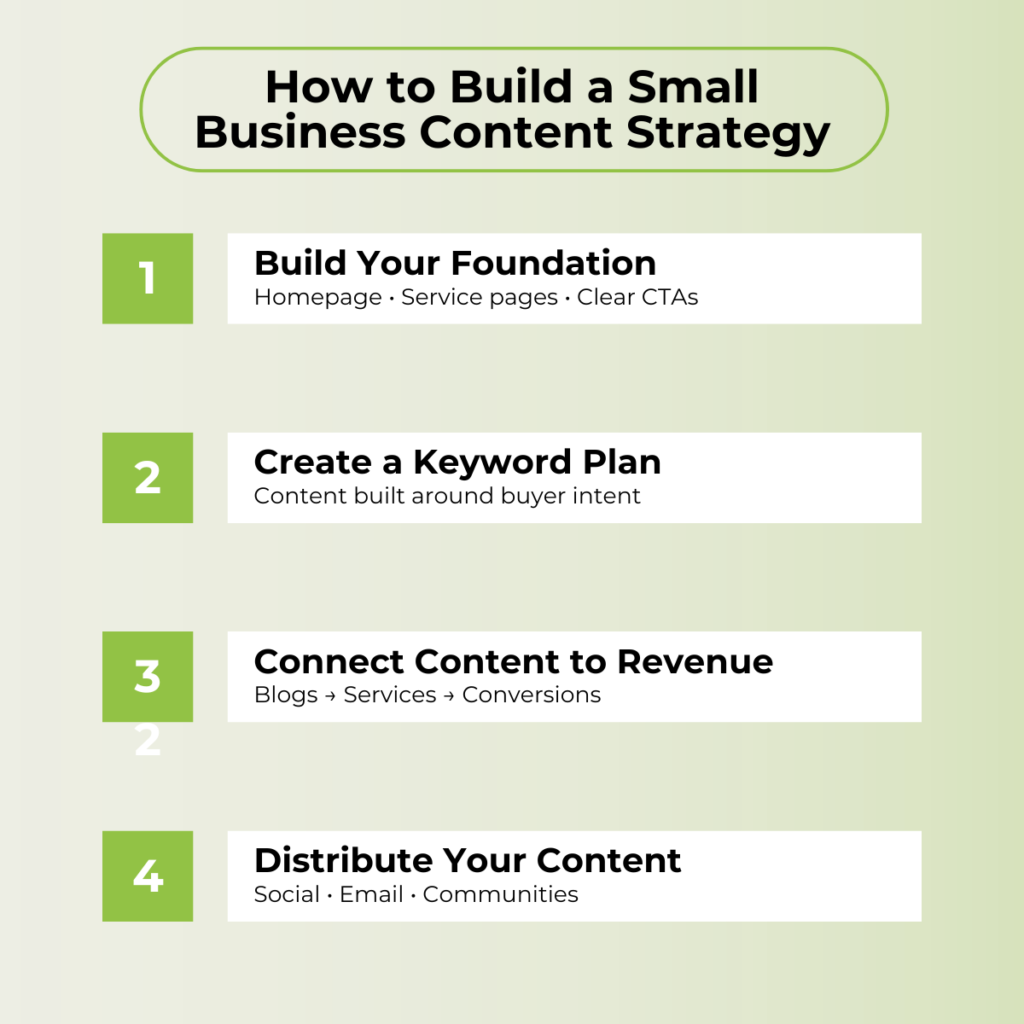
The difference between a business that gets results from content and one that doesn’t isn’t talent or budget. It’s having a system that connects content to revenue. Here’s how to build that system in four phases.
Create or Fix Your Core Website Pages
If you don’t have a website yet, or your current pages are thin and unclear, this is step one. Your core website content (homepage, service pages, about page) is the foundation for conversions. Without it, blog traffic has nowhere meaningful to land.
For businesses starting fresh:
- Build a homepage that clearly states what you do, who you serve, and why it matters
- Create one dedicated page per service or offer
- Write an about page that builds trust (credentials, process, proof)
- Include a clear conversion path on every page (contact form, booking link, phone number)
For businesses with existing pages:
- Audit each core page against three criteria: positioning (why you over competitors), proof (testimonials, results, specifics), and conversion path (clear next step)
- Rewrite pages that don’t sell. A page that just describes what you do without giving the visitor a reason to choose you is leaking leads.
- Fix navigation gaps. If a visitor can’t get from your homepage to your service page to your contact page in two clicks, there’s friction.
If these pages leak, all the blog traffic in the world won’t convert. Foundation first. Always.
Build a Keyword-Driven Content Calendar
Find the questions your buyers type into Google before they buy. You don’t need expensive tools.
- Google autocomplete shows real searches as you type
- People Also Ask boxes reveal related questions buyers have
- Reddit and Quora threads show how your audience describes their problems in their own words
- Competitor blogs reveal which topics already have search demand
Map topics to buyer stages:
- Awareness content answers early-stage questions (“What is content marketing for small businesses?“)
- Consideration content compares options (“content marketing vs paid ads for small business“)
- Decision content addresses objections and pushes toward action (“how much does content marketing cost”)
4-5 posts per month are enough when each one targets a real keyword and serves a clear intent. Quality beats quantity every single time.
Connect Every Piece of Content to a Business Outcome
A blog post without a next step is a dead end. Every piece of content needs to be connected to revenue.
- Internal linking ties every blog post to a relevant service page
- CTAs matched to intent (not generic “contact us” on everything)
- The conversion path is simple: organic search brings a visitor to your blog, the blog links to your service page, the service page converts
No dead-end content. Every post is a step in a journey that ends with an inquiry.
Content Distribution Is Part of the Strategy
Organic doesn’t mean “publish and hope Google notices.” Distribution makes your content work harder, especially in the first few months before SEO compounds.
- Share blog content across social channels (repurpose key points into native formats, don’t just link-drop)
- Email your list when new content publishes
- Answer related questions in communities and forums, link back where it genuinely helps
- Repurpose long-form posts into carousels, threads, or short-form video scripts
Distribution amplifies organic reach during the months before compounding kicks in. After that, Google does most of the heavy lifting.
How Content Marketing Strategy Differs for Local vs. Global Small Businesses
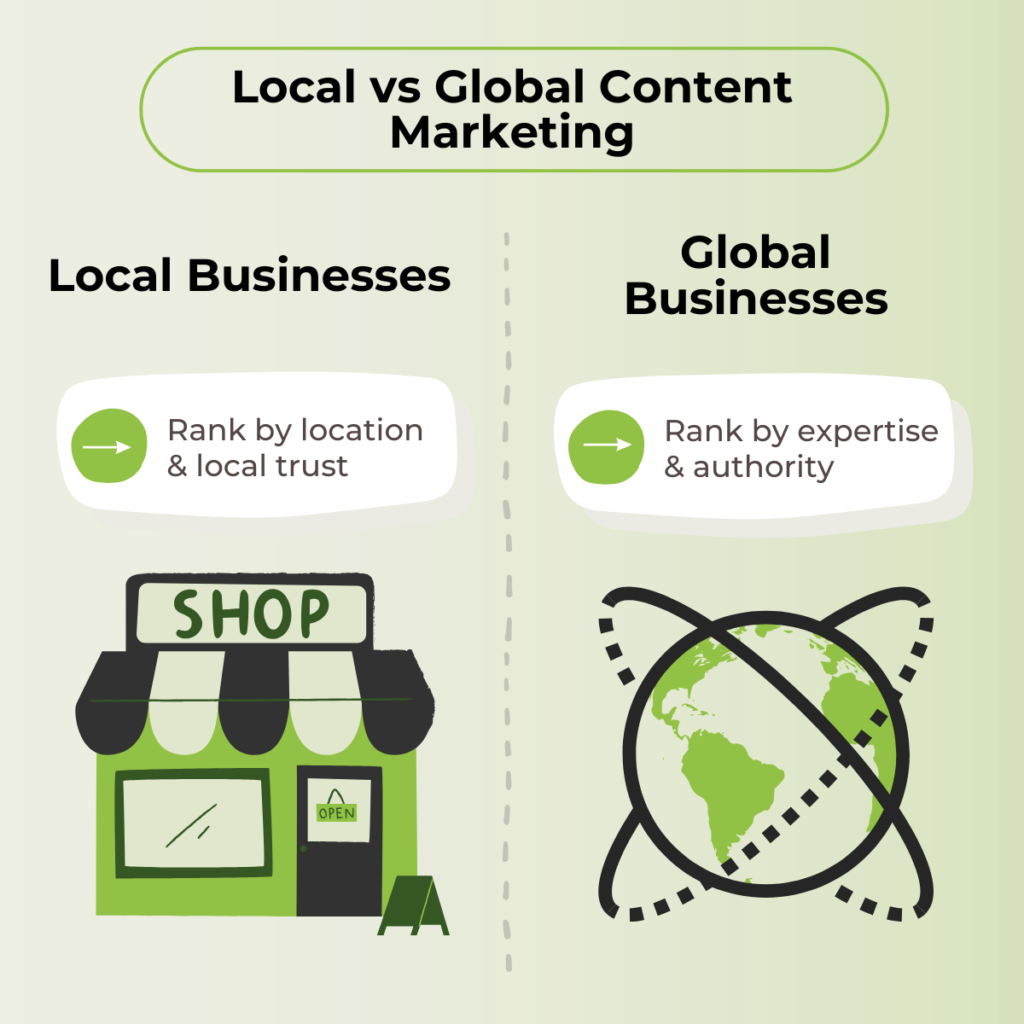
A local plumber and a remote brand consultant both benefit from content marketing, but their keyword strategies, content types, and distribution look nothing alike.
Local Businesses That Serve a Specific Geographic Area
If customers come to your physical location or you serve a defined area, your content strategy is geo-targeted.
Keyword Strategy
Geo-modified keywords are the foundation. “Emergency plumber in [city].” “Best accountant near [neighborhood].” “HVAC repair [zip code].” Every keyword includes a location qualifier that matches where your customers search from.
Content Channels and Tactics
- Google Business Profile becomes a content channel. Regular posts, photos, Q&A answers, and review responses all feed the local algorithm.
- Local landing pages multiply visibility. One optimized page per service-area combination. “Residential plumbing in [City A]” gets its own page, separate from “[City B].”
- Blog topics serve the local community. Seasonal maintenance guides, local event tie-ins, and area-specific problem-solving. Content that no national brand would bother writing, which is exactly why it works.
- Reviews and local citations act as trust signals that amplify everything else.
Global or Remote Service Businesses That Serve Clients Anywhere
If geography doesn’t limit your client base, your strategy shifts to topical authority.
Keyword Strategy
Industry or niche problem keywords without geographic modifiers. “Brand positioning for SaaS startups.” “Email marketing for e-commerce.” “Content strategy for B2B companies.” You compete on expertise, not proximity.
Content Channels and Tactics
- Thought leadership and expertise-driven blog content build authority. Frameworks, original takes, deep-dive guides.
- Case studies and results-based content do the selling. Prospective clients can’t visit your office. They judge you on published proof of competence.
- Topical authority strategy wins over time. Become the definitive resource in your niche. Cover every angle of your core topic so thoroughly that Google has no choice but to rank you.
- LinkedIn and professional communities serve as distribution layers for expertise content.
Example
A freelance brand strategist writing the definitive guide on “brand positioning for SaaS startups” targets a global audience of SaaS founders searching for that exact problem. If you run a SaaS content marketing operation, the keyword approach looks fundamentally different from local. Same principle for both models. Organic content generates leads. The execution is what changes entirely.
How Long Does Content Marketing for a Small Business Take to Produce Results
The average timeline is four to six months for first measurable results. But that number is meaningless without context because several factors push it shorter or longer.
Factors That Influence Your Results Timeline
These 6 main factors influence your content marketing results;
- Competition level in your niche or area. A local cleaning company in a mid-size city faces less competition than a SaaS company targeting “email marketing software.” Lower competition means faster rankings, often within three to four months.
- Consistency and publishing frequency. Two to four posts per month with no gaps compound faster than sporadic publishing. The businesses that publish five posts in January, then nothing until April, never see results because the compound effect requires momentum.
- Strategy quality and keyword targeting. Content targeting real buyer-intent keywords with sufficient search volume ranks faster than random-topic posts. Bad keyword choices waste months of effort.
- Website foundation strength. If your core pages already convert well, new blog traffic turns into leads faster. If your website leaks, traffic arrives but goes nowhere.
- Domain age and existing authority. A website that’s been live for three years with some existing content has a head start over a brand-new domain. But even new domains see traction within six months when the strategy is right.
- Backlink profile growth. Sites that earn natural backlinks through quality content build authority faster. This isn’t something you force. It happens when content is genuinely useful enough for others to reference.
Why Most Small Businesses Quit Content Marketing Too Early
They expect paid-ad speed from an organic strategy. Content marketing is a six-month investment that pays for years, not a six-day campaign that stops when the budget runs out.
The businesses that push through months three and four are the ones with a lead generation machine by month eight. The ones who quit have to start over again, every single time.
A Simple Content Marketing Framework for Small Businesses
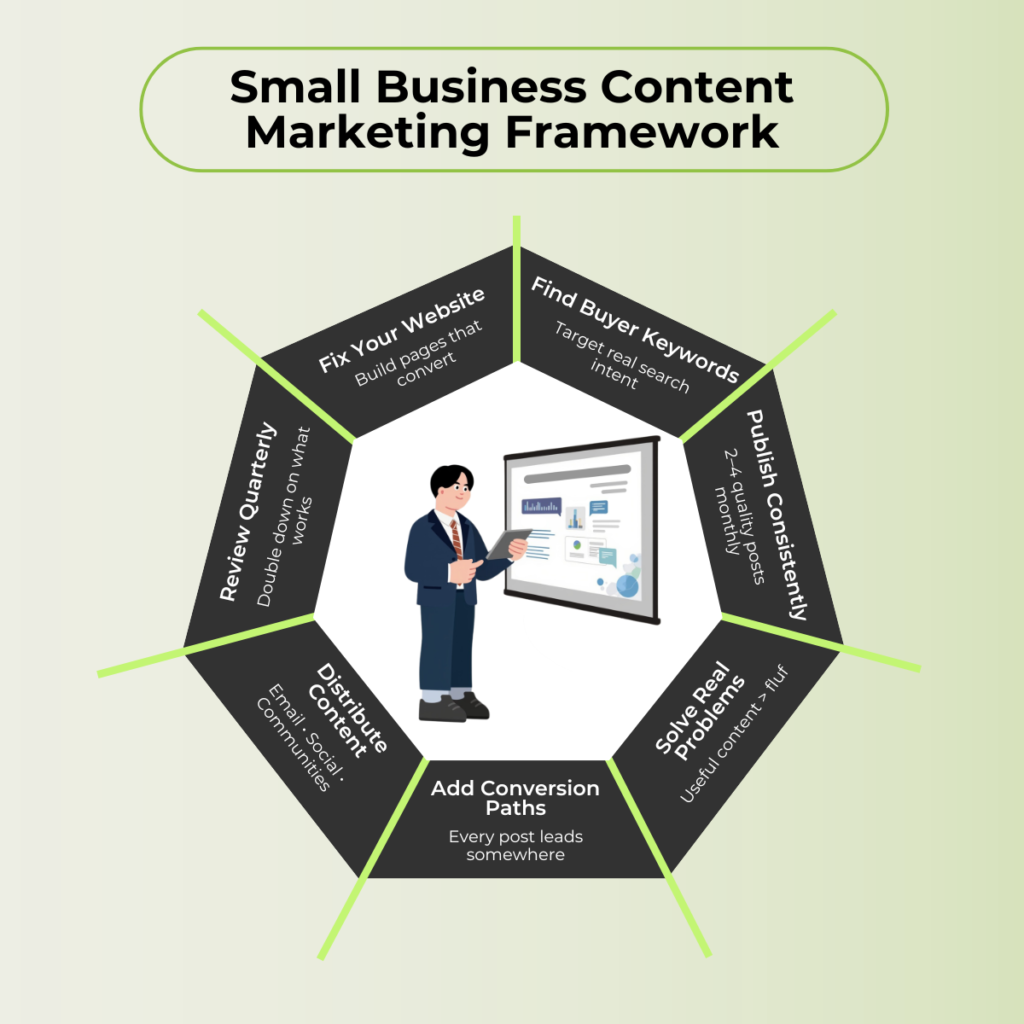
Here are the steps that you can follow to build a solid content marketing framework for your small business.
Step 1. Build or fix your website content.
If you don’t have core pages yet, create them (homepage, service pages, about pages with clear positioning and conversion paths). If you already have pages, audit them. Do they sell? Do they convert? Fix leaks before driving traffic.
Step 2. Identify 20 to 30 buyer-intent keywords.
What does your ideal customer type into Google before they buy? Build your content calendar around those questions.
Step 3. Set a sustainable publishing cadence.
Two posts per month minimum. Four if you have the capacity. Never zero.
Step 4. Write content that solves real problems. Not company news. Not fluff. Real answers to real questions your buyers are asking.
Step 5. Link every post to a conversion path.
Internal link to a service page plus a clear CTA. No dead-end content.
Step 6. Distribute across owned channels.
Distribute your website content around email lists, social profiles, and relevant communities. It gives a backup to every post. Do not blindly throw the content everywhere, tweak it and refine it for every platform.
Step 7. Review and adjust quarterly.
What’s the ranking? What’s converting? Double down on what works and cut what doesn’t.
If you are consistent enough to implement these 7 steps, you’ll get results in 3-4 months.
The Best Content Marketing Channels for Small Businesses by Business Type
Not every business should invest in the same channels. This table maps business types to their highest-ROI content focus.
| Business Type | Primary Content Channels | Content Focus |
| Local service business (plumber, HVAC, electrician) | Local SEO + Google Business Profile + blogs | Geo-targeted service pages, seasonal tips, emergency guides |
| Local retail or brick-and-mortar | Local SEO + social content + GBP | Product highlights, local events, in-store experience |
| Restaurant or food service | GBP + social + local blog | Menu updates, behind-the-scenes, local food guides |
| Real estate agent or agency | Local SEO + blogs + email | Neighborhood guides, market reports, buyer and seller education |
| Legal firm (local) | Local SEO + blogs + website content | Practice area guides, FAQ content, case result summaries |
| Accounting or financial services | SEO blogs + website content + email | Tax guides, financial planning content, deadline reminders |
| Healthcare, dental, or wellness | Local SEO + GBP + blogs | Condition guides, treatment explainers, patient education |
| SaaS or software company | SEO blogs + website content + email sequences | Product-led content, comparison posts, integration guides |
| E-commerce (niche products) | SEO blogs + product content + email | Buying guides, product comparisons, use-case content |
| Freelance consultant or coach | SEO blogs + LinkedIn + case studies | Thought leadership, framework posts, results-driven content |
| Digital agency or marketing firm | SEO blogs + case studies + website content | Process explainers, industry guides, results showcases |
| Online education or course creator | SEO blogs + email + social content | Free educational content, lead magnets, and student success stories |
| B2B professional services | SEO blogs + email + LinkedIn | Industry analysis, how-to guides, vendor evaluation content |
| Home services (cleaning, landscaping) | Local SEO + GBP + blogs | Seasonal guides, maintenance tips, before-after showcases |
| Fitness or personal training | Local SEO + social + blogs | Workout guides, nutrition content, transformation stories |
| Wedding or event services | Local SEO + social + blogs + portfolio | Planning guides, vendor roundups, real event showcases |
Find your business type. Start with the primary channels listed. Expand only after those are working.
Stupid Mistakes Small Businesses Make in Content Marketing
I’ve seen small business owners making these mistakes often. Each one wastes months or thousands of dollars. Are you on the list? See yourself;
Writing for Yourself Instead of Your Buyer
Many businesses are publishing company news, team updates, office renovation announcements, etc. The buyers do not care about this stuff. They care about their problems. Every piece of content must answer one question. “What does my buyer need to know, decide, or do?“
Ignoring SEO Entirely
Publishing blogs without keyword research is writing a letter and never mailing it. If Google can’t find your content, neither can your buyers. Every post needs a keyword target, even if you do the research yourself in five minutes using Google autocomplete.
Starting With Social Media Instead of Website Content
Social posts disappear in hours. Blog posts rank for years. If your website doesn’t convert, sending social traffic to it is pouring water into a leaking bucket. Fix the foundation first. Amplify second.
Being Inconsistent and Expecting Results
Five posts in January. Zero in February through April. Then wondering why content marketing “doesn’t work.” The compound effect requires consistency. Two posts per month, every month, no gaps. That’s the minimum.
Chasing Word Count Instead of Value
A 500-word post that answers the reader’s question directly beats a 2,000-word post that says nothing useful. Never write to fill space. Write to deliver exactly what the reader needs.
No Conversion Path From Content to Inquiry
Blog posts with no internal links, no CTA, no next step. You generate traffic that has nowhere to go. Every post must connect to a service page or a clear action.
Trying to Be on Every Platform at Once
One channel done well beats five done poorly. Start with organic search content. Master it. Expand when it’s working and you have the bandwidth.
Copying Competitors Instead of Understanding Your Buyer
What works for them might not work for you. Their audience, positioning, and strengths are different. Research your own buyers. Find your own angle. Build content that only your business could write.
You Might Have These Questions About Small Business Content Marketing
If you do it yourself, the cost is your time. With a content marketing partner, expect $1,500 to $5,000 per month, depending on scope and volume. The better question is this. What’s the cost of not doing it for another 12 months while competitors build their organic presence?
Yes, especially at the start. Many small business owners write their first 10 to 20 posts themselves. But there’s a ceiling. When your time is worth more than the cost of hiring a copywriter for your small business, it makes financial sense to bring in support.
Blogging is one tactic inside a larger system. Content marketing is the strategy that connects website content, SEO content, distribution, and conversion into a single engine. A blog without a strategy is just a blog. Content marketing without a blog is still a system.
Absolutely. Lower competition plus higher conversion intent equals faster results. Local content marketing often produces leads within three to four months because fewer competitors are doing it well in most local markets.
If you need leads tomorrow, use paid ads. If you want leads every month for years without increasing spend, use content marketing. The best approach for most small businesses is to use paid to survive while organic compounds in the background.
Build the Content System Once and Let Compound Growth Do the Rest
Every month you wait is a month your competitors build organic authority you’ll have to outwork later. The businesses investing in organic content marketing now are the ones that stop worrying about lead generation costs in 18 months.
Paid ads stop the moment you stop paying. Organic content keeps bringing qualified visitors, whether you spend another dollar or not. Every post you publish is a lead-generation asset that works around the clock and compounds on itself.
The system isn’t complicated. Build your website foundation. Target buyer-intent keywords. Publish consistently. Connect everything to a conversion path. Let compound growth handle the rest.
Book a call if you want a content marketing system built for your specific business
