
Every Nick & Joe in B2B knows they need a solid content strategy to grow their business organically in the long run. They also know that SEO/AI-search is THE best channel. But almost every day, when I’m auditing a B2B site for a client or a prospect, every time I feel like no one gave a damn thought about WHY they’re publishing and WHAT needs to be published.
And then some of them come to me complaining that SEO + content are dead. Nothing works now. But in reality, the strategy is shit.
This blog post is about the WHY and WHAT of B2B content strategy. In the end, you’ll walk away with what a real B2B content strategy looks like in deliverable terms, what a strategist actually hands you, and how to tell real strategy from a dressed-up blog schedule.
What Usually Goes Wrong With B2B Content Strategy
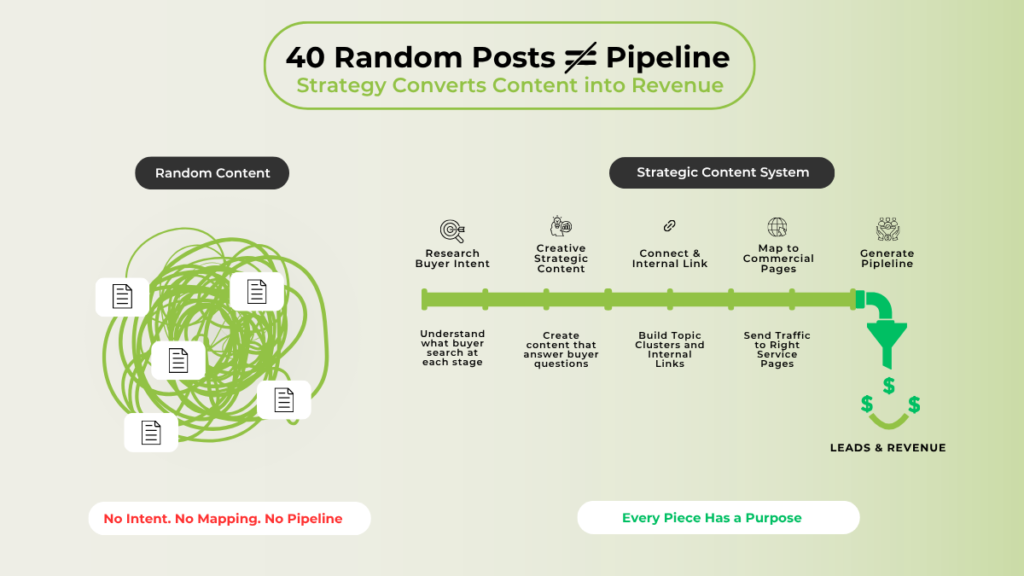
Short answer: Publishing random content without any strategy & end goals in place.
Long answer: B2B folks are mostly busy with business operations. They don’t have time, nor do they have the expertise, to devise a B2B content strategy that supports their business growth objectives.
What mostly happens is that someone in the company says, “We need to do SEO content.”
A marketer picks topics from gut instinct, executive requests, or whatever a competitor posted last month. No one researches what buyers actually search for at each stage of their decision. No one maps topics to commercial pages. No one plans how post #5 will support post #12. They just publish, randomly, and hope that volume eventually produces leads.
It doesn’t. And it can’t. Because you can’t scale randomness into a pipeline.
The Random B2B Content Strategy Costs More Than Doing Nothing
Random publishing burns loads of your budget and also builds the wrong foundation. You end up with 30 or 40 posts that don’t rank for buyer-intent keywords, don’t link to each other, and don’t connect to the service pages that actually convert visitors. Every post sits in isolation.
You also face a scaling problem. You can’t build on top of a broken foundation without tearing it down first. The content and SEO audit become larger, and the cleanup becomes a neck pain. The competitor who started six months after you now outranks you because their 15 posts work as a system, while your 40 posts do not.
Why This Strategy Randomness Keeps Happening in B2B
The Content Marketing Institute found that only 22% of B2B marketers rate their content strategy as extremely or very successful. 42% say a lack of clear goals is the primary barrier.
That 42% tells you everything. The failure point isn’t writing quality. It’s not publishing frequency. It’s that nobody defined what “success” means for each piece of content before it was created. No intent mapping. No scaling plan. Just production for production’s sake.
The only fix is a strategist who builds the system that makes content work toward revenue.
What A B2B Content Strategy Includes That A Content Strategist Must Deliver
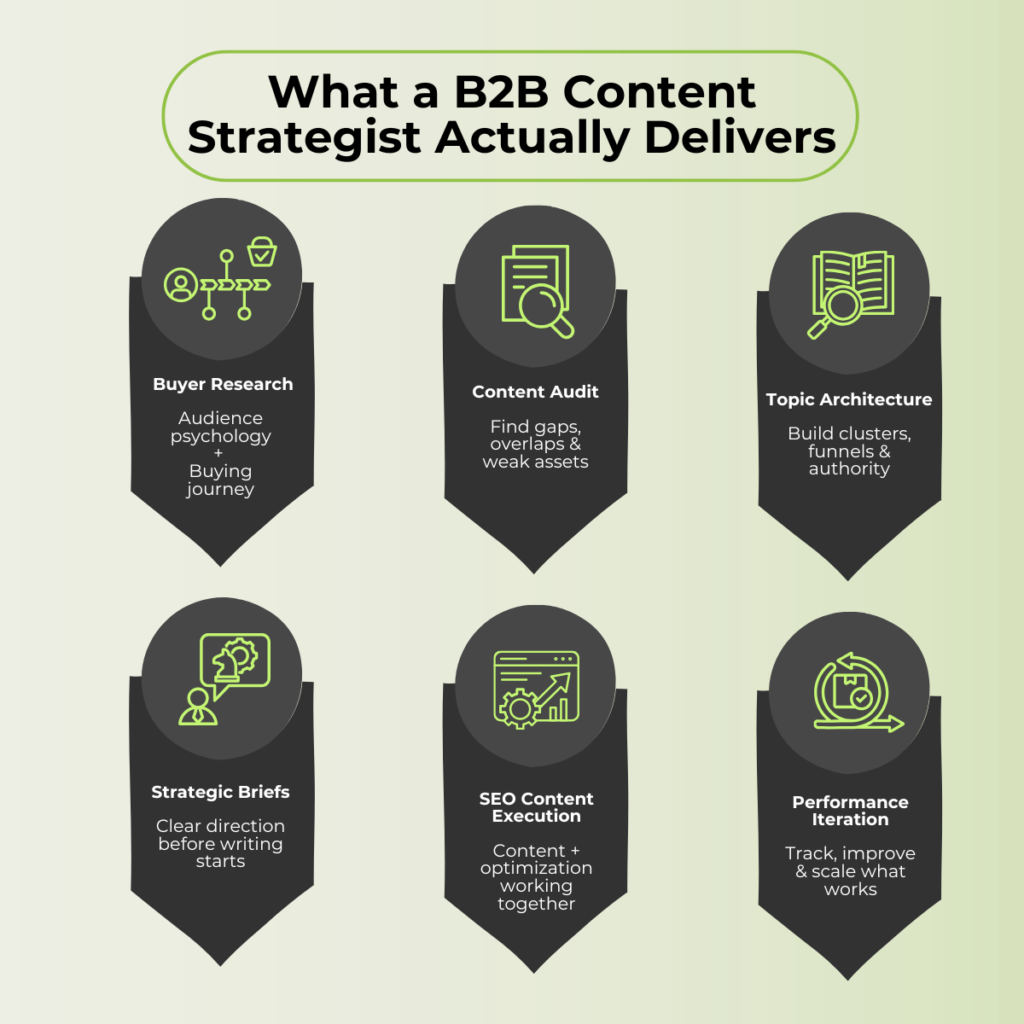
Audience and Buyer Journey Research
A strategist maps the actual questions your buyers ask at each decision stage and builds the content plan around those questions. And no, buyer persona does not only mean demographics and age, etc.
The research covers:
- Who your buyers are by role, seniority, and decision-making authority within their organization
- What they’re afraid of getting wrong if they choose the wrong vendor or solution
- What hesitations stop them from moving forward, even when they know they need help
- What risks they perceive in spending budget on content or SEO (and how your content can address those risks before the sales call)
- What specific questions do they type into Google at each stage of their buying decision
- What language do they use to describe their problem (not your internal jargon, their actual words)
- Where they go for validation before making a decision (peers, communities, review sites, case studies)
Content Audit and Gap Analysis
Before building anything new, a strategist reviews what the company already has. What’s performing and what’s a dead weight. Where the gaps are relative to competitors and search demand.
This is where a strategist finds the 15 blog posts to consolidate into 5. The service pages have no supporting content beneath them. The keywords competitors rank for that your company hasn’t touched. The audit is the foundation. Without it, new content risks duplicating what already exists or filling gaps that don’t matter.
Keyword Strategy and Topic Architecture
A strategist will never hand you a keyword list; instead, you’ll get a map that shows how every piece of content supports another and drives traffic toward commercial pages. The difference between picking keywords and building a topic architecture is the difference between 30 disconnected posts and 30 posts that compound each other’s authority. Here’s what that map includes:
- Keywords grouped into clusters based on commercial intent, not just search volume
- Each cluster mapped to a specific service page or conversion endpoint on your site.
- Topic sequencing that shows which posts to publish first to build topical authority fastest.
- Internal linking architecture planned before a single post is written, so every new piece strengthens existing pages.
- Funnel-stage assignment for every topic (TOFU for awareness, MOFU for evaluation, BOFU for decision).
- Gap identification showing which keywords your competitors rank for that you haven’t touched.
- A scaling plan that defines how the architecture grows from 10 posts to 50 without breaking the structure.
This is where content strategy meets content marketing at the structural level. The keyword architecture is not a separate discipline from the content itself. It’s the blueprint that shapes every piece of content writing that follows.
Editorial Planning and Content Briefs
What goes into a brief that actually produces quality content versus a brief that’s just a keyword and a word count?
A strategist’s brief includes search intent analysis, competitor positioning, the content angle, heading structure, internal linking targets, and specific guidance on what to cover that ranking pages don’t. The brief is the control mechanism. When the brief is strong, the writer can execute with confidence because every strategic decision has already been made upstream.
Content Production and SEO Execution
This is where strategy becomes published content. Your content strategist supervises your writers and oversees quality. Every piece will bear the strategist’s fingerprints because the brief shapes the output.
Here’s how the content production under a strategist’s supervision looks like:
- Every post is written against a detailed brief with search intent, target keyword, content angle, and specific competitor gaps to exploit
- On-page SEO is handled during writing, not bolted on afterward (title tags, meta descriptions, heading hierarchy, keyword placement)
- Internal links are placed with intent, connecting each new post to existing pages based on the topic architecture, not randomly
- Content formatting follows readability best practices (short paragraphs, scannable headings, strategic use of bullets and tables where they serve the reader)
- Quality control happens at the brief level, not the editing level, so rewrites are rare because the strategic decisions were made upstream
- Every published piece serves a defined role in the system, whether that’s ranking for a specific keyword, supporting a cluster, or answering a buyer objection
Performance Tracking and Iteration
A good strategist keeps a close eye on the rankings, organic traffic by intent type, lead quality from content pages, and pipeline influence. Based on the findings, they iterate their strategy and double down on what’s working.
A strategist who only reports on sessions and bounce rate is measuring effort, not outcomes. The iteration is where the real value compounds. Month over month, the strategist adjusts topic priorities, doubles down on what’s gaining traction, and cuts what isn’t performing.
How to Tell if Your Content Strategy Is Built for Revenue or It’s Just A Noise In The Void
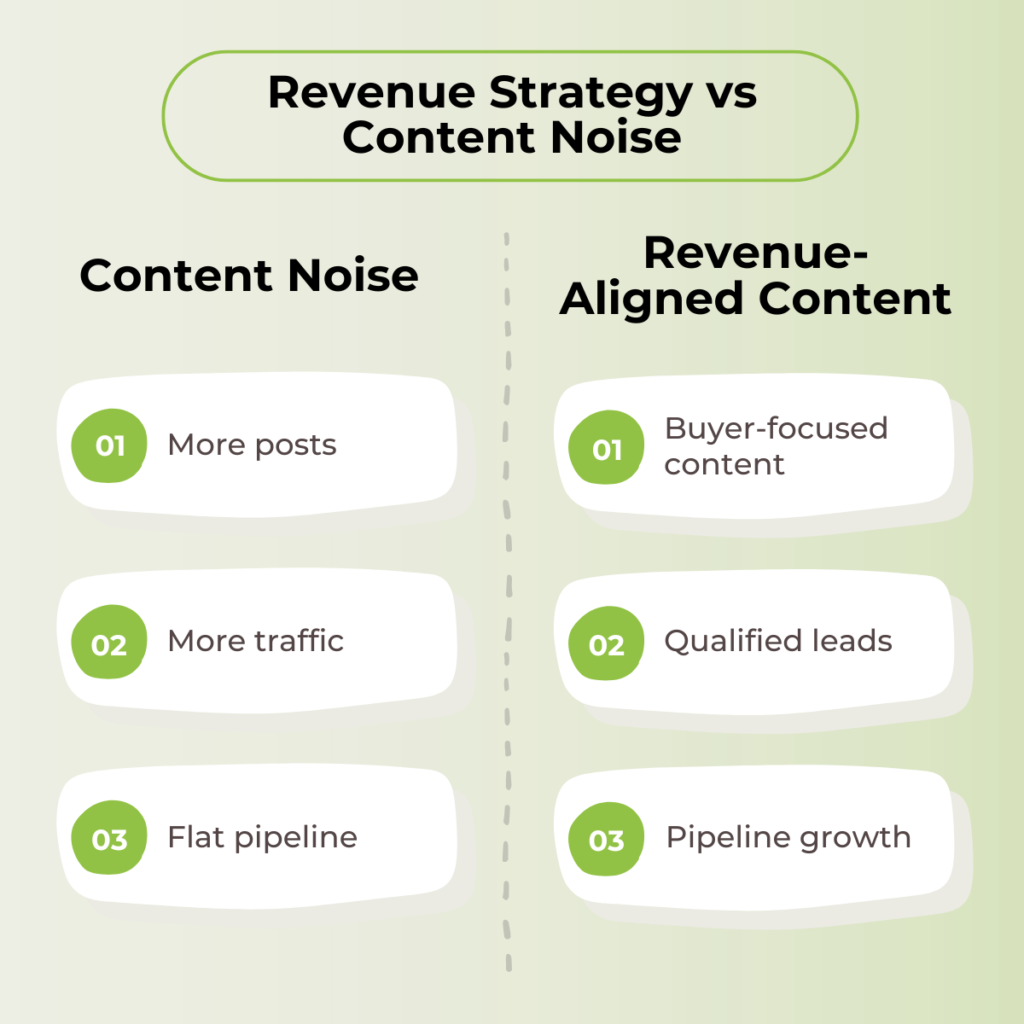
There are two fundamentally different approaches to B2B content strategy, and they produce fundamentally different results.
- A volume-based approach measures success by the number of articles published, the keywords targeted, and traffic growth. It looks productive. Dashboards go up. Reports look good. But the pipeline stays flat.
- A revenue-aligned approach measures success by which content pieces influence the pipeline, which pages generate qualified leads, and whether organic traffic from content converts at a higher rate than paid.
Signals of a Revenue-Aligned Strategy
You need a revenue-aligned strategy that maps content to specific buyer objections and decision-stage questions.
BOFU and MOFU content are prioritized alongside TOFU (not treated as afterthoughts). Internal linking deliberately guides readers from educational content to commercial pages. Conversion data is tracked at the page level, not just at the domain level.
Here’s the number that matters. The average B2B buyer consumes 13 pieces of content before making a purchase decision.
[Source: Cunningham Web Solutions]
The question isn’t whether your company publishes enough. It’s whether your 13 pieces are the ones they’re reading, and whether those pieces move them closer to choosing you.
When B2B Companies Need a Content Strategist
You need a content strategist, whether you have 60 published posts that are not generating results or a blank slate with no posts. But here are some further signs that scream you need a content strategist now;
Signs You Need a B2B Content Strategist Now
- Your sales team answers the same 8 to 10 buyer questions repeatedly on calls, and none of those questions are addressed anywhere on your website. That’s content that should exist and doesn’t.
- You’ve been publishing consistently for 6+ months, but organic traffic from those posts isn’t generating qualified inquiries. The content exists, but it’s not connected to buyer intent.
- Your competitors rank on page one for the exact terms your buyers search before making a purchase decision. You don’t. Every day that continues, you’re losing pipeline to companies whose content answers the question first.
- You’re starting content from scratch and don’t know which topics to prioritize, how to structure them, or how to make sure your first 10 posts build toward something instead of sitting in isolation.
- Your team has writers but no one with SEO expertise, keyword research skills, or the strategic thinking to connect content to funnel stages. You have the execution capacity, but not the direction.
- You’ve invested in paid ads and want organic content to reduce your reliance on paid spend over time, but you have no roadmap for how content can take over that demand-generation role.
- Internal stakeholders keep requesting content based on gut feeling (“we should write about X“), and there’s no research-backed framework to prioritize or push back.
If three or more apply, the gap isn’t execution. It’s architecture.
Signs You Might Not Need a B2B Content Strategist Yet
- Your product-market fit isn’t clear yet. If you’re still figuring out who you sell to and what problem you solve, a content strategy built now will be built on unstable ground.
- You haven’t defined your ICP beyond “mid-market companies.” A strategist needs specifics (industry, company size, buyer role, decision triggers) to build anything useful.
- You don’t have internal bandwidth to participate. A strategist needs access to sales conversations, customer objections, product knowledge, and competitive context. If nobody in the company can provide that input, the strategy will be built on assumptions.
Should You Hire a Strategist Or a Full-stack Agency
Most mid-market B2B companies (20 to 200 employees) need a strategist who can build the system first. A full agency for content production makes sense once the strategy is in place and proven.
Hiring a content agency before hiring a strategist is how companies end up with 40 blog posts and no results. The strategist builds the blueprint. The agency (or in-house team) executes it. Reversing that order is the most expensive mistake in B2B content.
The best option is to find a content strategist who can later bring in their own writers and content managers.
Red Flags in a B2B Content Strategy Proposal
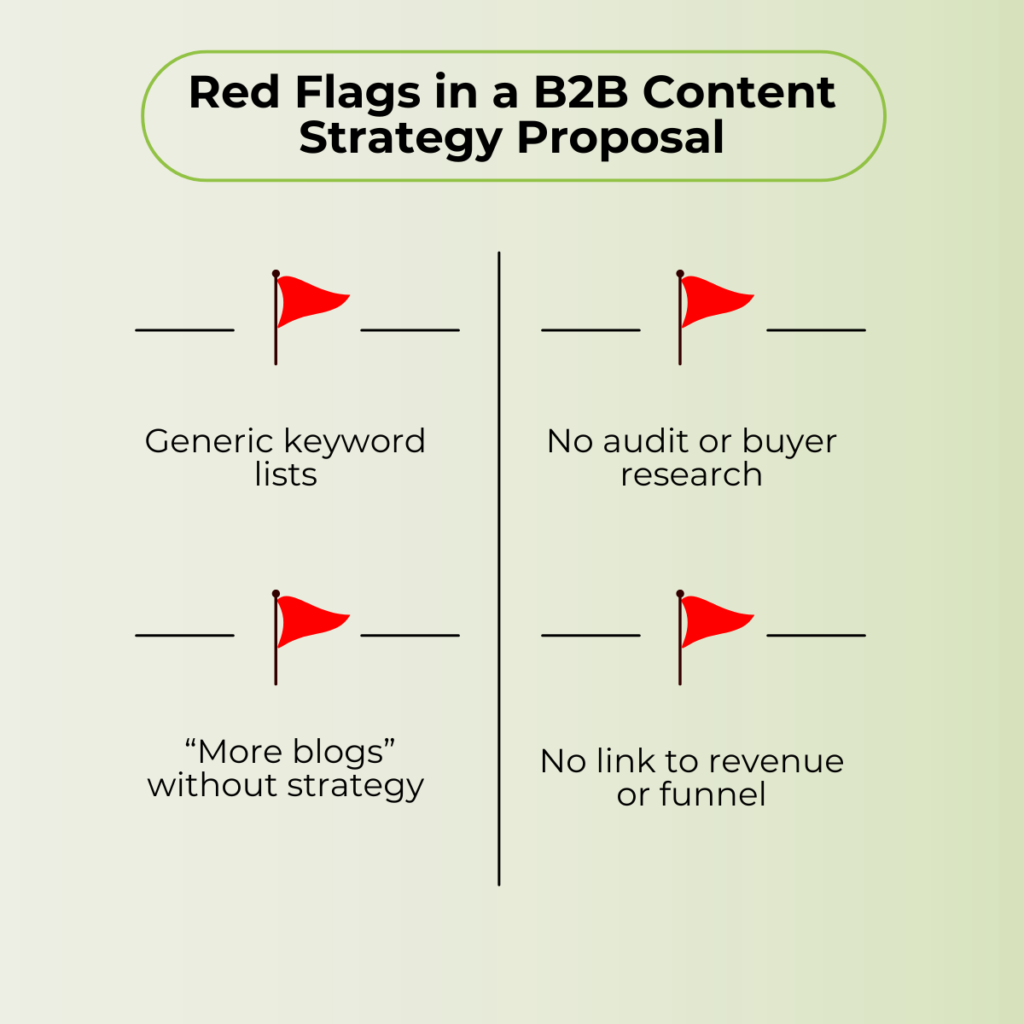
When you’re evaluating strategists, the proposal tells you everything you need to know. Here’s what separates a real strategy proposal from a dressed-up content calendar.
Watch for these red flags:
- No mention of your specific industry or audience anywhere in the proposal
- Generic keyword lists with no topic architecture or clustering logic
- No content audit step (they’re proposing new content without knowing what you already have)
- Deliverables described only in volume terms (“8 blogs per month” with no strategic rationale for why those 8 topics)
- No performance benchmarks or success criteria defined
- No explanation of how the content connects to your service pages or sales funnel
- The proposal reads like a template with your company name swapped in
A strong proposal starts with your business goals and works backward to content. A weak proposal starts with content volume and hopes the business impact follows.
How Long Does It Take to Get Results From a B2B Content Strategy
The usual timeframe is 3 to 6 months before meaningful traction shows up in rankings, traffic, and early pipeline signals. But “3 to 6 months” is a range, not a guarantee. Several factors push you toward the shorter or longer end.
Factors That Speed Up Results
Your website already has domain authority from backlinks and age. You have existing content that can be optimized and interlinked (instead of starting from zero).
Your industry has moderate keyword competition rather than extreme. And you can commit to a consistent publishing velocity once the strategy is built (a minimum of 2 to 4 quality posts per month).
Companies with an established site and 20+ existing posts often see keyword movement within 8 to 12 weeks of strategic optimization, because the foundation already exists. The strategist reorganizes and strengthens it rather than building from scratch.
Factors That Slow Down Results
Your domain is new or has minimal authority. You’re in a highly competitive niche where top-ranking pages have thousands of backlinks. Your internal team can’t provide input fast enough for the strategist to build accurate briefs. Or you can only publish one post per month, which limits how quickly the topic architecture takes shape.
Companies starting from zero should expect 4 to 6 months before meaningful keyword movement and 6 to 9 months before content starts contributing to the pipeline. That’s not slow. That’s how organic compounding works.
Why B2B Companies Quit Content Too Early
Sometimes a content strategy fails even if the company hires a content strategist. But that does not mean that content does not work.
Content strategy compounds. Post #15 performs better than post #5 because it benefits from the internal linking, topical authority, and domain signals that the first 14 posts built. Abandoning at month two means you paid for the foundation but did not build the house on it.
Instead of asking “When will we see ROI?“, ask “What leading indicators tell us the system is working before the pipeline shows up?” Those indicators include keyword movement from page 5 to page 2, growth in indexed pages, increasing impressions in Search Console, and improving click-through rates on SERP listings.
You Might Have These Questions About B2B Content Strategy Services
Ranges widely depending on scope. Strategy-only engagements (audit, strategy document, keyword architecture) can run $1K to $3K as a one-time project. Ongoing strategy plus production typically runs $3K to $5K+ per month, depending on volume and depth. The real cost driver is depth of research and strategic planning, not word count.
You can, if you have someone with SEO expertise, strategic thinking, content production capacity, and the analytical discipline to iterate monthly. Most B2B teams have one or two of those capabilities, not all four. A strategist fills the gaps without requiring a full-time hire.
A strategist decides what to create, why, for whom, and how each piece connects to business goals. A writer executes. The best results happen when the strategist and writer work within the same system, because content writing is the execution layer of content marketing, not a separate discipline.
Organic traffic growth for commercial-intent terms. Keyword rankings for MOFU and BOFU queries. Lead quality from content pages. Pipeline influence. And time-to-close reduction. Not just pageviews or total sessions.
Industry understanding (or a documented process for getting up to speed fast). A clear methodology they can walk you through. Willingness to show past results with context, not just screenshots. And a proposal that focuses on your business goals before content volume.
Solid Strategy = Long-term Organic Growth
A B2B content strategy is a sales asset that works around the clock, takes no days off, doesn’t require a commission structure, and never gets tired of answering the same buyer questions.
Every page that ranks for a commercial-intent keyword is a sales conversation you didn’t have to schedule. Every piece of content that answers a buyer’s objection before they hit your pipeline is one less barrier between them and a signed contract.Book a call with Saiqic to discuss what that looks like for your company. Bonus: If you come after reading this blog, you’ll get a free site audit.
