
SaaS content marketing without a strategy is a waste of time and money. You can publish every week, rank for dozens of keywords, and watch traffic rise on tools. But if the content doesn’t match how your buyers or customers search, evaluate, and decide, forget the signups & conversions.
I’ve seen that really good SaaS companies that have been publishing content on their website for months, not getting any traction organically from their content, even if they have traffic in thousands.
And I have also seen relatively new SaaS websites with no more than 100 visitors a month getting decent sign-ups.
Here’s what a real SaaS content marketing operation includes and what to demand from any partner doing it.
How SaaS Content Marketing Strategy Is Different Than Any Other Content Marketing Strategy
Generic content marketing approaches do not apply to SaaS content marketing. Here’s what sets it apart:
- SaaS buyers loop through comparison posts, documentation, reviews, and product pages multiple times before requesting a demo. Content has to serve every stage of that loop.
- Multiple decision-makers evaluate the same product for different reasons. The CTO cares about integrations, the CFO about ROI, and the end user about workflow.
- Retention matters as much as acquisition. MRR depends on keeping customers, so content has to serve onboarding and expansion alongside new signups.
- Buyer-intent keywords outperform high-volume keywords dramatically. “Best project management tool for remote engineering teams” converts at a far higher rate than “what is project management.”
- SaaS CAC has risen by roughly 60% over the past 5 years. Content marketing is the organic counter-play, but only when the strategy is solid enough.
- The product is invisible until someone logs in. Content does the explaining and convincing that a demo alone can’t do at scale.
- Technical depth is non-negotiable. SaaS buyers spot shallow content immediately.
These differences shape everything from keyword strategy to the type of writer you need.
What Should Be Included in an Organic SaaS Content Marketing Strategy
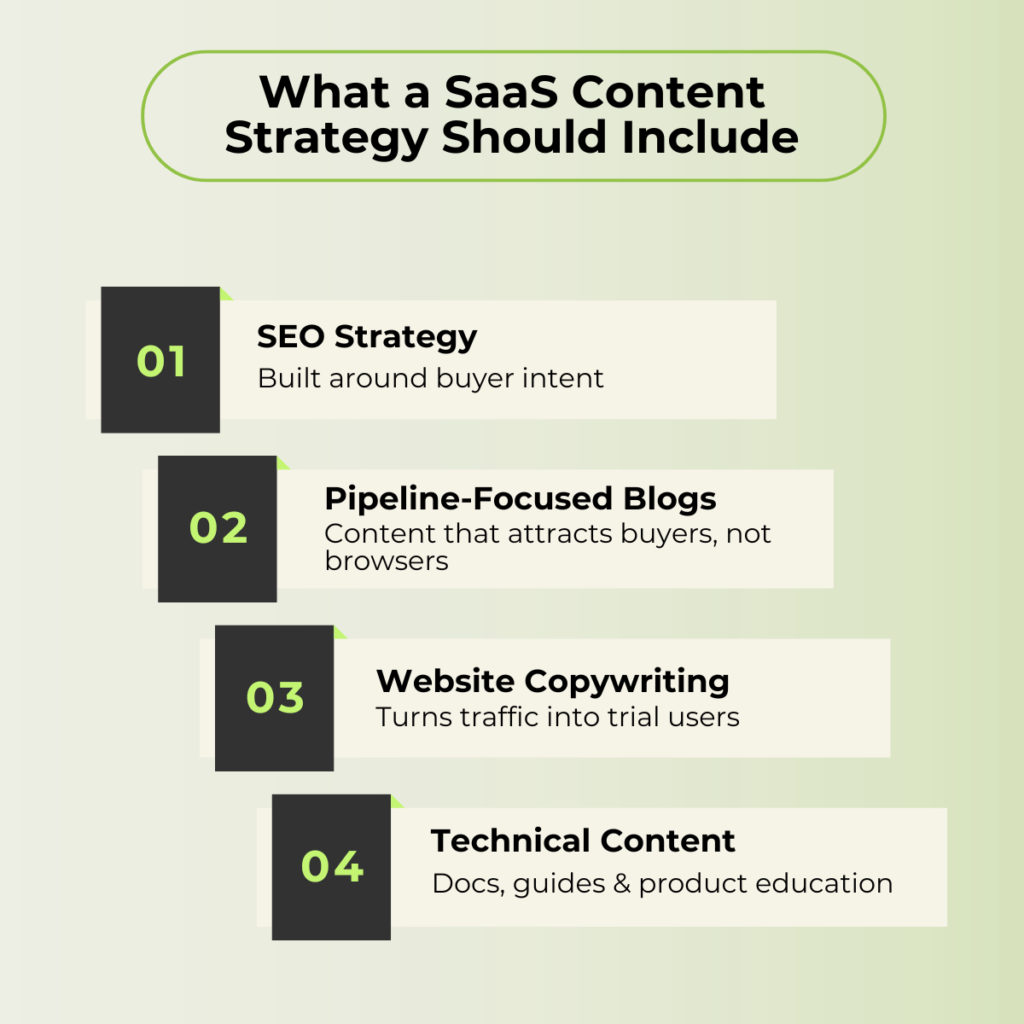
Most SaaS companies evaluating content marketing partners don’t know what the full scope of work should look like. Here’s what a SaaS content marketing strategy includes;
SEO Content Strategy Built Around Buyer Intent
The foundation of any SaaS content operation is keyword strategy, but the approach differs from generic content marketing. The focus goes to commercial and bottom-of-funnel terms first:
- Keywords like “best [category] software for [use case]” or “[competitor] alternative for [industry]” carry purchase intent
- Informational keywords support topical authority, but are scheduled around the commercial terms
- Competitor gap analysis identifies where competitors rank but fail to convert because their content is shallow
- Every topic is mapped to the SaaS buyer journey with a defined role (attract, educate, compare, convert, or retain)
The output is a content roadmap that compounds over time, where each new piece strengthens the architecture rather than sitting in isolation.
Blog Content That Earns Pipeline
SaaS blogs fail when they attract researchers instead of buyers. Publishing 30 “what is” posts builds traffic, but none of those visitors are evaluating software. They came for information, got it, and left.
The content types that move pipeline are different.
- BOFU comparison posts (“X vs. Y for [use case]”), alternative pages, and use-case content that shows the product solving a real problem.
- Product-led content where the software appears naturally as the solution, not as a forced pitch. The writer producing these posts needs to understand the product deeply enough to demonstrate it within the content.
Website Copywriting That Converts Visitors Into Trial Users
Blog content drives organic traffic. Website copy converts it. Homepage messaging, features pages, pricing pages, and landing pages carry the sale once a visitor arrives. So the web content is the essential part of organic content marketing. One brings them in, the other closes the gap between interest and action.
Most content agencies blur this distinction. They offer “content marketing” but only deliver blog posts. A full SaaS content marketing operation treats blog writing and website copywriting as two execution layers under the same umbrella. Because that’s what they are.
Technical Content and Product-Led Resources
SaaS buyers read documentation before they book a demo. They evaluate integration guides before they evaluate pricing. They check your knowledge base before they check your blog.
Technical content (API documentation, integration guides, implementation walkthroughs, knowledge base articles) serves the buyer at the evaluation and decision stage.
That’s where you need high-quality tech and software content writing. The writers producing this content need to understand what the software does, how it integrates, and the technical problems it solves. Companies that treat technical content as an afterthought lose deals to competitors whose documentation answers the technical buyer’s questions first.
What SaaS Companies Should Expect from a Content Marketing Strategist
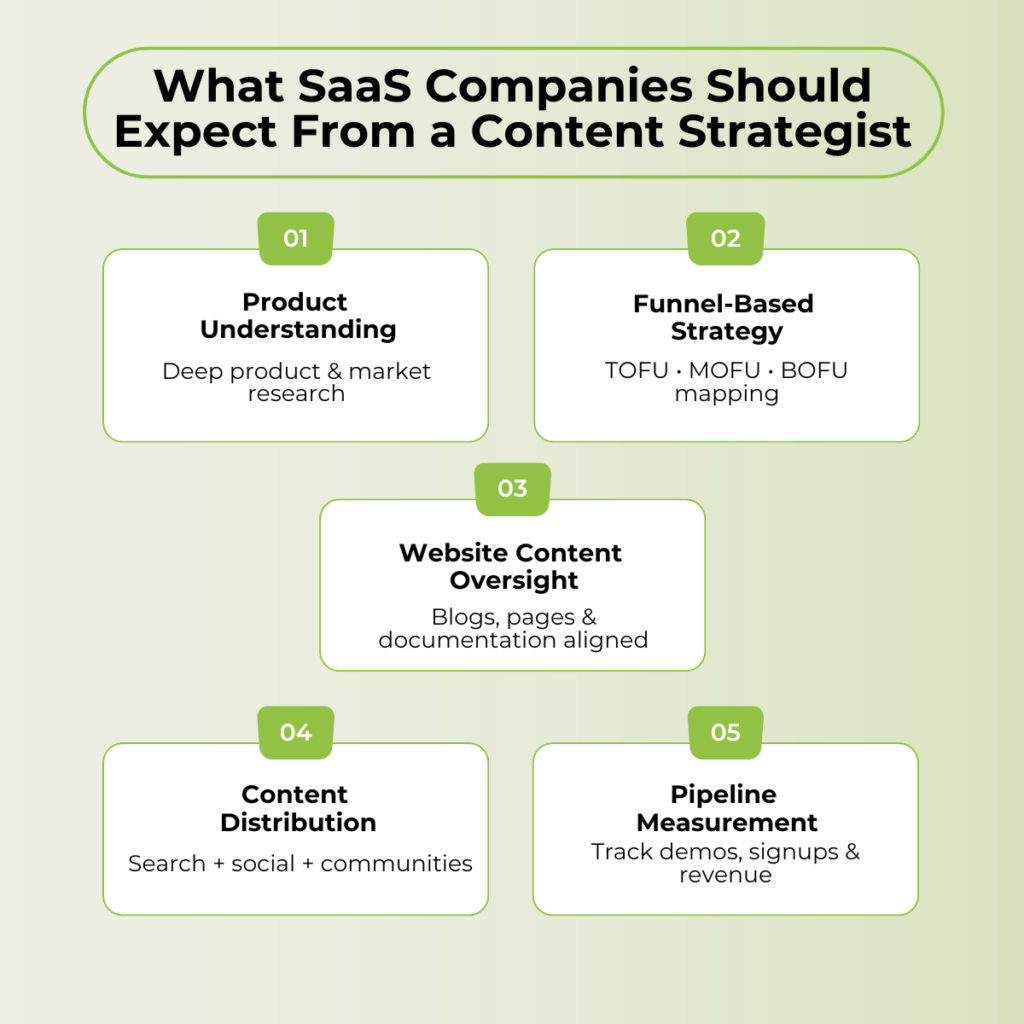
When you finally have the budget and are ready to put efforts into organic content marketing, here is what you should expect from your content strategist;
Product Understanding That Goes Beyond the Features Page
The content strategist/marketer must understand (OR be willing to understand) your SaaS product. Because I have seen on SaaS websites that the content sounds so generic that it could be for any SaaS site.
An efficient content marketer spends two to four weeks learning the product before strategizing any single content piece. They request product walkthroughs, dig into customer calls (if available), interview the support team, and study the competitors.
A lazy content strategist sends a generic questionnaire, skims the website, and starts publishing. SaaS buyers spot this immediately because they’re domain experts. Generic content actively damages credibility.
Search Intent Mapping and Funnel Architecture
Expect your strategist to map every keyword to a specific stage of the SaaS buyer journey and a specific intent type. The SaaS goes beyond picking topics from a keyword tool. The strategist should build a full-funnel architecture that shows which content attracts new prospects, which helps them evaluate, and which pushes them toward a signup or a demo request.
Each piece of content gets a defined role in the system. TOFU content builds topical authority. MOFU content addresses objections and comparisons. BOFU content targets buyers who are ready to act. If your strategist hands you a flat list of blog topics with no funnel mapping, the strategy is missing the part that actually drives the pipeline.
Website Content Production Supervision
The strategist should either own content production or supervise content for your entire website. That means blog posts mapped to funnels, messaging, feature pages, pricing page copy, landing pages, documentation, and knowledge base content.
Each of these pages serves a different buyer at a different moment. The blog attracts organic traffic. The features page educates. The pricing page handles the money objection. The documentation reassures the technical buyer. A strategist who only plans blog content is covering one surface of a product that SaaS buyers evaluate from every angle.
Content Distribution Strategy For Social and Forums
Organic search is one channel. A good SaaS content strategist also plans how content gets distributed across LinkedIn, X, niche communities, newsletters, and relevant forums where your buyers spend time. This includes repurposing blog content into social-native formats, writing original thought-leadership posts for the founder’s LinkedIn, and creating discussion-worthy content for Reddit and industry Slack communities.
Not enough content distribution is where most SaaS content strategies fail. The content gets published on the blog and left there. A strategist who plans distribution from the start ensures every piece of content reaches the audience through multiple touchpoints, not just organic search.
Pipeline-Focused Measurement From Day One
Your strategist will define success in terms of pipeline. Product signups, demo requests, and qualified leads are the business outcomes that matter. A good strategist tracks leading indicators from the start: keyword movement for commercial terms, page-level conversion rates, and content-assisted pipeline.
If the monthly report only shows sessions and pageviews, the strategy is measuring effort, not results.
How to Evaluate Whether a Content Marketing Strategist Can Deliver for SaaS
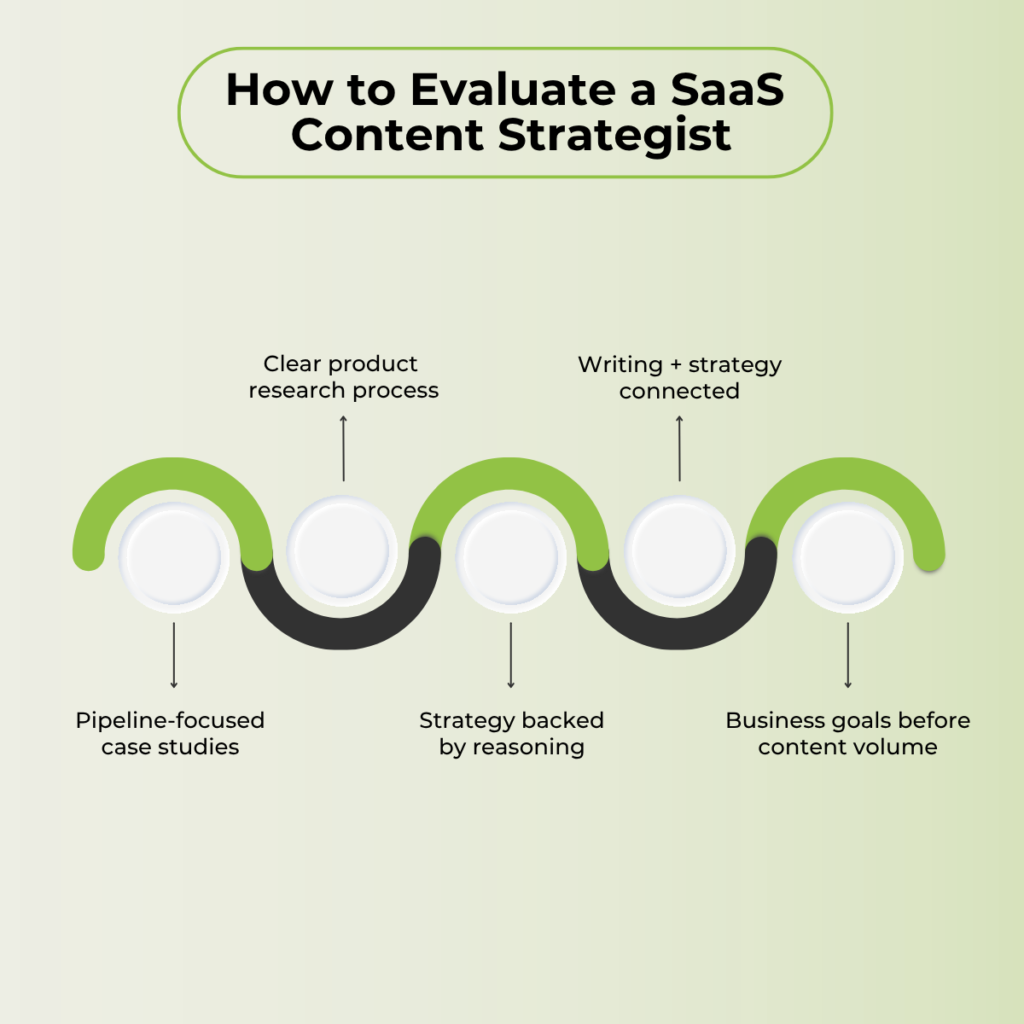
Before you hire, here’s how to tell whether the strategist actually has the thinking to back up the pitch.
- Ask for case studies that show pipeline metrics (signups, MQLs, demo requests), not just traffic charts. If their results are only measured in sessions and rankings, they’re reporting activity.
- Ask them to walk you through their process for your specific product. If they can’t explain how they’d learn your SaaS, understand your ICP, and research your competitors, they’ll be strategizing from the surface.
- Ask why that specific strategy pointer on their proposed list matters more than 50 other options. If they can’t answer that clearly, the strategy is guesswork.
- Look at how they talk about content production. A strategist who separates “strategy” from “writing” is splitting what should be one system. Content writing is the execution layer of content marketing. If those two are disconnected, every piece will be on-topic but strategically hollow.
Check whether their proposal starts with your business goals or with content volume. “8 blogs per month” without funnel logic is a content calendar, not a strategy.
You Might Have These Questions About SaaS Content Marketing
SaaS content marketing accounts for longer buying cycles, multiple decision-makers with different concerns, product-led content opportunities, and the need to serve retention alongside acquisition. It requires a full architecture spanning blog, web copy, technical documentation, and product content.
Most SaaS companies see meaningful keyword movement within 3 to 4 months and pipeline impact within 6 to 9 months. The timeline depends on domain authority, publishing velocity, keyword competition, and whether existing content can be optimized. Companies with an established site and existing content see results faster than those starting from zero.
Strategy-only engagements (audit, keyword architecture, content roadmap) run $1500K to $3K as a one-time project. Ongoing strategy plus production typically costs $3K to $10K+ per month, depending on volume, depth, and technical complexity. The real cost driver is strategic depth and product-specific research, not word count.
AI can assist with research, outline generation, and the acceleration of first drafts. But AI-generated content published without deep product knowledge, strategic intent, and human editorial judgment produces exactly the kind of generic, surface-level material that SaaS buyers ignore. The companies flooding their blogs with AI-generated posts are building traffic that will never convert because the content lacks the product specificity and expert depth that SaaS decision-makers require.
Pipeline influenced by content. Specifically, how many demo requests, product signups, or qualified leads originated from or were assisted by organic content. Traffic and rankings are leading indicators, but they only matter if the traffic is coming from commercial-intent queries and converting into business outcomes.
The Right SaaS Content Strategist Builds Your SaaS Pipeline & Helps You Grow Faster
SaaS content marketing is a precision operation. Every piece of content either serves a defined role in moving a buyer closer to a signup or demo, or it sits in your blog archive collecting pageviews that never convert. The difference between those two outcomes lies in the strategic architecture behind the content, not in the volume of posts published.
The companies winning at SaaS content marketing treat content writing as the core execution layer of their strategy. The thinking and the execution live in the same system, built around how SaaS buyers actually search, evaluate, and purchase.If your SaaS content has been producing traffic but not pipeline, more posts won’t change that. Book a call with Saiqic to discuss what that would look like for your product.
