
AI has messed up (& kinda abused) SaaS content writing. Open any SaaS website, and you’ll see web content that is hard to read, blog posts that do not make any sense. SaaS founders who don’t know the ABCs of SEO + content are confident they can handle content writing with Claude.
After burning millions of tokens and weeks of busy work, they get nothing in return. And then eventually they conclude that content does not work. SEO is dead. No one reads blogs these days.
The problem is almost always cheap, scaled, low-effort content. No one has ever liked this kind of content, and no one ever will. And I know that AI has changed the content KPIs and visitors’ search behavior. Traditional ways of approaching and marketing organic content have changed, but the importance of content is still the same.
So, what you should know if you want content to grow your SaaS business organically in the post-AI era? This blog post will tell you exactly this.
What You’re Paying for When You Invest in SaaS Content Writing
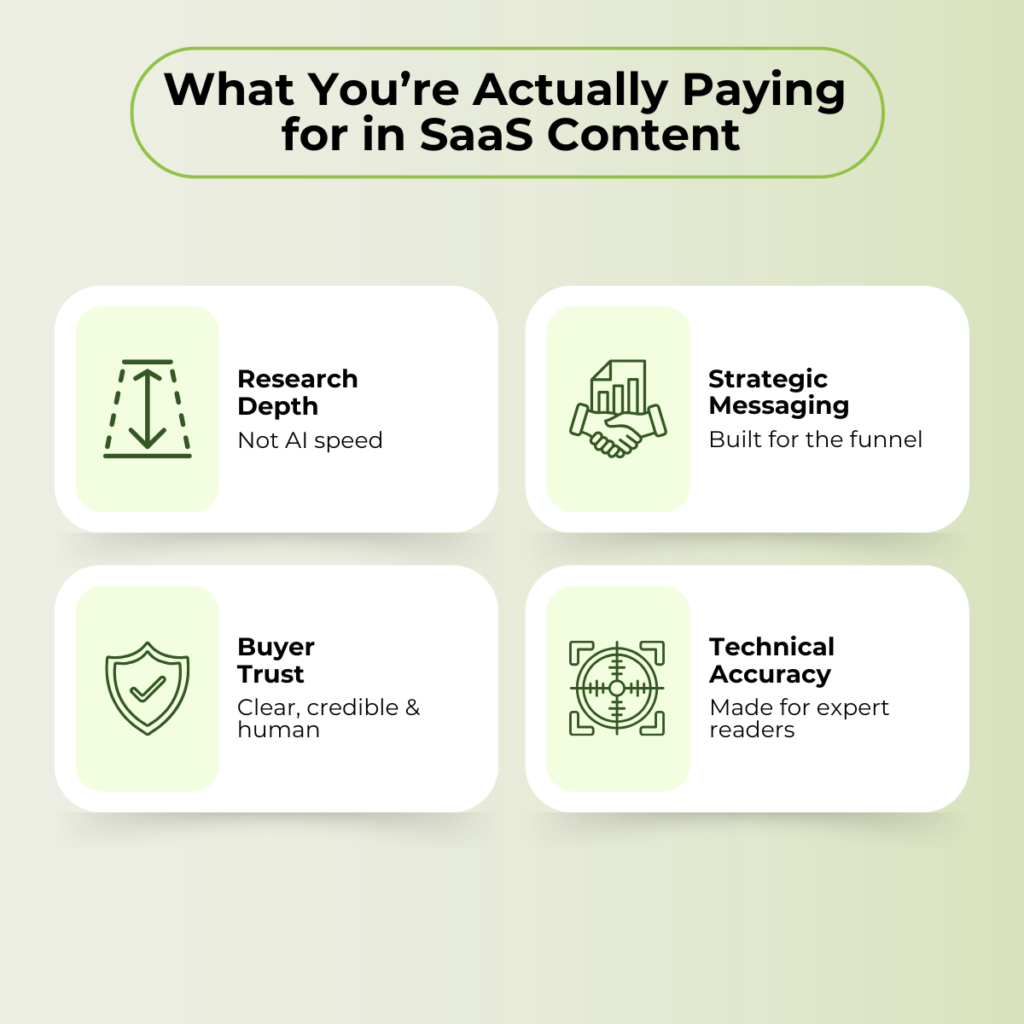
AI made the delivery cheap & ridiculously fast. Anyone can generate a 1,500-word blog post in 30 seconds, and anyone can produce 100s of pages in a day now.
But what AI didn’t make cheap is the process behind the content. That’s what you’re actually paying for when you invest in SaaS content writing, and here’s what you get:
- A well-researched, high-quality content piece that clearly describes your SaaS product.
- Human-written (even if it’s AI-assisted) content that your ideal reader reads, and you build trust and credibility.
- Strategic writing that supports your overall funnel. Not a scattered content piece with keyword stuffing and made-up content sections.
- Content that explains, educates, and convinces your target audience simultaneously.
- The content that speaks to multiple decision-makers in a single piece. B2B SaaS buying committees involve 6 to 11 stakeholders evaluating the same product for different reasons.
- A blog post that’s worthy of being read by the same prospect three times before they book a demo. SaaS’s long sales cycles mean content has to work across weeks and months.
- A content piece that is technically sound and in-depth. SaaS buyers spot shallow content immediately because they’re domain experts.
All of these are also the reasons that SaaS content pricing varies so dramatically. Because you’re paying for the depth of the process, not the word count.
Why the Content You Already Have Might Not Be Working
If you’ve invested in SaaS content writing before but didn’t get any results, one of these (or more) might be the problem(s).
The Blog Is Full of Top-of-Funnel Content That Attracts the Wrong Readers
High-volume informational keywords bring traffic from people who are months away from buying anything.
If you’re into tech & software software SaaS and writing a blog post like“What is customer success software?” you’reattracting curious researchers.
But if you write a topic like“Best customer success platform for mid-market SaaS” you’ll attract buyers.
Most SaaS blogs are 80% TOFU content because the writers defaulted to the highest-volume keywords.
BOFU content (comparisons, pain-point posts, product-led guides) converts at a dramatically higher rate because the searcher is already evaluating solutions. If your blog traffic is climbing but signups are flat, check what percentage of your published content targets commercial-intent queries. The answer usually explains the gap.
The Content Is AI-Generated, Surface-Level, and Could Belong to Any SaaS Company
Good enough content, that looks grammatically and structurally good, but when you read it, you’ll feel like vomiting. It says nothing specific about the product, the buyer’s actual problem, or how the software solves it. Because it was never written from product knowledge. It was generated from the top three Google results and an AI prompt.
AI can produce a serviceable 1,500-word article in seconds. That’s exactly why purely informational SaaS content has been commoditized.
This mostly happens with startups or newly launched sites, because they quickly want to scale & get results.
When the person producing your content has never logged into your product, never spoken to your team, and never studied how your customers actually use the software, the output is generic by default.
SaaS buyers are domain experts. They spot recycled content immediately, and it damages credibility faster than publishing nothing at all.
The Content Is Well-Written, but Never Mentions What You Actually Sell
There’s a persistent belief that content should educate, not sell. In SaaS, this creates blog posts that teach readers everything about a problem, then end without mentioning that your product solves it.
Readers searching bottom-of-funnel terms want to know how your product fits their situation. The fix is to weave the product into content naturally, as the logical answer to the problem, not as a forced pitch. That’s what makes SaaS content writing convert.
The blog post that explains “5 ways to reduce churn” and naturally shows how your platform handles each scenario will outperform the one that never mentions your product at all.
How to Evaluate a SaaS Content Writing Agency Before You Hire/Sign a Contract
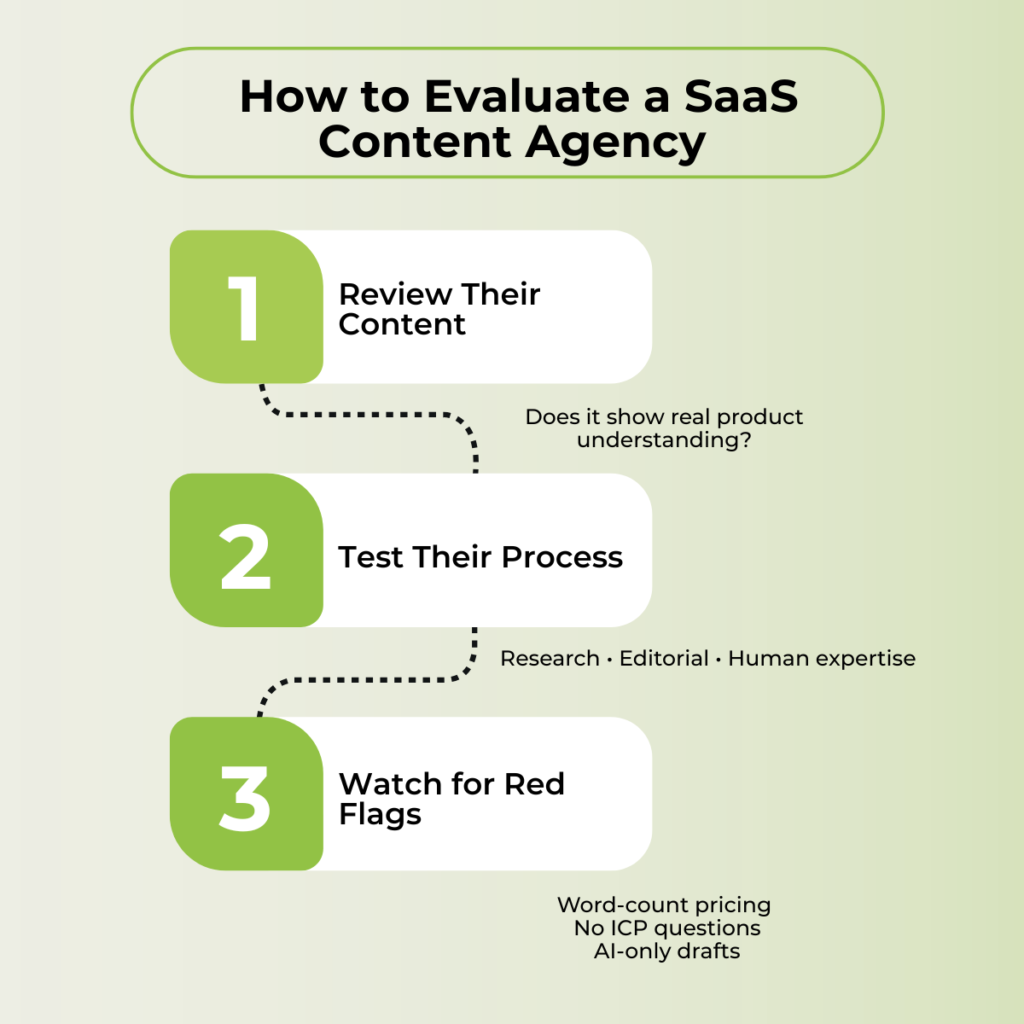
AI Every SaaS content writing agency claims that they will write content that’ll rank on Google & appear on search intent. You sign the contract and after 2 months, the content does not move your bottom line…and you feel like you wasted hundreds on content.
This should not happen and there must be a better way to evaluate before hiring.
Here are some pointers that you can consider before hisirng an agency for your SaaS content writing;
Look at Their Already Published Content
Look at the content they’ve produced for other SaaS clients (or in any relevant niche). Do not get flattered by the ranking pieces. Check the content pieces beyond rankings, check whether the content demonstrates real product knowledge or reads like generic industry advice. Read two or three pieces closely and ask yourself whether a competitor in the same category could publish the same content without changing a word.
If the answer is yes, the content writing process behind it is shallow. Never sign up with someone like this.
Questions That Reveal Whether a Real Content Writing Process Exists
These four questions tell you whether the agency has a real content writing process or just a content calendar:
- “Walk me through how you research a topic before writing starts” (expect to hear SERP analysis, product demo, competitor review, and content interviews with your team)
- “Show me a piece that drove demos or signups.”
- “What does your revision and editorial process look like?”
- “Where does AI fit in your content writing process, and where does human expertise take over?“
If the answers are vague or the agency can’t articulate where the human brain ends and the AI starts, the writing process behind the pitch is thin.
Red Flags in a SaaS Content Writing Engagement
Certain patterns consistently predict content writing engagements that waste budget:
- Pricing structured purely around word count or publishing frequency, with no discussion of research depth
- No questions about your ICP, product, or buyer journey during the sales conversation
- No SEO process beyond “we include keywords naturally.”
- Promising rankings or traffic results without asking about your current content, competitors, or domain authority
- First drafts that are fully AI-generated with no expert editorial layer
Any one of these alone is a concern. Two or more together is a pattern.
What Separates SaaS Content Writing That Builds a Pipeline From Content That Just Ranks
Getting rankings is NOT a flex anymore. You can publish loads of content really fast and some pieces from them would eventually get rankings.
The gap between content that ranks and content that converts has widened because buyers have more noise to filter through. Here’s what actually moves the pipeline now.
Every Piece of Content Maps to a Specific Buyer Problem and Funnel Stage
SaaS content that converts starts with a buyer problem. It’s anti keyword-first approach. It means that before thinking about the keyword search volume or difficulty, you think about your target audience problem.
When you think from end user/customer’s POV, the content will be naturally helpful. And then even if you choose a generic topic like “how to reduce customer churn” can be written as a product-led piece that shows exactly how a specific type of software prevents churn at each stage of the customer lifecycle. The content piece will attract buyers who are evaluating solutions. And that’s how you’re mapping the content to buying-intent funnel.
The Product Appears Naturally as the Answer
Most of the content out there “educates but never sells.”
The fix is product-led content writing. The product appears in the narrative as the logical solution to the problem the reader came to solve. Not in a“and here’s where our tool comes in” CTA block at the end. Inside the actual content, demonstrating how the feature works in the reader’s scenario.
This requires the person writing the content to understand the product deeply enough to weave it into practical examples without it feeling forced.
Content that dances around the product for 1,500 words and then drops a CTA at the bottom is a missed opportunity.
Content Interviews Replace Google Research as the Primary Source
The practice that separates SaaS content writing from generic B2B content is the content interview. A 30-minute conversation with a product manager, customer success lead, or founder produces material that no amount of SERP research can replicate. Real customer objections, specific use cases, technical nuances, and internal language that make the content feel like it was written by someone who knows the product.
Companies that skip this step end up with content that sounds like it was written for the marketing website. Companies that invest 1 to 2 interviews per post in the early months get content that SaaS buyers actually trust. The time investment drops significantly as the content partner becomes more familiar with the product.
The Writing Is Structured for Both Traditional Search and AI Retrieval
ChatGPT, Perplexity, and Gemini now surface SaaS content in response to buyer questions. Content that earns citations from AI models shares specific characteristics: original data points, clearly attributed expert perspectives, specific technical details, and direct answers to narrowly defined questions.
Generic content that restates what ten other posts already said gets ignored by both search engines and AI models. SaaS content writing that includes proprietary insights, named frameworks, and real numbers gives AI models something unique to cite. This is becoming a real competitive advantage for SaaS companies that prioritize depth over volume in their content writing.
What You Need to Have Ready Before You Invest in SaaS Content Writing
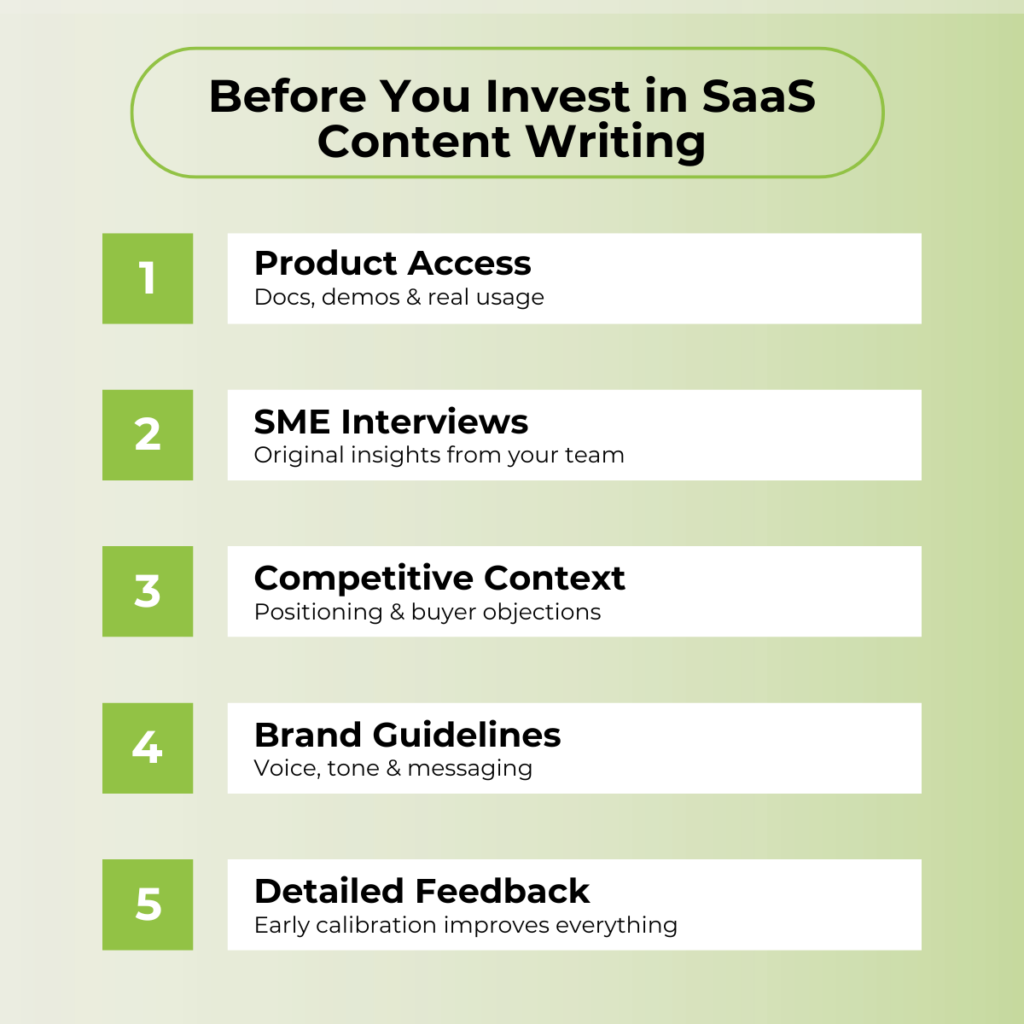
SaaS content writing fails most often when the company wasn’t prepared for the engagement. And in the post-AI era, preparation matters more because the difference between good content and AI-generated filler comes down to the inputs you provide. Before you hire anyone, having these five things in place determines whether the investment produces pipeline or just blog posts.
- Product documentation and access. Demos, walkthroughs, feature docs, and ideally a sandbox account. Content writing that’s informed by real product experience reads completely differently from content researched off your marketing website
- Available SMEs for content interviews. Founders, product managers, sales leads, or customer success people who can give 30 to 45 minutes per topic. This is where original insights come from. Plan for 1 to 2 interviews per post in the first few months. Without this, the content will sound like every other SaaS blog in your category
- Competitive context. Who you compete against, how you’re positioned differently, and what objections your sales team hears on calls. This shapes how every piece of content frames your product against the alternatives
- Brand voice and positioning guidelines. Tone, messaging pillars, terminology preferences. Even a one-page brief gives content writing a foundation to build on. Without it, every draft becomes a guessing game that wastes revision cycles
- Willingness to give detailed feedback early. The first 3 to 5 posts are calibration. Detailed feedback (not “looks good”) during this phase is what makes posts 6 through 50 dramatically better. The quality compounds from there
How to Measure Whether Your SaaS Content Writing Is Actually Working
AI made it easy to publish 20 posts a month. That doesn’t mean 20 posts a month is working. Stop measuring publishing frequency and word count. Those are inputs, not outcomes. Here’s what to track instead:
- Pipeline metrics that matter. Demos booked from organic traffic, trial signups attributed to specific posts, SQLs where content influenced the deal, revenue attributed to content-sourced leads
- Realistic timeline. Individual posts take 3 to 6 months to gain traction organically. BOFU content often converts faster because the searchers are closer to a decision. Don’t panic at month two
- When to refresh vs. when to cut. Content that ranked and stopped converting needs a CTA and angle refresh. Content that never ranked needs a structural or intent-alignment fix. Content that never attracted the right audience needs to be replaced entirely
- Consistency over volume. 4 to 6 high-quality, strategically mapped posts per month will outperform 20 generic ones every time
The companies that track pipeline impact from content (not just traffic) are the ones that scale the investment. The ones that only track sessions and pageviews eventually cut the budget because they can’t prove ROI.
You Might Have These Questions About SaaS Content Writing
Freelancers charge $400+ per post for decent mid-level work, significantly more for senior specialists with SaaS experience. Agencies run monthly retainers from $3,000 to $10,000+, depending on scope, research depth, and strategic involvement. Cheap content costs more in the long run when it fails to rank or convert.
Expect organic content to compound over 3 to 6 months. BOFU pieces (comparisons, pain-point posts) often convert faster than TOFU educational content. Consistency accelerates the timeline. If someone promises leads from SEO content in month one, that’s a red flag.
AI can speed up drafting when paired with expert input: product positioning, competitive differentiation, and customer pain points. Without that expert layer, AI produces the same generic content faster and cheaper. The value in SaaS content writing comes from the human expertise behind the words, the product knowledge, the strategic intent, the buyer empathy. Not the writing tool.
Content writing covers blog posts, guides, case studies, and thought-leadership pieces. It’s the long-term organic growth engine. Copywriting covers homepage messaging, landing pages, product pages, and pricing pages. It’s the conversion layer. Both sit under content marketing as execution layers. Both are essential. Different skills, different purposes, same strategic umbrella.
Plan for 1 to 2 hours per post in the first few months (interviews, feedback, context-setting). As the writer or agency learns your product and voice, this drops significantly. The upfront time investment is what separates content that works from content that just fills your blog.
High-quality SaaS Content Writing Is The Investment With 100% ROI.
AI made humans lazy and there’s loads of cheap scaled content that can be easily beaten if you put a bit of effort. The companies that treat content writing as a process (research-backed, product-informed, mapped to buyer intent, connected to their content marketing strategy) are the ones building an organic pipeline that compounds. The ones that handed it to AI without a process are the ones saying content doesn’t work.
If your SaaS content has been producing traffic but not pipeline, more posts won’t fix that. A content writing agency who builds the process first and writes second will. Book a call with Saiqic to talk through what that looks like for your product.
