
I’ve seen 10s of SaaS owners hiring ‘not-so-ideal’ SaaS content writers and wasting their time and $$$. The reason is not always that the content writer was incompetent or didn’t understand what the client wanted. Sometimes the SaaS owner was not sure WHAT kind of writer they needed, what their objective was, or how to evaluate one.
That means the hiring process and evaluation of a competent SaaS SEO writer is where a SaaS owner should be careful.
This blog post will help you select your ideal writer so that you can never go wrong.
Three Types of SaaS Content Writers And Who Could Be Your Best Fit
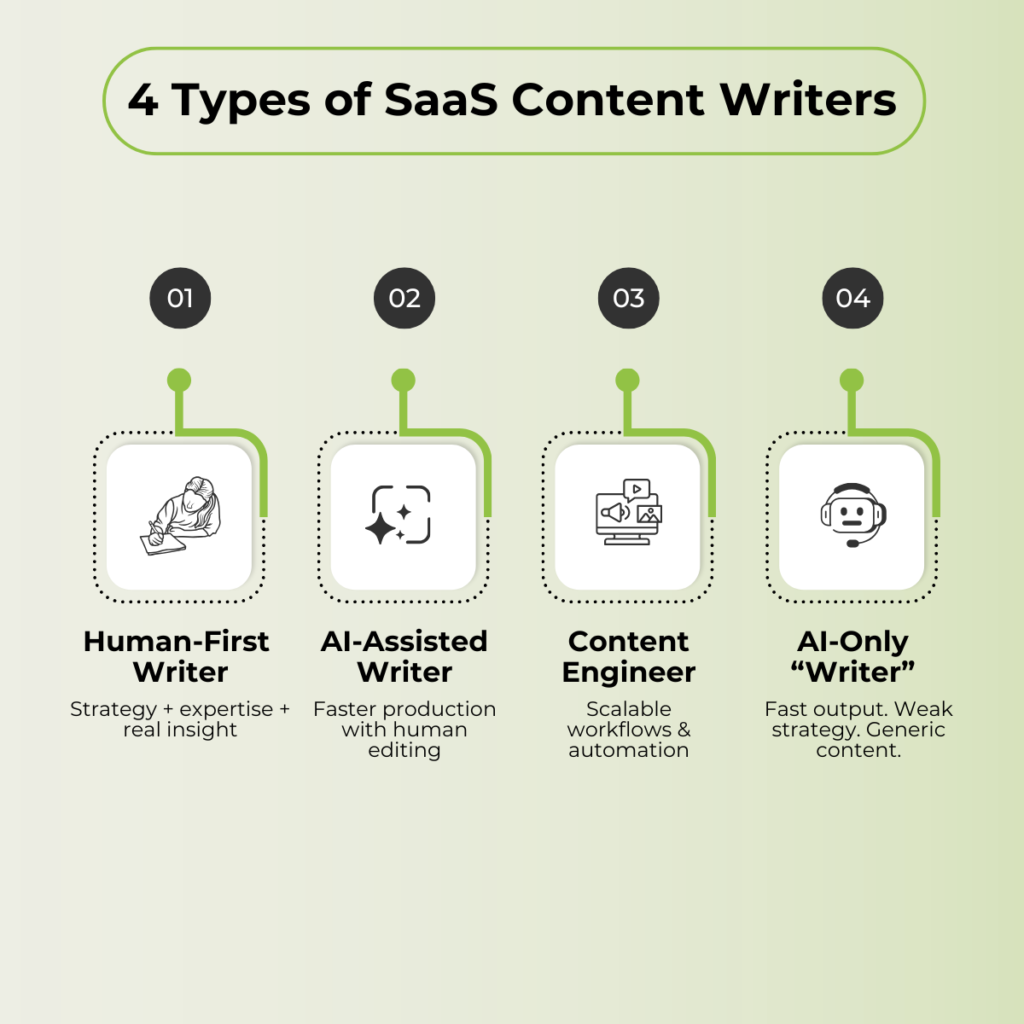
You need SaaS content writing services, and you’re evaluating writers. But the proposals, the portfolios, the pitches all look and feel different. And you need to select the one that suits you best. In 2026, you’ll encounter these three types of SaaS (or in any niche) writers;
The Human-First SaaS Writer Who Uses AI as a Tool
This is the writer who does the thinking. They research your product, interview your team, study your competitors, and build the content strategy from their own understanding. AI enters the picture for specific tasks: speeding up research, checking facts, refining a draft after it’s already written. But the structure, the angle, and the voice are all human.
This is the most reliable type of SaaS content writer. The output reads as if someone who understands your business wrote it, because someone did. The trade-off is speed and cost. Expect $500 to $1,200+ per long-form piece, or $2,000 to $5,000+ on a monthly retainer.
Best for: SaaS companies publishing 4 to 8 high-impact pieces per month where thought leadership, product-led content, and brand voice consistency matter more than volume.
The AI-Heavy SaaaS SEO Writer Who Edits Manually
This writer understands how content works. They know structure, flow, and what good SaaS writing should accomplish. But their process leans on AI for the heavy lifting: generating first drafts, building outlines, sometimes producing full sections. They then edit, reshape, and add their own perspective.
The quality here depends entirely on how deep the editing goes. A light pass produces content that reads like polished AI output. A thorough rewrite that adds product context, reworks weak sections, and injects real buyer insight gets close to human-first quality at a lower cost per piece.
Best for: SaaS companies scaling to 10-20+ pieces per month. Works when you need volume and the writer has enough product knowledge to catch what the AI misses.
The Content Engineer Who Builds Workflows
This person might not come from a traditional writing background. They understand the content production process, know how to train AI agents, build prompt chains, and set up automated workflows using tools like Jasper, custom GPT pipelines, or purpose-built content systems.
They can produce high-volume informational and TOFU content at speed. But they struggle with product-led content, comparison pieces, and anything that needs genuine buyer psychology.
The output tends to sound like every other SaaS blog using the same stack.
Best for: High-volume informational content where uniqueness isn’t the priority. Think glossary pages, basic how-tos, and keyword coverage plays. Not your flagship thought leadership or BOFU content.
The AI-drunk SaaS Writers (or even should I call them writers?)
They paste a keyword into ChatGPT and publish what comes out. Mostly, these are the SaaS founders themselves. They never tasted any content piece, and they know nothing about how it works or should work. So they don’t have a strategy, and they can’t edit the output.
Google’s helpful content signals penalize this. Readers bounce when they recognize the pattern. And the content eventually needs to be rewritten, so you end up paying twice.
What Makes a SaaS Niche Content Writer Different from a Generalist
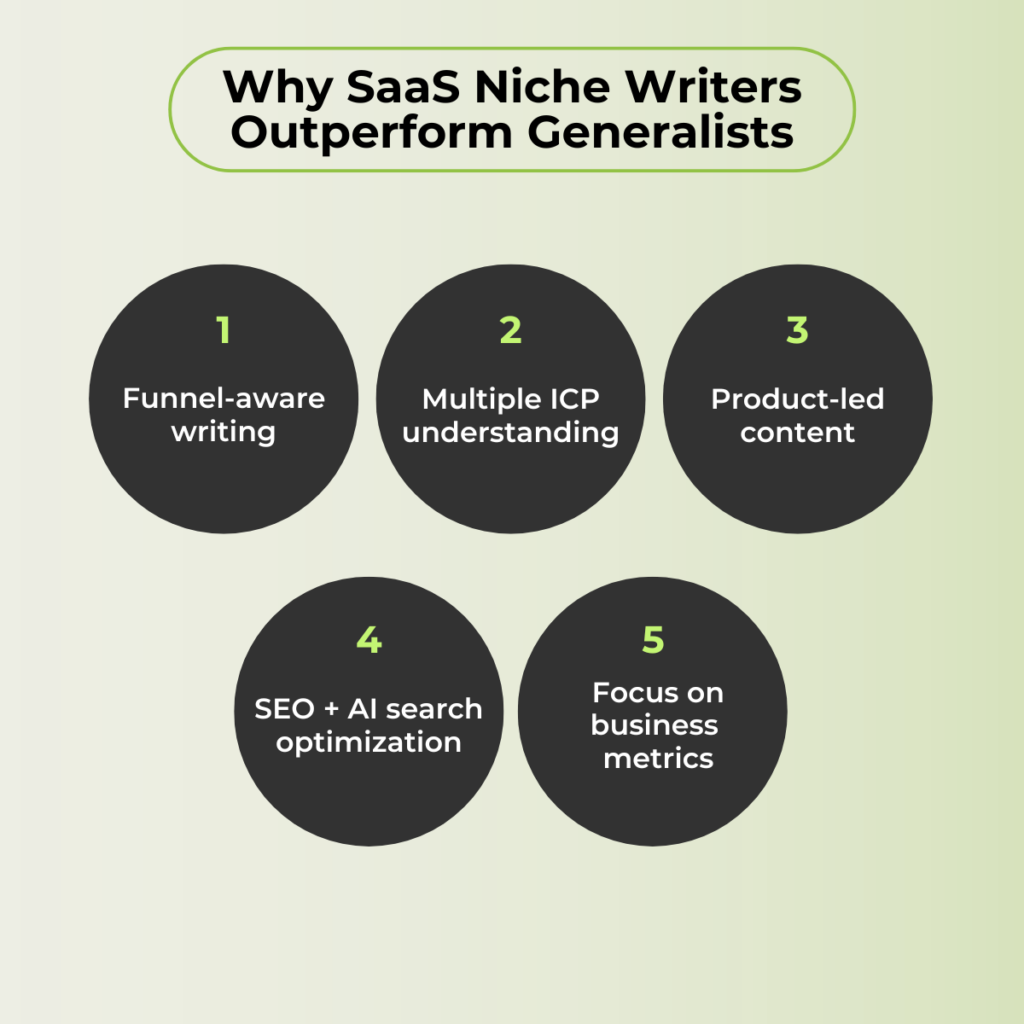
A generalist content writer can produce a decent blog post about almost anything. That’s exactly the problem. “Decent” doesn’t move SaaS metrics, just like it wouldn’t move metrics in fintech, healthtech, or any other specialized space. What separates a niche-fluent writer from a generalist shows up in specific areas.
- Funnel awareness. A niche SaaS writer understands that a TOFU awareness post and a BOFU comparison post serve completely different purposes and require different structures. A generalist writes both the same way.
- ICP fluency. Can they adjust the depth and vocabulary for a CTO, a VP of Marketing, and an end user? SaaS companies sell to multiple buyer personas. The content has to flex.
- Product-led writing. A SaaS content writer weaves the product into the content naturally, as a solution that emerges from the reader’s problem. A generalist drops a product mention in the last paragraph like an afterthought.
- SEO plus AEO awareness. In 2026, content needs to rank well in traditional search AND be cited by AI models. A niche writer structures content for both.
- Metric alignment. Good SaaS content moves specific numbers: trial starts, activation rate, MQLs, and expansion MRR. A generalist optimizes for traffic. A niche writer optimizes for business outcomes.
Niche fit matters more than writing polish. I’ve seen brilliant writers produce SaaS content that missed the mark because they didn’t understand the buyer’s decision process. And I’ve seen less “elegant” writers who understand SaaS funnels produce content that directly drives signups.
When to Hire a SaaS Content Writer Based on Your Company’s Stage
There’s no universal answer to “who should I hire?” The right SaaS content writer and the right content setup depend on where your company is right now.
Pre-Product-Market-Fit (Don’t Hire a Writer Yet)
If your positioning changes monthly and your ICP is still a hypothesis, a content writer can’t hit a target that moves weekly. Founder-written content works better here. You’re the closest person to the problem and the customer.
When to transition: Once your ICP stabilizes and your sales motion becomes repeatable.
Post-PMF to Series A (One Specialized Freelancer)
This is the sweet spot for a dedicated freelance SaaS content writer. Volume is low (4 to 8 pieces per month), quality matters a lot, and one person can hold the full product context.
What to look for: A writer who genuinely understands your product, customers, and competitors. A content writer whom you can evaluate based on their merit.
Series A to B (A Content Lead Plus Freelancers or an Agency)
Content velocity starts to matter. You need 10 to 15+ pieces per month across blog content, comparison pages, and landing page copy. One freelancer can’t carry that.
The decision splits: hire an in-house content lead who manages freelancers, or partner with an agency that has genuine SaaS depth.
The agency trap: Agencies that pitch volume but deliver content written by someone who learned about your product from your homepage. Ask who’s writing and how they’ll learn your product before signing.
Series B and Beyond (Content Operations, Not Just Writing)
At this scale, you need a content operation. In-house team, agency partnerships, AI-assisted workflows, editorial calendar, and a content strategy that ties content directly to revenue metrics. The SaaS content writer becomes one role inside a larger system. The hiring question shifts from “who should write my next blog?” to “how do I build a content engine that compounds?”
How to Vet a SaaS Content Writer Before Committing
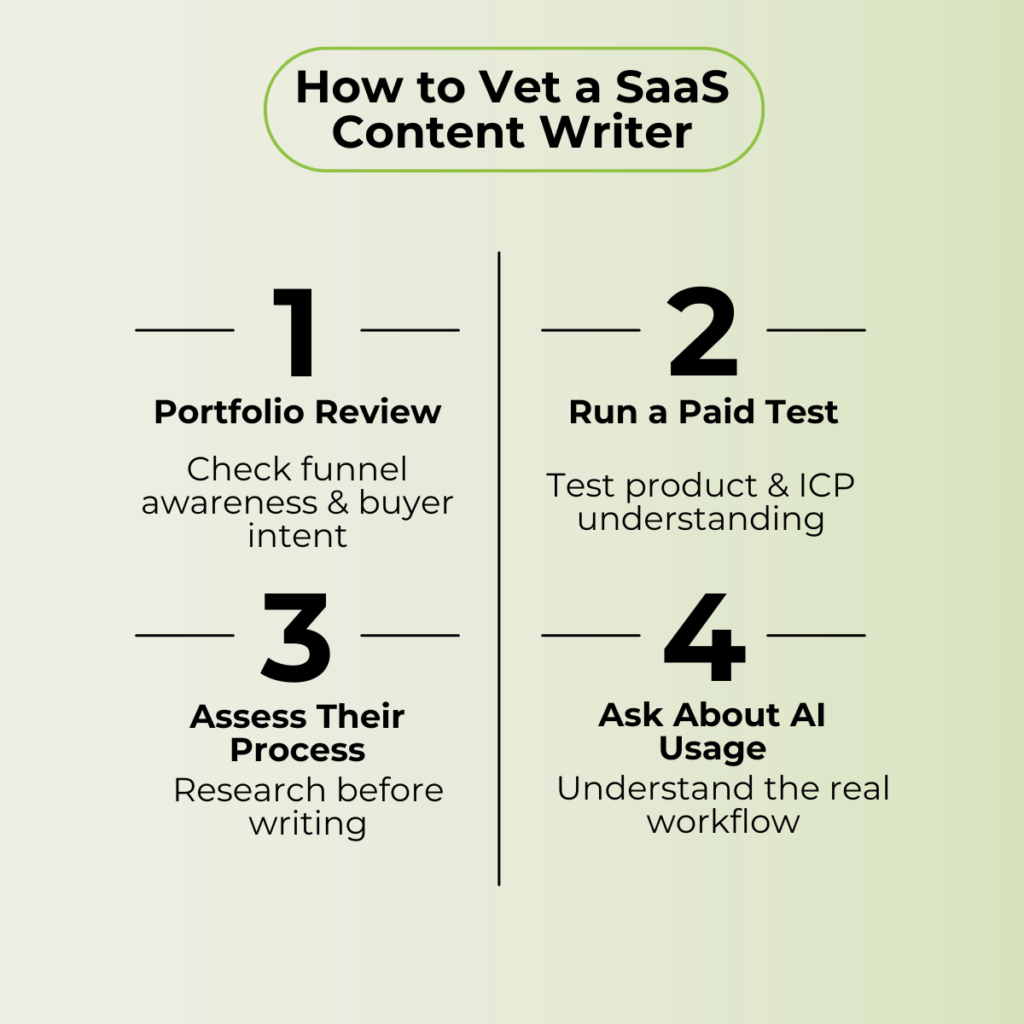
Everyone says, “Check their portfolio and do a paid test.” That’s not wrong, but it’s incomplete.
Review Their Portfolio for SaaS Funnel Awareness
Look at whether they’ve written across the funnel: TOFU educational content, MOFU comparison content, BOFU decision-stage content.
A writer with only top-of-funnel posts may struggle with the commercial-intent content that drives the pipeline. Also, check if their content guides readers toward action or just explains a topic and ends.
Run a Paid Test That Reveals Product Understanding
Give them a real topic tied to your product and ICP. Not a generic one.
Evaluate:
- Did they research your product and competitors?
- Did they ask smart questions during onboarding?
- Does the draft show understanding of your buyer’s actual situation, or could it apply to any SaaS company with a few name swaps?
Assess Their Process Carefully Along with The Output
A good SaaS content writer asks about your ICP, positioning, competitors, and content goals before writing a word. If they jump straight to “send me the brief and I’ll deliver by Friday,” they’ll produce generic work. The best writers treat the first engagement as a mini-strategy session.
Check for AI Transparency
I don’t trust AI detection tools. They don’t work. But you ned to know how the writer uses the tools to do your work.
So simply ask them: “Do you use AI in your workflow?”
The sophistication of the answer tells you everything. A writer who says“I use AI to accelerate research and scaffold outlines, then rewrite entirely” is fundamentally different from one who says “I don’t use AI” (they probably do) or “I use it for first drafts” without explaining how much rewriting actually happens.
What a Bad SaaS Content Hire Costs You (Spoiler: It costs a lot 🙂
The writer’s fee is the smallest line item in a bad content hire.
- 3 to 6 months of wasted content. Blog posts that don’t rank, don’t convert, and misrepresent your product to the people who find them.
- Internal team time burned on editing. Your product marketer or founder is spending hours rewriting or re-explaining the product.
- The compounding window you lose. Good content compounds. Every month of underperforming content is a month of missed compounding. You can’t get those months back.
- Brand perception damage. Low-quality blog posts live on your domain. If your content reads like it was written by someone who spent ten minutes on your homepage, prospects notice.
- The double ramp-up penalty. Fire the wrong writer, find the right one, and the new writer needs onboarding, too. You’ve doubled the learning curve.
I’ve spoken with SaaS founders who estimate that a bad content hire costs them 6 to 12 months of momentum. Not because the content was terrible on the surface, but because it was invisible: ranked nowhere, converted nobody.
You Might Have These Questions About Hiring a SaaS Content Writer
For long-form content (1,500 to 2,500 words), expect $400 to $1,600+ per piece from an experienced SaaS writer. Pricing below $150 per piece typically indicates generalist quality. Monthly retainers run $2,000 to $5,000+. Agencies charge $3,000 to $15,000+ per month, depending on volume and whether strategy is included.
Depends on the stage and volume. Pre-Series A: one specialized freelancer. Series A to B: content lead plus freelancers or an agency. Series B+: in-house team with agency and freelancer support.
For high-volume informational content, AI workflows with editorial oversight can handle the load. For product-led content, thought leadership, and anything requiring genuine buyer understanding, a human writer (potentially AI-assisted) is the better investment.
Expect 2 to 4 pieces before they fully absorb your product, voice, and ICP. Built-in runway. Judge the trajectory, not just the initial output.
They don’t ask questions. A writer who jumps into writing without understanding your product, buyer, and competitive landscape will produce generic content every time.
Hire The Right SaaS Content Writer, Build a Solid Foundation
The difference between SaaS companies that get results from content and those that don’t isn’t the quality of any single blog post. It’s whether they matched the right type of writer to their stage, goals, and content model before they started publishing.
The companies that get this right publish content that compounds. Content that moves readers from search to trial to paid. Content that their sales team actually uses in conversations.
This ONLY happens when you choose the best fit writer, give them genuine access to your product and customers, and treat content as a system rather than a series of disconnected blog posts.If you want to discuss which content setup best fits your SaaS stage, book a call with Saiqic.
