
Most copywriting engagements that go wrong for small businesses go wrong before the copywriter writes a single word. The business doesn’t have a clear offer. The audience is “everyone.” The brief is a one-line email that says “make it sound professional.“
And then the copy comes back sounding like it was written for a completely different company.
This is not a copywriter problem; that’s when you don’t know who to hire and whether you’re ready to hire a readiness problem.
This post walks through what to sort out before spending a dollar on a small-business copywriter, which type of writer to look for, and how to tell a good one from a polished fake.
Most Small Businesses Aren’t Ready to Hire a Copywriter (And That’s the Real Problem)
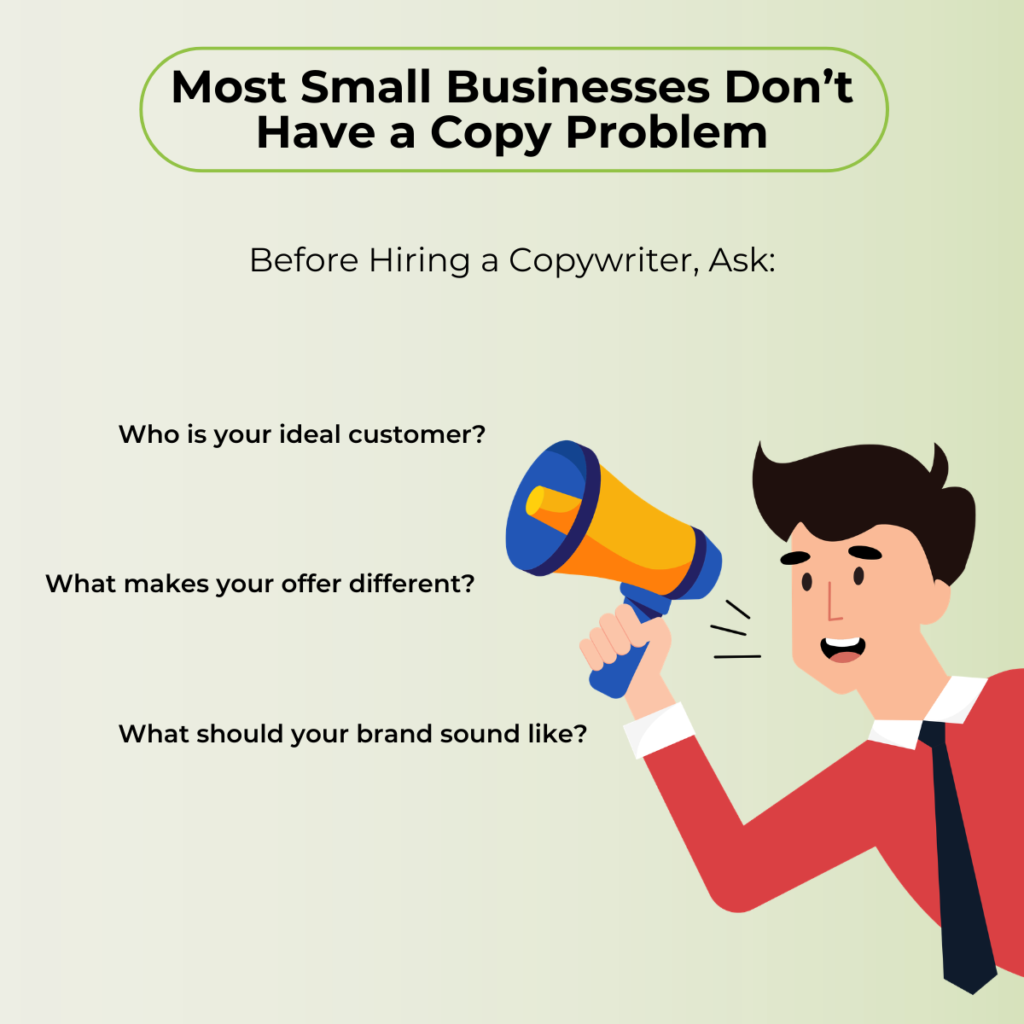
The most common reason small business copywriting fails isn’t the copywriter. It’s the client.
That sounds blunt. But it’s what every experienced copywriter will tell you off the record. I’ve experienced it in meetings with business owners. They mostly won’t have a defined offer, a clear picture of their audience, or any sense of how their brand should sound. Then they hand a copywriter an impossible job and blame the output.
Before outsourcing copy, a small business needs at least three things figured out.
Three Questions That Tell You If You’re Ready
Ask yourself these questions honestly.
Can you describe your ideal customer in one sentence without saying “everyone”?
If the answer is “anyone who needs [your service],” you don’t have a target audience yet. You have a hope. The copy you’ll receive will not talk to anyone. Copywriters need a specific person with specific problems.
Can you explain what you sell and why it’s different from competitors in under 30 seconds?
If you can’t articulate that verbally, the copywriter won’t be able to either, no matter how deep they run their research. You need a differentiator if you’re expecting impactful copy.
Do you know what tone your brand should sound like, even roughly?
“Professional” isn’t a tone. “Friendly but authoritative, like a doctor who actually explains things” is getting closer. If all you can say is “just make it sound good,” you’re setting the copywriter up to guess. And guessing costs you revision rounds and money.
If the answer to any of those is no, the move is to do that foundational work first. Positioning, audience research, and competitor analysis. That doesn’t require a copywriter. It might require a brand strategist, a marketing consultant, or just a weekend of honest self-assessment.
How to Know You’re Ready for Hiring A Copywriter for your Small Business
| Signal | Ready | Not Ready Yet |
| Your offer | You can articulate exactly what you sell and who it’s for | You’re still testing services or pivoting frequently |
| Your audience | You know their pain points, objections, and the language they use | You describe your audience as “anyone who needs [X]“ |
| Your voice | You have a rough sense of how your brand should sound | You say “just make it professional” with no further input |
| Your website | You have live pages that need better copy | You don’t have a website yet or you’re still building the structure |
| Your budget | You’ve set aside marketing dollars specifically for copy | You’re hoping to pay under $200 for a full website rewrite |
If most of your answers land in the right column, hold off on the hire. The investment won’t pay off until the foundation is in place.
You Might Not Need a Copywriter (You Might Need a Content Writer or a Strategist)
Small business owners use “copywriter,” “content writer,” and “marketing writer” interchangeably. They’re not the same, and if you don’t know it, you’ll end up hiring the wrong person.
- A copywriter writes conversion-focused copy. Landing pages, homepages, service pages, ad copy, email sequences. The goal is to move someone toward an action.
- A content writer writes long-form educational content. Blog posts, articles, guides, resource pages. The goal is organic traffic and authority over time.
- A brand strategist or messaging consultant doesn’t write copy. They define your positioning, your voice, and your messaging hierarchy. The copy comes after their work is done.
These are different skill sets. Hiring a content writer to write your homepage is like hiring a carpenter to do electrical work. Both are in the building trades, but the output won’t be what you expected.
| What You Need Done | The Right Hire | Not the Right Hire |
| Homepage, service pages, and landing pages that convert visitors into leads | Copywriter (conversion-focused) | Content writer or blogger |
| Blog posts, articles, and guides that bring organic traffic over time | Content writer (SEO-focused) | Copywriter (they’ll write well, but not blog strategy) |
| Email sequences, ad copy, sales page for a product launch | Direct response copywriter | General content writer |
| Full messaging direction, brand voice guide, and positioning work | Brand strategist or messaging consultant | Any writer without a strategy background |
| A bit of everything on a small budget | Marketing generalist or small agency | A specialist you can’t afford to use for everything |
Figure out what you need before you figure out who to hire. The deliverable determines the role. Getting this wrong is the second most common failure point after readiness, and it happens constantly because these titles sound interchangeable from the outside.
What a Small Business Copywriter Does (And What They Don’t)
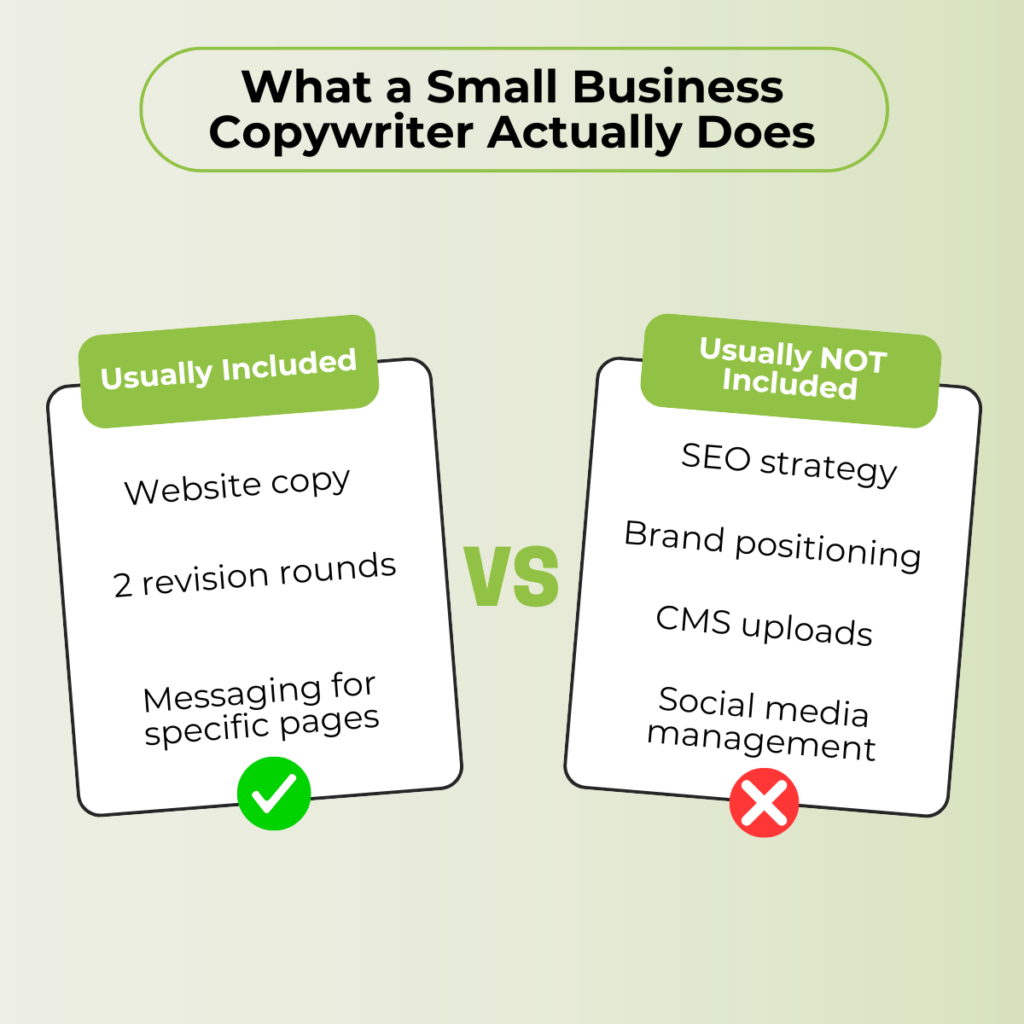
When you know exactly that you’re ready to hire a copywriter for a specific job, then you get in touch with a copywriter and set the scope of work. Both parties must align their expectations first. To align the expectations and set the scope of work, you should know what a copywriter does.
What’s Typically Included in a Copywriting Assignment
A small business copywriter delivers finished copy for specific pages or assets. That usually means a defined number of pages (homepage, about page, three service pages), a set number of revision rounds (industry standard is two), and delivery in a document format you can review and provide feedback on.
Some copywriters include light audience research or a kickoff strategy call. But those extras vary by copywriter and price point. Don’t assume they’re standard.
What Most Small Business Owners Assume Is Included (But Isn’t)
This is where expectations go sideways.
- SEO keyword research for a small business is not standard in most copywriting engagements. If you need SEO-optimized copy, you need a writer who specifically offers that service, or a separate SEO strategist working alongside the copywriter.
- Content strategy is also a separate function. A copywriter writes the words. A strategist decides what pages, in what order, and why need to exist. Those are different jobs. Content strategy is part of the broader content marketing picture, and a standalone copywriter typically doesn’t own it.
- Brand positioning and voice development fall into the same category. If you show up without a brand voice and expect the copywriter to invent one from scratch, you’re asking for strategy work at copywriting rates.
- CMS uploads, design direction, and social media management are not copywriting services either.
What You Need to Bring to the Table
The copywriter needs input from you. At minimum: who your customer is, what you sell, what makes you different, and what action you want the reader to take after reading the page. You don’t need a 20-page brand document. You need honest answers to those four questions.
The worst-case scenario is what experienced copywriters call the “empty-handed client.” Zero direction. Zero context. Full expectations. The first draft misses because it was built on guesswork, and both sides walk away frustrated.
Two focused revision rounds with clear, specific feedback produce better results than five rounds of vague corrections. Come prepared, and the process works.
How to Evaluate a Small Business Copywriter Without Getting Fooled
Here’s what actually separates a good hire from a regrettable one.
What Their Portfolio Tells You (And What It Doesn’t)
A portfolio full of beautiful prose that doesn’t sell anything is a portfolio of writing, not copywriting. Those are different outcomes.
Look for case studies. “This landing page converted at X%.” “This homepage reduced bounce rate by Y%.” Not every copywriter tracks performance metrics, but those who do understand that copy has a job beyond sounding nice.
If every sample in the portfolio sounds the same across industries, that’s a template writer. A good small business copywriter adapts voice, tone, and structure to each client’s brand. If the dental clinic copy reads like the SaaS company copy, the writer is running a formula.
And a small portfolio with three strong, relevant pieces beats a massive collection of generic work. Depth over volume.
What to Listen for on a Discovery Call
The Green Flags.
- The single most reliable green flag is that a good copywriter asks you more questions than you ask them.
They’ll want to know about your audience, your goals, your competitors, what you’ve tried before, and what fell flat. If the first call feels more like a thorough interview than a sales pitch, that’s the signal you want.
- They push back on something. Not combatively. But they challenge an assumption or offer a different perspective on your messaging. That means they think strategically, not just take orders.
- They explain their process in plain language. No jargon. No“synergizing your brand narrative.” Just clear steps: here’s what I need from you, here’s what I do, here’s when you’ll see the draft, here’s how revisions work.
Now, The Red Flags.
- “I write for all industries and all formats.” Specialists outperform generalists in small-business copy almost every time. A copywriter who understands the constraints of small business operations (tight budgets, limited teams, founder-does-everything reality) will produce better work than a generalist who writes for everyone.
- They quote a price before understanding your needs. A copywriter who names a number before asking about your project scope is guessing. Or they charge a flat rate regardless of complexity, which means someone is always overpaying.
- They promise guaranteed rankings, conversions, or viral results. Nobody can guarantee those outcomes. A copywriter who does so is either inexperienced or misleading you.
What Small Businesses Pay for Copywriting in 2026
Pricing is where small business owners get most confused and frustrated. “How much does a copywriter cost?” is the wrong question. The question should be “how much does the specific deliverable I need cost?“
Here’s what the market looks like right now.
| Deliverable | Budget Range | Mid-Range | Premium | What Changes Between Tiers |
| Single web page (homepage or service page) | $150 – $200 | $300 – $500 | $800 – $1200 | Research depth, revision rounds, SEO integration, voice matching |
| Full website (5-7 pages) | $800 -$1200 | $1200-$1500 | $3000-$5000 | Strategy included, messaging hierarchy, conversion architecture |
| Landing page (sales or lead gen) | $200 – $250 | $400-$600 | $900 – $1500 | Audience research, A/B copy variations, funnel awareness |
| Email sequence (5-7 emails) | $700 – $1,000 | $1,200 – $2000 | $3,000 – $3500 | Segmentation, behavioral triggers, subject line testing |
| Monthly blog retainer (4 posts) | $600 – $800 | $9,000 – $1200 | $1500 – $2,000 | Keyword research, content strategy, editorial calendar |
A few things worth knowing about these numbers.
- The $150 expectation for a full website rewrite guarantees bad work. At that rate, the copywriter is spending less time on your entire site than a mid-range writer spends on a single page. You get what that pace allows, which isn’t much.
- A higher rate often saves money in the long run. Fewer revision rounds. Tighter copy out of the gate. Better conversion results. If a budget writer takes four revision rounds to get it passable and a mid-range writer nails it in two, the real cost difference shrinks fast.
- Think about return, not just cost. If a copywriter charges $1,000 for your website copy and that copy brings in three new clients worth $2,000 each, you’ve netted $5,000 in month one. The copy keeps generating returns long after the invoice is paid.
What a Professional Copywriter Does That GPT, Claude (Or any AI) Cannot (Yet)
It would be dishonest to write about hiring a copywriter in 2026 without talking about AI.
Most small business owners searching for a small business copywriter right now have already tried ChatGPT, Jasper, or another AI writing tool. Some got decent rough drafts. Some got generic output that sounded like every other website in their industry. Many are searching for a human copywriter specifically because the AI output didn’t deliver.
Here’s where the line actually falls.
Where AI can Help In Copywriting
AI is useful for brainstorming headlines, generating rough first drafts, repurposing existing copy into new formats, and getting past blank-page paralysis. If you need 20 subject line options in 30 seconds, AI wins that race easily.
Where AI can’t Help In Copywriting
AI cannot capture your brand voice from scratch, understand your specific audience’s emotional triggers, make strategic decisions about what to emphasize and what to leave out, or produce copy that differentiates you from competitors running the same AI tools with similar prompts.
If you and your competitor both use ChatGPT to write your homepages, those pages will sound remarkably similar. Same structure. Same phrasing patterns. Same generic claims about “quality” and “dedication.” A professional copywriter is how you break that sameness.
The Best Fit Copywriter is 100x ROI for Your Small Business
Every business needs words. There’s no alternative, either it’s the AI era, or it’s agentic AI in 20230. Small businesses need the copywriter the most because their organic growth depends on it. But hiring the best fit for the business takes some time, research, and a bit of knowledge of how copywriting works.
If you’ve read this far and the foundation is solid, start with a conversation. Or read how Saiqic handles copywriting for small businesses to see if the approach fits what you’re looking for.
