
You can produce 100 pieces of copy per day with a $20 AI subscription. A professional writer takes 2 to 5 days and charges hundreds for just one piece.
AI tools sound like the obvious choice. Faster, cheaper, and no chasing a writer every other day.
But does AI-generated copy fulfill your business objectives? Does your target audience connect with your brand when they read it? Do they buy from you?
Those are the questions the “best AI tool” listicles never ask. By the end of this post, you’ll know what AI copywriting tools deliver vs what professional SEO copywriting delivers, and which approach fits your business.
How AI Copywriting Tools and Professional SEO Copywriting Compare Where It Counts
The “AI vs human” debate is never-ending, and it has been the hot topic for some years now. AI is fast, cheap, and you get heaps of content in a matter of minutes. Speed, affordability, and volume do matter, but these factors are not what determine whether your content ranks or converts.
Here’s how the two approaches compare on the dimensions that drive business outcomes.
| Dimension | AI Copywriting Tools | Professional SEO Copywriting |
| Speed | Produces drafts in minutes. High volume output per day. | 2 to 5 days per piece. Slower output, higher strategic depth per piece. |
| Cost per piece | $20 to $200/month subscription. Near-zero marginal cost per article. | Hundreds per piece. Cost reflects research, strategy, and editorial depth. |
| Search intent alignment | Matches keywords to templates. Follows patterns from training data. | Decodes why someone is searching, what they know, and what will shift their decision. |
| Content quality signals | Generates grammatically correct, structured text. Often generic across audiences. | Builds EEAT signals (experience, expertise, authority, trust) that Google weights for rankings. |
| Brand voice | Can mimic tone with prompting. Drifts across pieces. Requires constant correction. | Maintains consistent brand positioning and voice across every piece in the content system. |
| Conversion ability | Produces functional CTAs and benefit statements. Doesn’t read the buyer’s emotional state. | Writes copy that meets the reader at their decision stage and moves them toward action. |
| Ranking performance | Content can index and appear in positions 5 to 10. Rarely holds top-three positions in competitive SERPs. | Human-led content is 8x more likely to hold Position 1 [PLACEHOLDER: STAT – Semrush study link]. |
You can see in the comparison that AI tools win on speed and per-piece cost. Professional SEO copywriting wins on every metric tied to ranking performance and business outcomes.
This DOESN’T mean that AI tools are garbage (most of them are:), this means that speed and cost are execution metrics, while rankings and conversions are strategy metrics. The two approaches serve different layers of the content operation.
AI-generated Content Does Not Even Get Stable Ranking
Semrush analyzed over 20,000 URLs across competitive keywords and found that human-written content is 8x more likely to occupy Position 1.
AI content performs comparably in positions 5 through 10, but the gap widens sharply at the top of the SERP.
And 64% of SEO teams now use a human-led, AI-assisted workflow. The professionals haven’t abandoned AI. They’ve put it in the right seat. Strategy, research, and editorial judgment stay human. AI handles draft speed and keyword suggestions.
Only 19% of SEO teams reported that AI tools improved the actual quality of their content. The rest use AI for efficiency, not for the quality layer that drives rankings.
This Comparison Matters for Your Content Budget More Than Your Estimate
If your business needs high-volume, low-stakes content (product descriptions, location pages, social media variations), AI tools could benefit those tasks.
If your business needs content that ranks for competitive keywords, builds topical authority, and drives qualified leads, the comparison shifts. The per-piece cost of professional copywriting is higher, but the per-ranking-result cost is lower. And rankings compound. A professionally written blog that reaches Position 2 can drive traffic for 12 to 24 months.
When AI Copywriting Tools Fit Your Business and When You Need a Professional
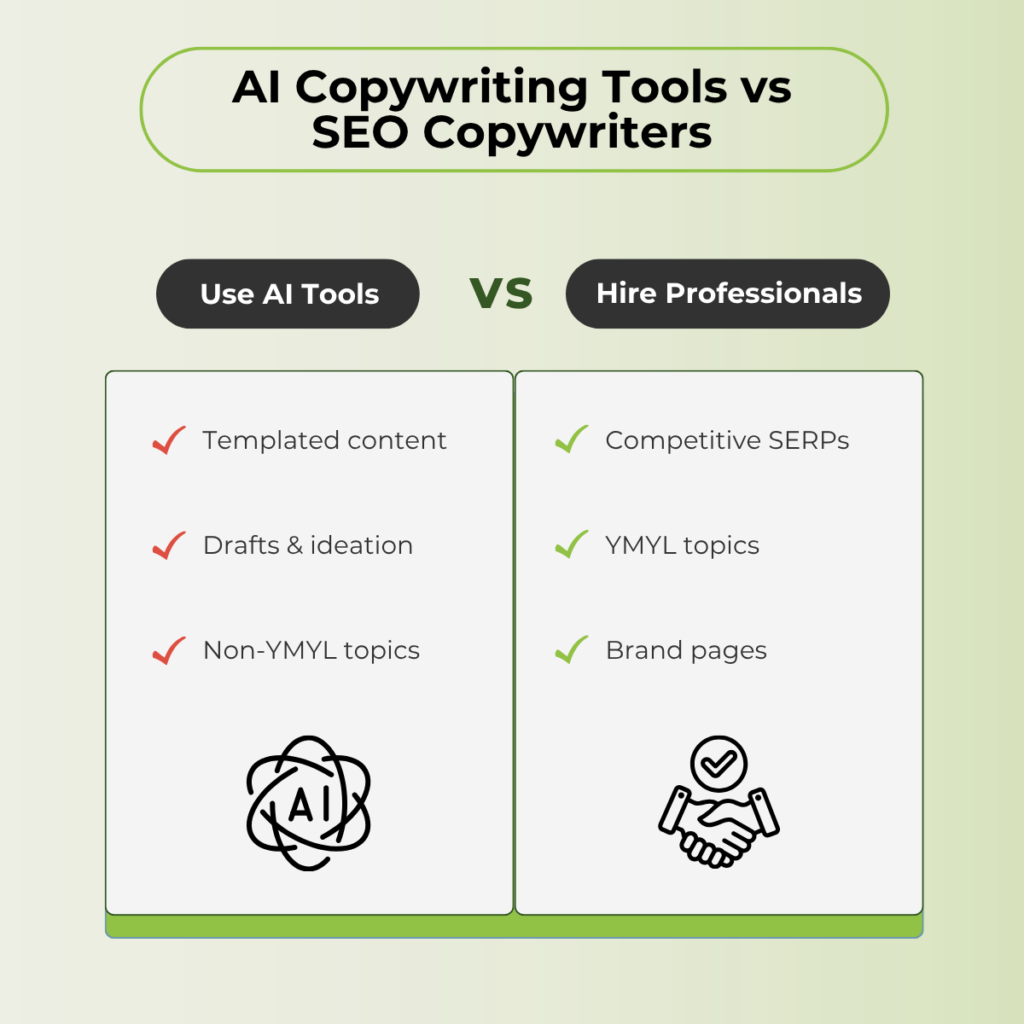
The right answer isn’t always one or the other. It depends on what you’re trying to achieve and the environment you’re competing in.
When AI Copywriting Tools Make Sense
You can benefit from AI tools wherever you can, and you should. Here are some scenarios where an AI copywriting tool can help you;
- Low-competition niches with thin SERP content. If the top-ranking results for your target keywords are short, shallow, or outdated, well-edited AI content can compete. The quality bar is lower, so execution speed becomes an advantage.
- High-volume, templated content. You can use AI tools in generating product descriptions, location-specific landing pages, and FAQ expansions. But never rely 100% here, either. Always edit and refine the content manually.
- Internal content and first drafts. Internal documentation, content briefs, brainstorming sessions, headline variations. AI tools are excellent as starting-point generators that a human then refines.
- Non-YMYL topics with broad audiences. If your content doesn’t fall under Google’s Your Money or Your Life scrutiny (health, finance, legal), and your audience isn’t highly specialized, AI-assisted content with solid editing can serve well.
When You Need a Professional SEO Copywriter
These are some scenarios where you’ll need a human SEO copywriter who knows what they’re doing.
- Competitive SERPs where the top 5 results are deep, expert-written pieces. If you’re competing against established sites with strong content, AI-only output rarely breaks through. You need the strategic depth and quality signals that come from professional research and writing.
- YMYL topics. Health, finance, legal, and any category where Google applies stricter quality evaluation. The EEAT bar is higher, and AI content is at greater risk of being flagged as low quality.
- Brand-critical content. Your homepage, service pages, pillar content, and the blog posts that directly support your sales funnel. These pages represent your brand’s expertise to potential buyers. Generic copy erodes trust.
- Building topical authority from scratch. A newer site competing against established players needs every available quality advantage. Content architecture, internal linking strategy, and deep topic coverage require a professional who understands SEO content as a system, not a collection of individual posts.
- Sophisticated B2B audiences. If your readers are industry professionals who spot shallow content in two paragraphs, AI-only copy costs you credibility. These audiences expect depth, nuance, and evidence.
Google’s Quality Signals and Why the “Publish More” Strategy Backfires
The biggest selling point of AI copywriting tools is volume. Publish more, rank more. The math sounds right until you check it against Google’s own policies.
Scaled Content Abuse Is Now a Specific Spam Category
In its March 2024 spam policy update, Google added “scaled content abuse” as a dedicated category. The definition targets content produced at scale, with or without AI, that exists primarily to manipulate rankings rather than serve users.
The key phrase is “without meaningful added value.” If your content operation uses AI tools to generate dozens of posts with surface-level keyword coverage and no original insight, this is the category you land in. Not because AI wrote it. Because nothing valuable was added on top.
Businesses don’t usually intend to fall into this bucket. But when the content marketing strategy is “produce more content faster” and the tool writes without human editorial oversight, that’s exactly where the output lands.
The Quality Rater Guidelines Now Assess AI Oversight
Google’s January 2025 Quality Rater Guidelines update made something explicit. Raters are now asked to assess whether content shows evidence of human editorial oversight. Content that shows no human fingerprint can be rated “Lowest.”
Google does not automatically penalize AI-generated content. But the content without meaningful human involvement gets flagged during quality evaluation.
For businesses relying entirely on AI tools, this is a signal worth paying attention to. The content doesn’t need to be written by a human. But it needs to be shaped, reviewed, and improved by one.
What Professional SEO Copywriting That Brings Results Looks Like
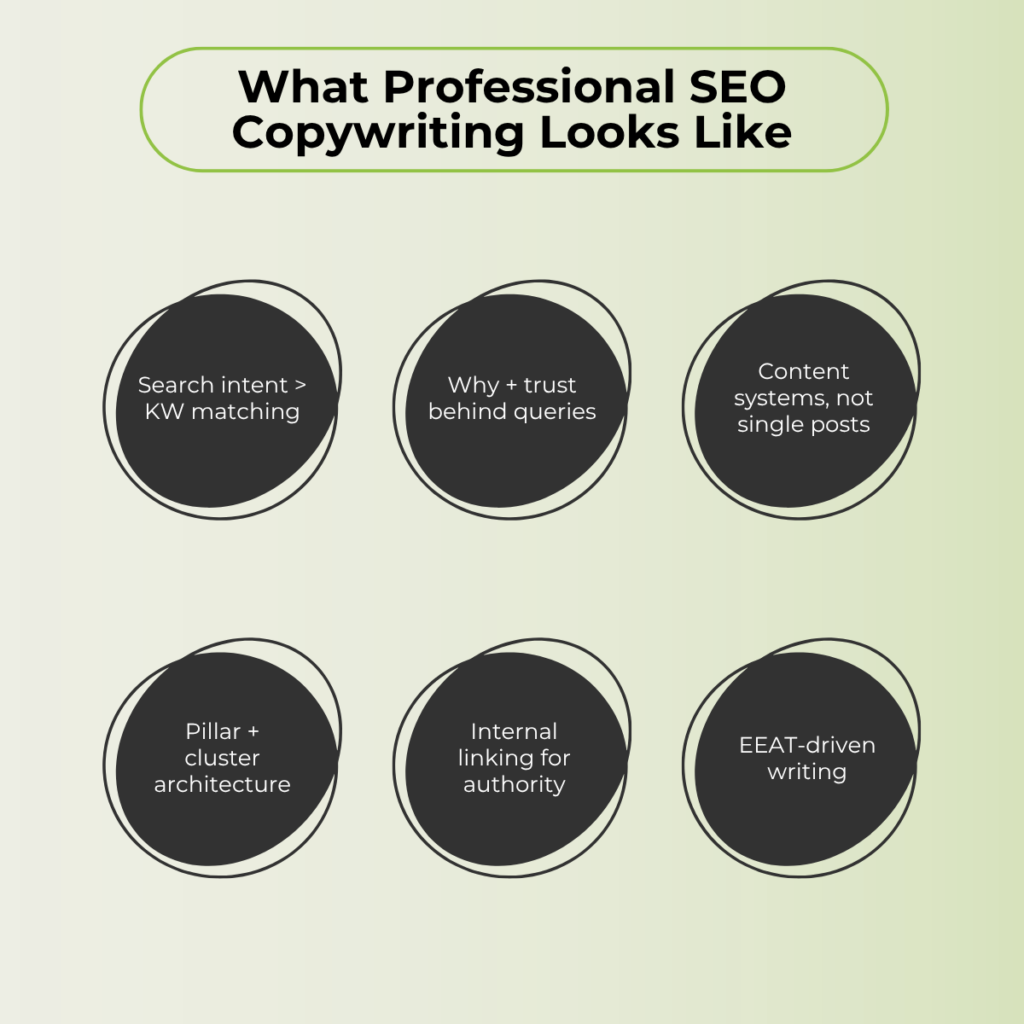
I’ve written 1200+ content pieces for 55+ clients, and the pattern for successful posts has always been consistent. The posts that rank and bring results have nothing to do with the writing tools. Almost all of them were based on a solid content strategy.
Professional SEO copywriting isn’t “better writing.” It’s the strategic layer that starts before a single word hits the page.
Search Intent Research That Goes Beyond Keyword Matching
AI tools match keywords. They find related terms. They suggest density targets.
A professional SEO copywriter asks different questions. Why is someone searching this term? What do they already know? What are they comparing? What will make them trust this page over the next one?
Intent satisfaction is the ranking factor that keyword matching alone cannot deliver. A page can include every relevant keyword and still fail to rank because it doesn’t answer the question the reader came with. Professionals decode the intent. AI tools match the language.
Content Architecture That Builds Topical Authority
A professional copywriter builds content systems.
Each blog post supports a pillar page. Internal links create topic clusters. Every piece strengthens the site’s authority on a subject. This is content architecture, and it’s the structure that tells Google your site is the most comprehensive resource on a topic.
AI tools write individual pieces. They don’t understand where a piece fits in a larger content ecosystem. Whether you’re building this architecture from scratch or restructuring existing content that isn’t performing, the strategic layer requires someone who sees the full picture.
EEAT Signals That AI Genuinely Cannot Produce
Google’s EEAT framework (Experience, Expertise, Authoritativeness, Trustworthiness) sets the quality bar for ranking content. Each signal requires something that AI tools cannot generate on their own.
- Experience. Real client stories, practitioner insights, industry-specific examples drawn from doing the work. Not from summarizing other people’s work.
- Expertise. Nuanced knowledge that simplifies complex ideas for the target audience. What you leave out is as important as what you include.
- Authoritativeness. Confident positioning backed by evidence. Not hedging with “it depends” and no context to follow.
- Trustworthiness. Accurate information, proper sourcing, zero hallucinations. AI tools hallucinate. Professionals verify.
These signals separate content that ranks and holds its position from content that indexes and disappears. They require a human at the center of the process.
The Real Cost Comparison That Tool Marketing Ignores
AI copywriting tools are cheaper per article. That’s true. A tool subscription runs $30 to $200 per month and can produce unlimited output. Professional SEO copywriting costs significantly more per piece.
But “cost per article” is the wrong metric. The metric that matters is cost per ranking position.
Cost Per Article vs Cost Per Ranking Position
Consider these two scenarios.
Scenario A. You use an AI tool to produce 50 blog posts over six months. Total cost, including tool subscription and time spent on prompting, editing, and publishing, is roughly $800- $1200. Of those 50 posts, two reach page one. The rest sit beyond position 20, generating near-zero traffic.
Scenario B. You invest in 12 professionally written, strategically planned blog posts over six months. Total cost: $2,000 – $3,000. Eight reach page one. Three hold top-three positions. Those posts drive consistent organic traffic for 12 to 24 months.
The per-article cost of Scenario A is lower. The cost per ranking result is higher. The total return is worse.
This is the math the tool marketing doesn’t show you. Cheap content that doesn’t rank isn’t cheap. It’s a wasted budget.
You Might Have These Questions About AI Copywriting Tools and SEO Rankings
Yes. AI content can index and appear on page one. But Position 1 results are 8x more likely to be human-written. AI content tends to plateau in positions 5 through 10, while the top spots require depth, originality, and expertise that AI alone doesn’t deliver.
Google penalizes low-quality content regardless of how it was produced. The “scaled content abuse” policy targets mass-produced content that adds no value. If AI content goes through editorial review and adds genuine insight, it isn’t penalized for being AI-generated.
The most effective model is human-led, AI-assisted. Professionals use AI to speed execution while maintaining control over strategy, research, and editorial quality. 64% of SEO teams already work this way.
Strategy, search intent interpretation, EEAT alignment, content architecture, and conversion-focused writing. AI handles words on a page. Professionals handle the decisions that determine whether those words rank and convert.
Several factors influence the timeline. Domain authority, competitive landscape, content architecture quality, and topical relevance all play a role. Professional content typically builds compounding authority over 4 to 8 months. AI-only content may index faster, but it often plateaus or declines without strategic support.
Rankings Follow Strategy, Not Word Count
The question was never “AI or human.” It was always “execution alone or execution built on strategy.”
AI copywriting tools put words on pages faster. But rankings come from the strategic layer above the writing. Search intent research. Content architecture. EEAT signals. Conversion-focused framing. These are the inputs that produce ranking outcomes. And they require a professional at the center.
If your content isn’t producing the rankings you need, the tool isn’t the problem. The missing strategy layer is.
Ready to build an SEO content strategy that ranks? Book a call with Saiqic, and let’s map out what your content needs to do.
