
A real estate team hires a content writer, hands them a list of topics, and waits. Twenty posts go live over a few months. Traffic moves a little. The contact form stays empty.
The writer did what they were asked. Nobody handed them a strategy built to convert.
A real estate content writer is responsible for writing high-quality, SEO-optimized, and AI-search-friendly content on the topics they’re assigned, content that speaks to buyers and sellers separately, respects Fair Housing rules, and meets the research bar that Google expects for YMYL topics. Turning that content into leads is a strategy decision, made before the writer ever opens a doc.
This post covers exactly what to expect from a real estate content writer, what falls outside that role, and what your content needs to actually convert.
The Responsibilities of a Real Estate Content Writer (Spoiler: It’s Not Bringing Leads)
Here’s what a real estate content writer is actually on the hook for, and what they’re not.
Writing locally accurate, audience-specific content.
The writer knows how to write accurate content that resonates with your ideal reader. You get content written for your market, split between buyer and seller intent, using local data, school ratings, and submarket trends to make each post useful rather than filler.
Meeting YMYL research standards.
Real estate is a Your Money Your Life topic on Google. The writer’s research should draw on sources such as NAR reports, the local MLS, HUD data, and state housing authority publications, not just whatever’s already ranking. Surface research produces surface content, and that gets filtered out.
Writing Fair Housing-compliant copy from the first draft.
The Fair Housing Act bans language that expresses a preference, limitation, or discrimination based on protected classes, even in seemingly harmless phrases. A writer who knows this writes clean copy the first time, not after a compliance review flags it.
Structuring content for both Google and AI search.
This means clear headings, direct answers near the top, FAQ sections built around real questions, and a structure that AI tools can cite when someone asks ChatGPT or Gemini about your market.
Executing the topics and angles they’re given, on time and at quality.
A writer turns a content brief into a finished, optimized post. They don’t decide which topics get written, in what order, or how the site converts the traffic those posts bring in. That’s a different role.
If You Want Leads and Organic Growth, You Need a Content Strategist Who Also Writes
If your goal is more inbound inquiries, the role you need is broader than “content writer.” A content strategist who writes decides which topics to prioritize, how buyer and seller content maps to your sales funnel, what the site needs structurally to convert, and how it all builds toward rankings and AI visibility over time.
That person costs more, and should. Because they’re responsible for making the decisions that determine whether the writing matters.
| Role | Core Responsibility | What to Expect |
|---|---|---|
| General Content Writer | Write the assigned topics in a brief | Clean, readable posts. No topic selection, no strategy, no conversion ownership. |
| Real Estate Content Writer | Writes locally researched, audience-split, YMYL-compliant content on assigned topics locally | Content that’s accurate, compliant, and AI-search-ready, but only as good as the brief it’s built from. |
| Real Estate Content Strategist (Writer) | Plans the content roadmap, writes or oversees execution, and ties content to conversion | A system: prioritized topics, buyer/seller tracks, on-page structure, and a plan for turning traffic into leads. |
| SEO/GEO Agency (Full-Stack) | Strategy, writing, on-page SEO, technical structure, and site infrastructure as one operation | Everything above, plus the site-level work (internal linking, schema, page structure) that content alone can’t fix. |
What a Real Estate Content Writer Needs From You to Do This Well
Even a skilled writer can only produce content like the above if they’re working from a real plan, not a topic list pulled from a keyword tool. Here’s what that plan needs to include.
A content strategy, if the writer isn’t also your strategist.
Someone needs to decide which topics matter, in what order, and why. If your writer’s role is execution only, this has to come from you, an internal marketing lead, or an agency.
A buyer-seller content split.
Decide which queries and topics belong to buyer content and which belong to seller content before assigning anything. A writer can execute the split; deciding where the line falls for your market is a strategy call.
Research sources beyond other blog posts.
Point the writer to your local MLS access, any proprietary market data you have, and local news coverage. This is the difference between a post that sounds right and one that’s actually accurate.
Local market context.
Which neighborhoods are rising, which school districts have openings, what the commute corridors look like. A writer can research this, but a head start from someone who knows the market saves time and improves accuracy.
Fair Housing guardrails specific to your market.
The Act applies everywhere, but some states and cities add their own disclosure or language rules. Flag anything specific to yours.
You Need a Killer Real Estate Content Strategy if You Want Targeted Traffic
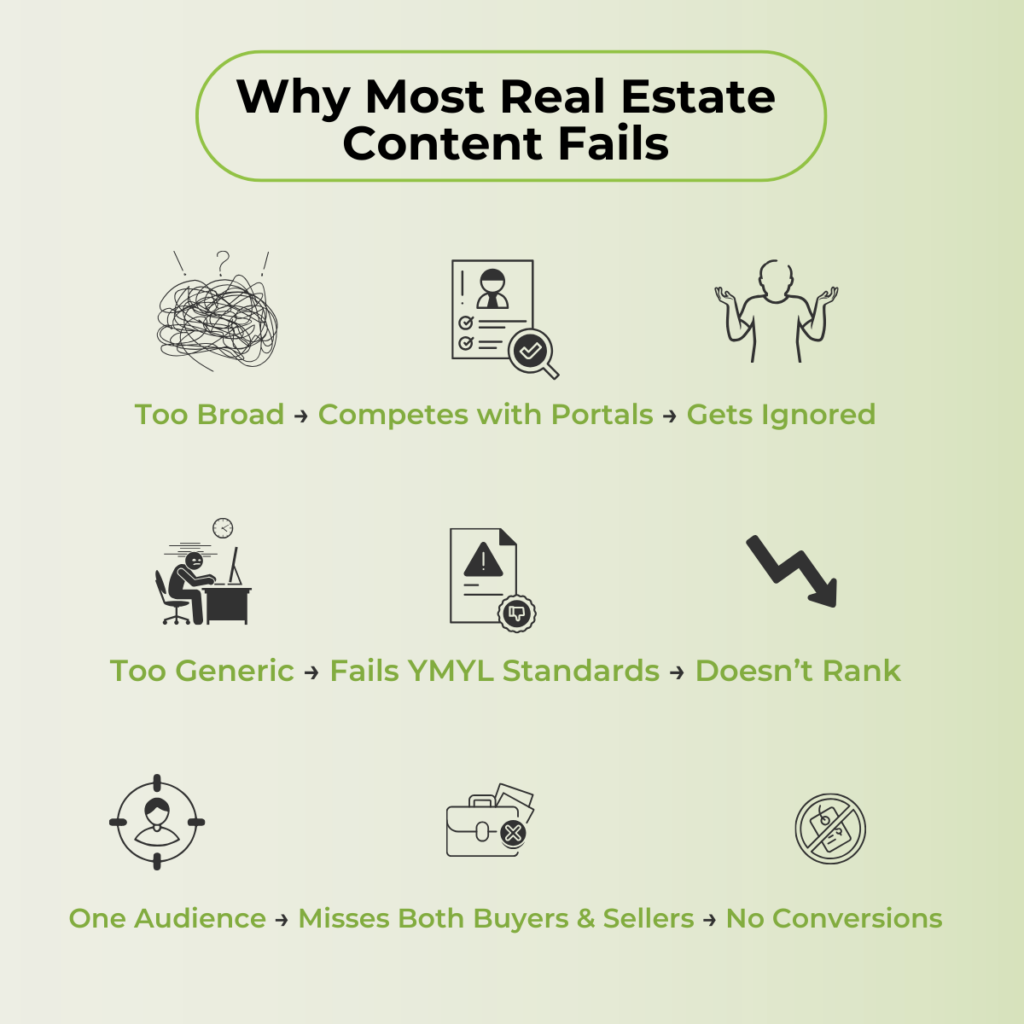
Real estate content that reads like a national magazine article never converts. There are two reasons behind it;
- First, most content treats “real estate” as one audience when it’s really two: buyers and sellers move through different timelines, emotions, and questions.
- Second, real estate is YMYL to Google, which means the EEAT bar is higher than it is for a lifestyle blog.
A skilled writer can solve the first problem if the strategy tells them where to draw that line. Neither a writer nor a strategy alone solves the second. A generalist topic list, however well written, won’t out-rank realtor(.)com or Zillow on a citywide query.
The winning move is hyperlocal: block-level, market-specific, the kind of post titled “How Long Homes in [Neighborhood] Actually Sit Before Selling Right Now” rather than “How to Stage Your Home.”
That hyperlocal angle has to come from the strategy, whether that’s you, a marketing lead, or an SEO partner.
The section below covers what that strategy should actually call for, broken down into buyer content, seller content, and listing copy.
The Type of Content Your Real Estate Strategy Should Prioritize
A real estate content strategy isn’t one list of topics. It’s at least three tracks, each with a different reader and a different job to do.
Buyer-Focused Content That Pulls Qualified Leads to Your Listings
Buyer content works when it’s specific, local, and tied to a decision the buyer is actively making.
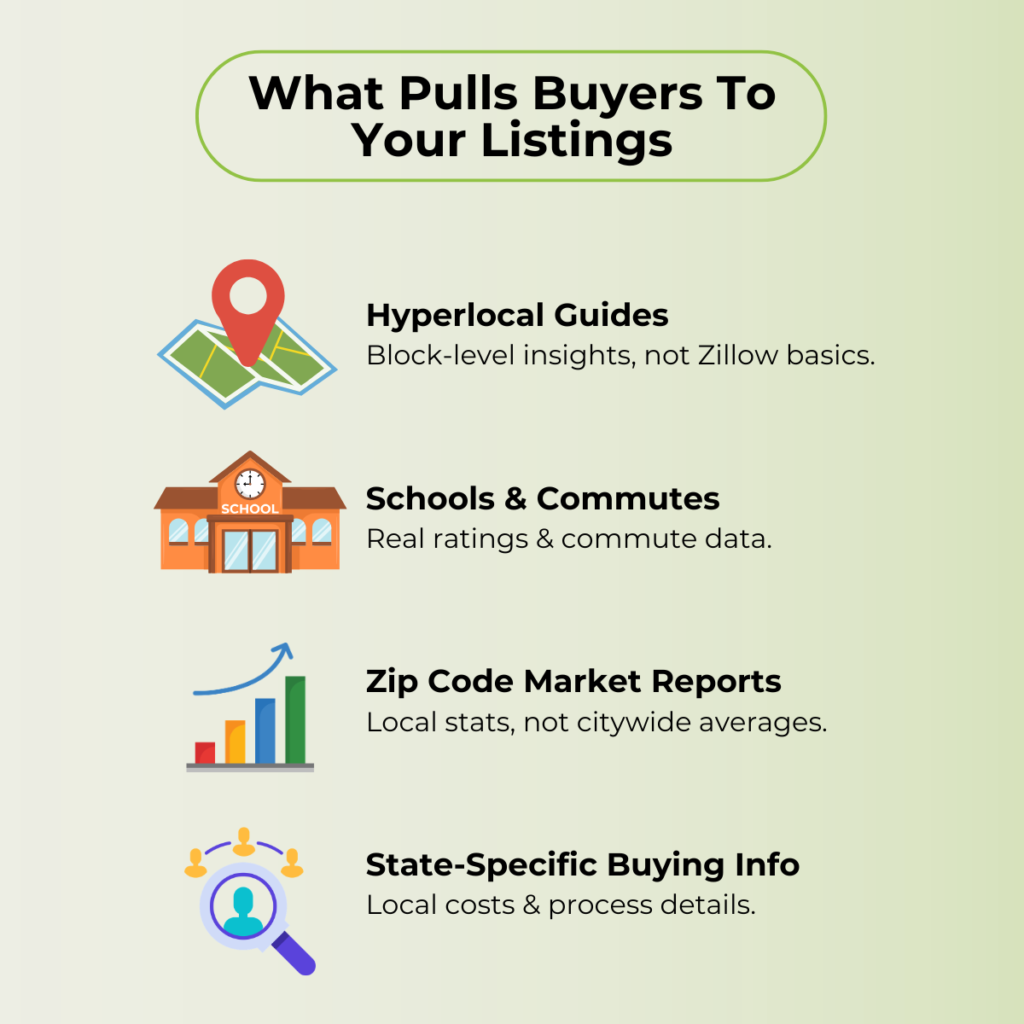
Hyperlocal neighborhood guides
The content that dig deeper than Zillow’s median price: walkability at the block level, parking after hours, flood-prone streets, the honest trade-offs of moving there.
School district and commute content should use real GreatSchools ratings, test score breakdowns, and commute times, since “best elementary schools in [city]” is one of the highest-converting buyer queries when it’s backed by data.
Submarket reports scoped to a zip code or neighborhood, covering median price, days on market, and price per square foot, give buyers something Zillow’s auto-generated data doesn’t.
State-specific home-buying content
Content like “how to buy a house in [state]”, with that state’s closing timelines and financing quirks) beats generic national guides. And closing cost or mortgage explainers with real numbers, “closing costs on a $425,000 home in [city]” rather than a vague national topic, are what turn a curious visitor into a form fill.
Seller-Focused Content That Brings Sellers to Your Contact Form
Seller content runs on a different emotional frame. Sellers want to know what their house is worth, how fast it will sell, and what to do before listing.
Home valuation content should be tied to live local comps, since every seller’s first search is some version of “what is my house worth in [city].” Generic “how to value your home” advice doesn’t convert; local comp analysis does. Days-on-market content should be scoped by neighborhood, price band, and season, since “how long does it take to sell a house in [city]” is one of the highest-intent seller queries, and most agent blogs answer it with a vague national stat.
Pre-sale prep content should reflect what buyers in that specific submarket actually expect, not a 2019 staging manual. And one “what to expect” post per market, covering fees, tax implications, and local closing quirks, is worth more than ten generic selling guides.
Listing Descriptions Deserve Their Own Place in the Strategy
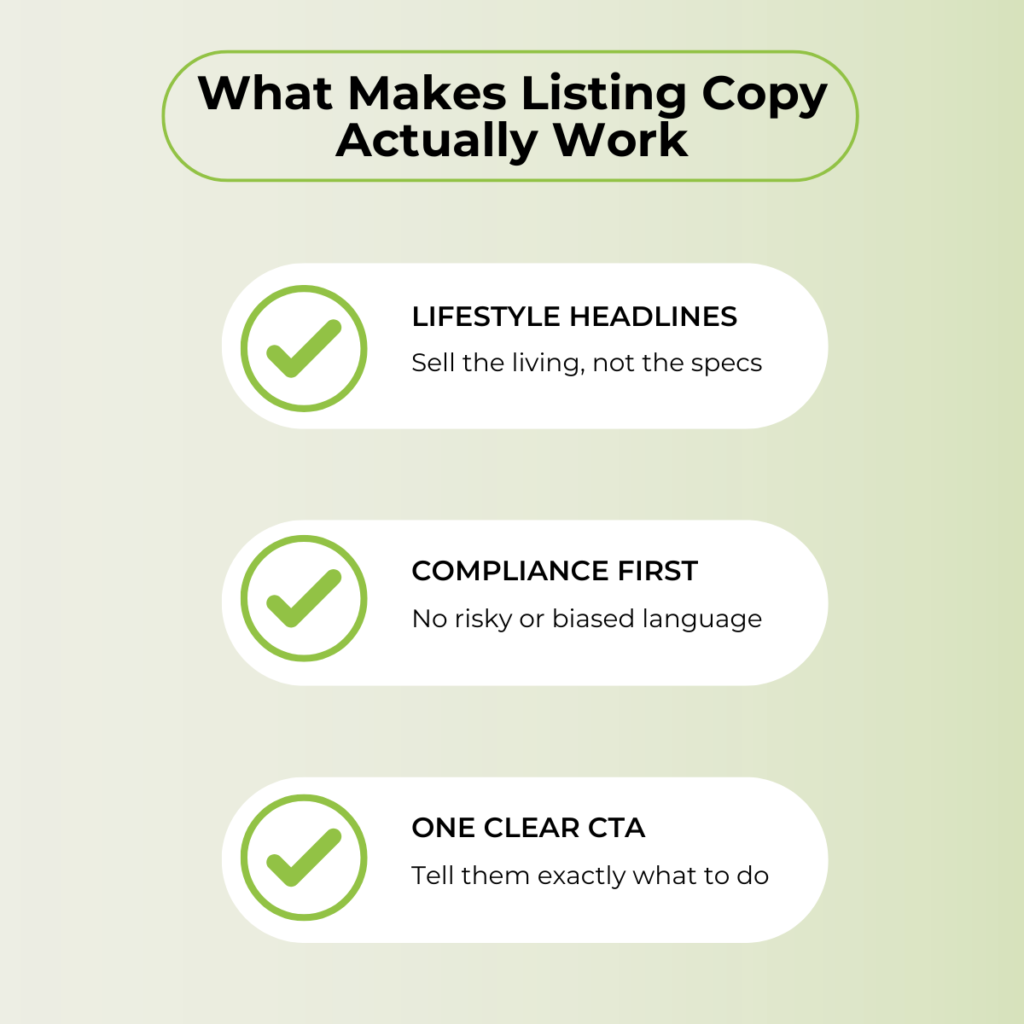
A 150-word listing description gets more buyer eyes per word than any blog post will, and most strategies treat it as an afterthought.
The headline’s job is to sell the lifestyle, not repeat the square footage the MLS data already shows. “Sun-Drenched Corner Unit With Park Views and Original Brick” does work the MLS data can’t.
Fair Housing compliance matters here more than anywhere else on the site. Phrases that sound harmless, like “family-friendly neighborhood,” “walkable” (when implying exclusion of people with disabilities), “exclusive community,” or “perfect for young professionals,” can all create real legal exposure. A strategy that builds Fair Housing review into the writing process, not just the final check, protects you here.
Every listing should end with one specific call to action matched to the buyer’s stage: “Schedule a private tour,” “Register for the open house Saturday,” or “Get pre-qualified to make an offer.” Not “contact us for more information.”
You Might Have These Questions About Real Estate Content Writing
No. A license is a legal requirement for practicing real estate transactions, not for writing about the industry. A competent writer can produce excellent real estate content through rigorous research, local market immersion, and EEAT-aligned citation practices.
Expect 4 to 6 months before a consistent publishing cadence starts producing qualified organic traffic. Early wins can come from submarket-specific long-tail content that has low competition. Lead generation through SEO content also heavily depends on your content strategy as well.
A real estate copywriter writes conversion-focused short copy (listing descriptions, landing pages, email sequences, ad copy). A real estate content writer writes longer educational content (blog posts, neighborhood guides, market reports, buyer and seller guides) designed to pull in organic traffic over time. Most brokerages need both.
Unedited AI content has poisoned a lot of real estate blogs and Google is increasingly good at filtering it out. AI can assist with research, outlines, and first passes, but it cannot replace the local fluency, compliance awareness, and EEAT depth that a real estate topic requires. The content still has to be written, or rewritten, by someone who knows the market.
Four to eight posts per month is the working range for most brokerages. Lower volumes work if every post is deeply local and well-researched. Higher volumes only help if the quality holds.
Hire a Real Estate Content Writer Who Knows the Market and the Leads Will Follow
Content writing isn’t a side project for a real estate brand. It’s one layer of a content marketing system that has to sit next to website copy, local SEO, and lead capture to actually work. A real estate content writer who understands the buyer-seller split, respects Fair Housing, knows YMYL, and writes hyperlocally turns a blog from a vanity asset into a lead source.
That’s the standard. Hire against it, and your content starts earning its keep.
If you want a team that builds this system end-to-end, content, copy, and the web infrastructure around it, book a call with Saiqic.
