
Every time a guest finds your hotel on Booking.com and clicks “reserve,” you hand over 15 to 25 percent of that booking. Expedia takes a similar cut. For a property doing $2M in annual revenue, that’s potentially $300,000–$500,000 leaving through a channel you don’t own.
Organic search is how you close that gap. Guests find your property on Google, land on your site, and book directly, at full margin. But most hotel SEO agencies pitch rankings. And there’s a wide gap between “ranked #4 for [city] hotels” and “direct bookings went up 30%.”
Here’s how to tell which side of that gap an agency is on before you commit to a retainer.
Why Hotel SEO Is Harder Than SEO for Any Other Industry
Most agencies treat hotel SEO as generic SEO. It isn’t. A hotel website’s SEO is structurally different from that of a law firm, an e-commerce store, or a SaaS product. Unless an agency understands those structural realities, its playbook will miss the mark even if it executes it well.
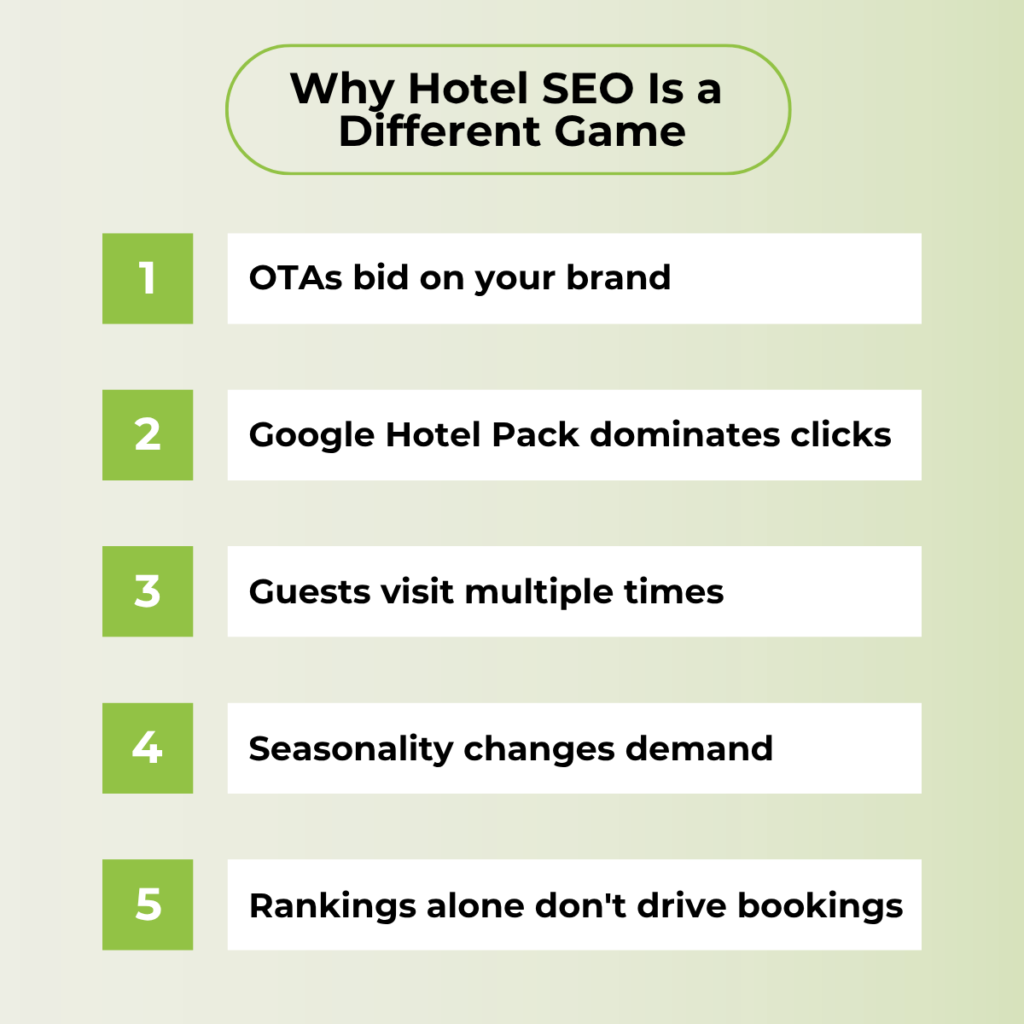
OTAs compete on your brand keywords, and they are well-funded
When someone Googles your hotel by name, you expect to rank first. Often you do, but Booking(.)com and Expedia are frequently bidding on that same branded term in paid search, and they’re capturing guests who would have booked direct. OTAs have advertising budgets that dwarf what most independent hotels spend on marketing in a year. A hotel SEO agency that doesn’t factor this into its strategy (specifically, how to capture direct bookings before a guest reaches an OTA) is ignoring the single biggest leak in your distribution channel.
Google Hotel Ads sit above organic results on high-intent searches
Search “hotels in [your city]” right now. Above the organic blue links, you’ll see Google’s hotel pack: a map, live pricing, availability filters, and direct links to booking platforms. On the highest-intent searches, organic results often appear below the fold. A good hotel SEO agency knows this and plans around it:
- They can tell you which keywords are dominated by the hotel pack and which have genuine organic opportunity.
- They build content and local strategy around the reality of the SERP, not an idealized version of it.
- They don’t chase rankings that get buried under paid placements on the searches that matter most.
The hotel booking journey is multi-visit, not impulse
Most guests visit a hotel’s website 3 to 5 times before making a reservation. They compare, they leave, they come back. That means a single page ranking doesn’t close the deal. The whole site needs to work: room pages that convert, location content that builds trust, a reservation system that doesn’t lose people at checkout. An agency focused only on getting one page to rank is optimizing one door on a leaky ship.
Seasonality compresses your keyword opportunity into windows
Hotel demand is seasonal, and keyword search volume moves with it. An agency publishing content on a flat monthly cadence, with no regard for when demand peaks, will miss the windows where organic traffic actually converts. The content calendar has to follow your booking calendar. A few examples of how that plays out:
- “Beach hotels in [destination]” searches spike in late spring, ahead of the summer booking season.
- Ski resort and mountain lodge queries cluster in early fall, when guests are planning winter trips.
- City hotels near convention centers see search volume surge weeks before major events.
- Holiday and long-weekend inventory gets searched far earlier than most agencies build content for it.
What Hotel SEO Services Should Include and Where Most Agencies Cut Corners
When you hire an SEO for your hotel website on a retainer basis, the only objective is to grow your website and business organically. Here’s what legitimate hotel SEO scope looks like, and where the shortcuts appear.
Technical SEO so your hotel site’s speed, structure, and search visibility hold up where it counts
The majority of hotel searches happen on phones, often while someone is mid-trip or actively comparing properties. Site speed on mobile is not a nice-to-have. Schema markup matters in this context too: search engines need structured data to understand your room types, pricing, availability, and review scores well enough to surface them in rich results. A hotel site with poor Core Web Vitals, broken mobile navigation, or missing structured data is fighting the SERP with both hands tied.
Any agency that treats the technical audit as a one-time setup item rather than ongoing work is cutting the corner that matters most. The things to verify in their proposal:
- Do they audit Core Web Vitals and mobile UX specifically, not just desktop?
- Do they implement and maintain hotel-specific schema (room types, pricing, review markup)?
- Is technical health monitored regularly, not just at onboarding?
Local SEO so your property shows up where nearby guests are searching before they book
Your GBP is one of the highest-leverage assets in your entire marketing stack: it drives calls, direction requests, and website clicks from people who are close to a booking decision. NAP consistency (your name, address, and phone number matching exactly across all directories), review strategy, and local citation building all feed into how well you appear in the local pack for destination searches.
An agency that doesn’t make GBP optimization a core deliverable isn’t doing hotel SEO. They’re doing generic SEO with a hotel client.
Content strategy so your pages attract guests with booking intent, not just destination curiosity
The mistake most agencies make is building the content calendar around informational blog posts: “10 Things to Do in [City],” “Best Restaurants Near [Hotel],” posts that get reads but don’t drive reservations. The content that converts looks different:
- Room pages written to close, not just describe. Specific details, clear rates, strong calls to action.
- Proximity pages targeting “hotels near [landmark/airport/venue]” queries from guests already narrowing their search.
- Destination content structured around the terms guests use when they’re actively choosing where to stay, not just learning about a place.
Informational content has a role (it builds authority and earns links), but it should support the commercial pages, not replace them.
Link building so your hotel earns authority from travel media and local sources
A mention in a regional travel guide or a link from a local tourism board carries more weight for a hotel than a batch of generic guest posts on unrelated blogs. Think of it as a business collaboration; a travel business could use your hotel, and you can collaborate with a trave/tourism company.
Hospitality link building requires outreach to travel journalists, local press, and authoritative directories. It takes relationships and time, which is why most agencies either skip it or outsource it to link farms. Ask specifically how they earn links for hotel clients and who is doing the outreach.
What Your Hotel SEO Reports Should Show and What Is Missing From Most
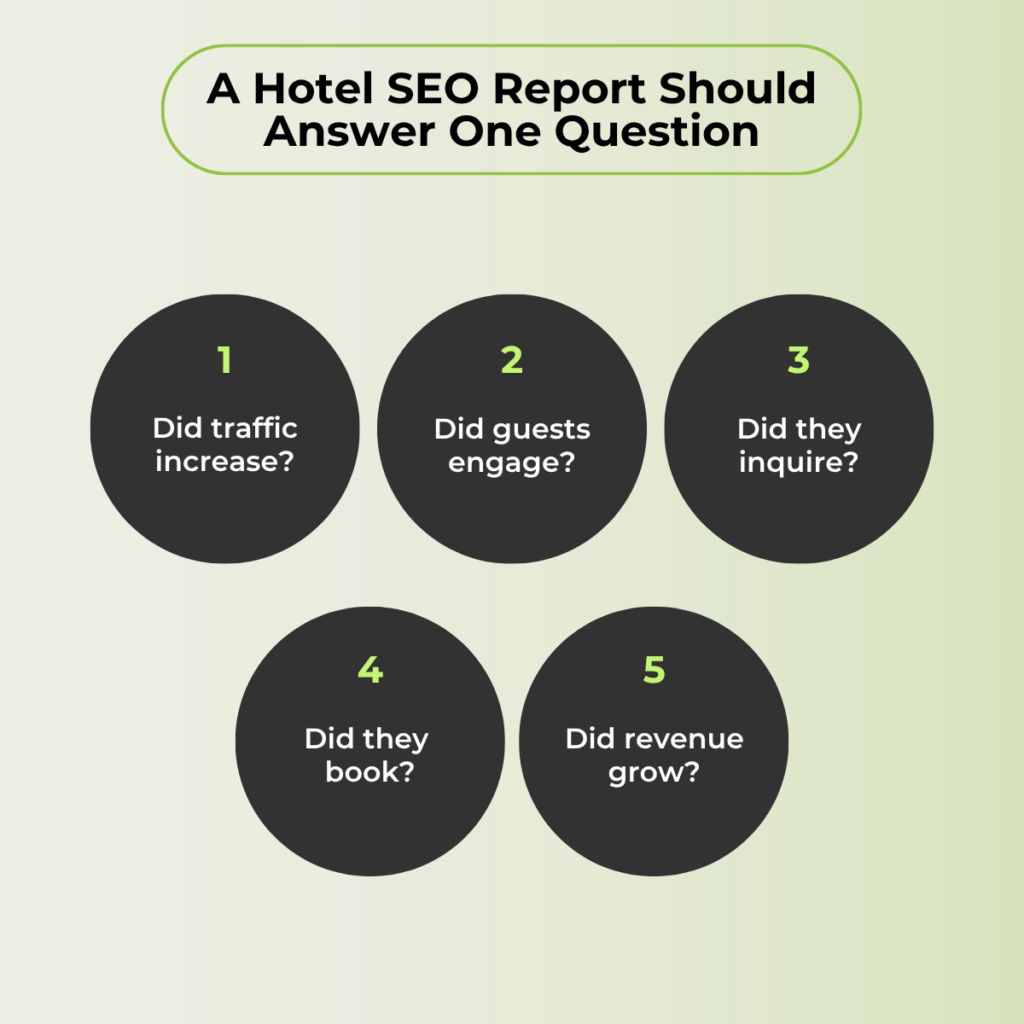
Most hotel SEO reports are built entirely from data the agency can pull on its own: GSC, GA4, and a rank tracker. The problem is that none of those tools tells you whether a guest actually completed a booking. Your confirmed reservation data lives in your property management system, your CRM, or your booking platform (GoHighLevel, Mews, Opera, or whichever system you run). The agency doesn’t have access to that unless you give it to them.
This creates a two-layer tracking problem. Understanding it is how you tell a report that means something from one that’s just noise.
Layer one: what the agency can track from GSC, GA4, and GBP
These are the signals your agency should be monitoring and reporting on every month without needing anything from your side:
- Organic search performance: clicks, impressions, CTR, and average position by page from Google Search Console. Room pages, proximity pages, and destination content should be tracked individually, not just rolled up.
- On-site behavior: session data, bounce rate, and time on page for high-intent landing pages in GA4. If a guest lands on your “Deluxe King Room” page and leaves in 15 seconds, that’s a content or UX problem the agency should flag.
- Booking engine events: if your booking engine fires a confirmation event or a “check availability” click, GA4 can capture it as a conversion. A good agency sets this up at onboarding so there’s a web-level proxy for booking intent, even without access to your confirmed reservation data.
- GBP actions: calls, direction requests, and website clicks from your Google Business Profile are tracked natively and should appear in every report. These are high-intent signals that require no integration with your backend.
- Local pack rankings: visibility for “[city] hotels” and destination terms in the map pack is a separate tracking layer from organic and should be reported separately.
Layer two: what only you can see and why you need to share it
Your agency’s data ends at the website. Confirmed bookings, revenue by channel, ADR by source, and actual lead volume all live in your PMS or CRM. A hotel SEO agency working in isolation from that data is reporting on behavior without knowing outcomes.
This is where most retainers go wrong. The agency shows traffic going up. You nod. Neither of you knows whether that traffic turned into bookings because no one built a bridge between the two data sets.
What you should be sharing with your agency every month:
- Confirmed direct bookings segmented by source (organic, direct, paid, OTA) from your reservation system
- ADR for direct bookings versus OTA bookings, so you can track whether the channel shift is also improving margin
- Inquiry or lead volume if your property takes enquiries through a CRM like GoHighLevel, since those are booking-intent signals your agency should know about
You don’t need to give your agency full access to your PMS. A monthly export or a simple summary sheet is enough to run a proper attribution conversation.
What a legitimate agency does with both layers
A good hotel SEO agency doesn’t wait for you to figure this out. They ask for your booking data at onboarding, set up GA4 tracking on your booking engine from day one, and build a reporting view that combines web-level signals with the booking outcomes you share. The monthly report becomes a conversation about channel shift and revenue attribution, not a screenshot of ranking positions.
If an agency has been running your SEO for three months and has never asked how many direct bookings came through last month, they’re reporting in a vacuum. Rankings and traffic are easy to show. Bookings are the point.
How to Evaluate a Hotel SEO Agency Before You Commit to a Retainer
The discovery call is where you’ll learn everything you need to know if you’re asking the right questions.
Ask for hospitality-specific case studies, not portfolio mentions.
“We’ve worked with hotels” tells you nothing. Ask to see a case study that shows a direct booking uplift, a shift in channel attribution, or a measurable reduction in OTA dependence. Any agency doing serious hotel SEO work has a result they’re proud of. If the best they can offer is “we can’t share client data,” push for anonymized metrics. Vague success stories are not evidence.
Listen for revenue metric fluency in the conversation.
Does the person you’re talking to mention RevPAR, ADR, or OTA attribution naturally, or do they keep defaulting to traffic and rankings? This is one of the fastest reads on whether an agency actually understands hotel economics. You don’t need them to be hospitality finance experts, but if revenue per available room never comes up in the context of what they’re trying to move, their frame of success isn’t aligned with yours.
Understand their audit process.
A real hotel SEO audit covers technical health, GBP and local visibility, content and keyword gaps, and the competitive OTA landscape for your destination. If their onboarding process is running Screaming Frog and doing keyword research without touching any of those other areas, you’ll be getting standard agency work, not hotel-specific strategy.
Look at their content strategy proposal.
Are they planning to target transaction-intent keywords (room type searches, “hotels near X” queries, destination pages) or is the content plan mostly informational blog posts? Informational content is not worthless, but if the ratio is heavy on blog posts and light on commercial-intent pages, the strategy will drive reads, not bookings.
Check the contract terms.
Month-to-month or a short initial commitment period with a reasonable exit clause (3 months after the engagement starts) signals confidence. Lock-in contracts that require 12 months upfront without performance milestones signal the opposite.
Red Flags That Tell You an Agency Does Not Understand Hotel SEO
Some of these are subtle. Others you’ll recognize immediately in a pitch call.
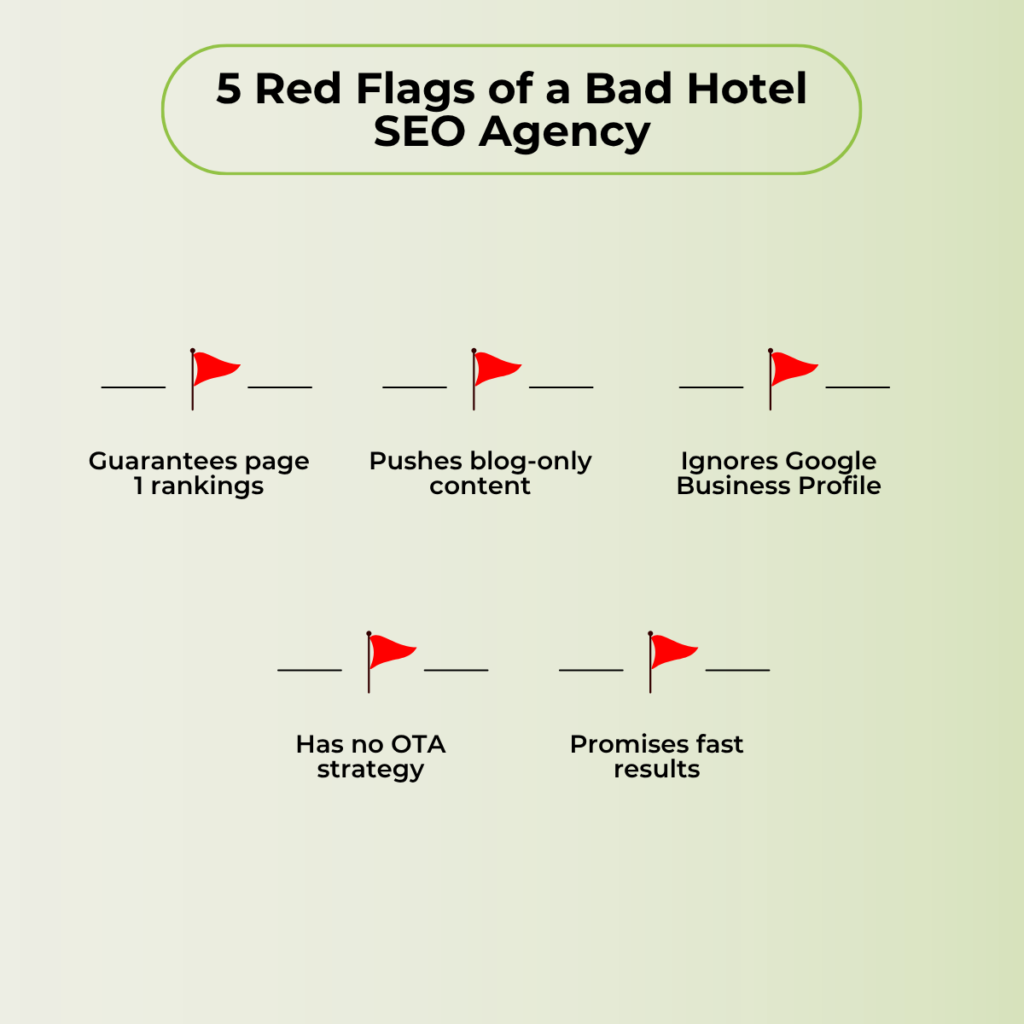
They promise “page 1 Google rankings” without clarifying what page 1 looks like.
On high-intent hotel searches, page 1 is mostly Google Hotel Ads, OTA listings, and the local map pack. Organic results often appear below the fold. An agency promising page 1 prominence without explaining this landscape either doesn’t understand it or is being deliberately vague.
The content plan is blog-heavy and transaction-light.
If the first three months of their content strategy are “10 Things to Do in [City],” “Best Restaurants Near [Hotel],” and “What to Pack for a Weekend Trip,” you’re looking at an agency that knows how to produce content but not how to build a direct booking channel.
They haven’t mentioned your Google Business Profile.
By the end of the first discovery call, a hotel SEO agency that knows what they’re doing will have brought up GBP, local pack visibility, or review strategy, without any prompting from you. If you’re 45 minutes into a call and none of those terms have come up, flag it.
They can’t explain how they’ll compete against Booking.com or Expedia on destination keywords.
OTAs have massive domain authority and deep content libraries. A credible agency has a specific answer to how they’ll compete, typically through hyper-local content, long-tail destination keywords, and GBP dominance in the local pack. “We’ll outrank them with great content” is not a strategy.
They’re promising results in weeks.
Hotel SEO has a structural lag. Technical improvements can show impact relatively quickly. Content and authority building take longer, typically 3-6 months, for meaningful organic traction. Anyone promising fast results is either targeting low-competition keywords that no one is searching for or setting expectations they know they can’t meet.
Reporting is rankings-only.
If their standard monthly report is a rank-tracking export, you’ll spend 12 months knowing where your pages rank without knowing whether any of it is moving your business. Ask to see a sample report before you sign.
How Hotel SEO Impacts Revenue When the Right Agency Is Doing the Work
The revenue impact of hotel SEO runs through three distinct channels. Each one works differently, and a good agency should be able to show you progress across all three.
The distribution cost shift
OTA commissions typically run 15 to 25 percent per booking, with Expedia reaching 30 percent for some independent properties. Direct bookings cost roughly 4 to 4.5 percent to process (payment gateway plus reservation system fees). SEO is what shifts the ratio. As organic-driven direct bookings grow, the blended cost of acquiring a reservation drops, and that difference goes straight to margin.
Traffic intent determines whether rankings turn into revenue
Not all organic traffic behaves the same way. A guest reading “10 things to do in [city]” is researching a trip. A guest searching “boutique hotel near [airport]” or “[city] hotel with rooftop pool” is choosing where to stay. The second type converts. The first rarely does.
A hotel SEO agency earning its retainer builds content around transaction-intent queries and measures conversion rates on those pages — not just overall traffic volume. Higher sessions with flat booking rates mean the wrong traffic is being targeted.
GBP captures guests who are closest to a decision
Someone searching “hotels near [venue]” on Google Maps is often hours or days from arrival, not weeks. GBP-driven actions (calls, direction requests, website clicks) convert at a meaningfully higher rate than blog traffic because the intent is immediate.
A well-maintained GBP, with up-to-date room details, recent photos, a strong review volume, and active Q&A, functions as a direct booking surface that costs nothing per click and bypasses OTA comparison entirely.
The compounding effect on RevPAR over time
Paid ads deliver traffic while the budget runs. SEO builds authority that holds. As commercial pages rank and earn links, their positions strengthen without proportional additional spend. Over 12 to 18 months, this shifts the channel mix: OTA dependency drops, direct share rises, and the cost to acquire each booking falls. RevPAR improves not because occupancy increases, but because the revenue per booking retained goes up.
That’s the model. Any agency that can’t explain its work in these terms before the contract is signed is the wrong agency.
Hire the Right Hotel SEO Agency and the Returns Will Outlast Every Other Marketing Spend
Unlike paid ads or OTA placements, well-executed SEO builds an asset you keep. Content ranks. Authority compounds. Direct bookings cost less to acquire every month, as the organic channel grows.
One question separates the agencies worth hiring from those who aren’t: “Show me how your work moved direct bookings.” A good agency answers it with data. If you want to work with one that does, book a call with Saiqic.
