
You’re paying 18% to Booking(.)com, and your direct booking share hasn’t moved in two years. You’ve thought about SEO content, but you’re not sure exactly what you need. Blog content? A new website, better ads, or a content marketing agency?
The honest answer is none of those, on their own.
Direct bookings come from one thing. A content marketing system where the SEO content brings in the right traffic, and the website copy converts it. Most hotels invest in one half and neglect the other, then wonder why OTAs keep winning.
This blog breaks down what hospitality brands need from each layer, the associated costs, and how to decide whether to build it in-house, hire a freelancer, or work with an agency.
You’re Not Getting Direct Bookings Because Your Hotel Is Not Visible On Google & In AI Search
Why do your target customers find your hotel on OTA? Because OTA has online brand visibility, and your website doesn’t. It’s not a pricing problem, and not even the channel problem. It’s about two things your website is probably not doing. Earning qualified traffic and converting it.
The OTA math that you hate but don’t want to do out loud
OTA commissions run 15% to 30%, depending on the platform and your participation tier.
| OTA | Typical commission range |
| Booking.com | 15 to 18% |
| Agoda | 18 to 25% |
| Expedia | 15 to 25% |
| Large chain (negotiated) | 10 to 15% |
Sources: StayFi, 2025; Little Hotelier.
A 40-room property running a $180 ADR at 70% occupancy clears roughly $1.83M in annual room revenue. If two-thirds of that flows through OTAs at 18%, the hotel hands over nearly $220,000 every year before anyone complains about housekeeping.
$220k is a LOT just to get bookings for your hotel. SEO content costs WAY less than that 🙂
Direct bookings are also more profitable, not just cheaper
A Kalibri Labs study of 18,000 U.S. hotels found direct bookings are 12.5% more profitable than OTA bookings after ALL marketing costs are accounted for.
And yet, OTAs still accounted for 63.4% of independent hotel bookings in 2025.
The reason isn’t that hotels don’t want direct bookings. It’s that the content isn’t earning the right traffic, and the copy isn’t converting the traffic it does earn. Everything that follows sits inside that problem.
I don’t blame hotels for this; nobody ever showed them the stats and presented a better organic SEO/GEO strategy.
What’s the Better Strategy and What Hotel Actually Needs in Content Marketing To Establish a Solid Organic Presence?

Most “hotel content marketing” articles list content ideas. Blogs, videos, emails, social posts. This is a messy, multichannel, chaotic content marketing. A content menu that does not serve even one channel properly.
You need a focused content marketing strategy to grow your single channel effectively. A channel that YOU own 100%. And that channel is your website. If the content strategy is strong, your website will attract the right travelers, and the copy (website content) will convert them. In simple words, your website should be the HUB of your content marketing system, and email, socials, should support the hub.
SEO content writing is the ONLY channel that compounds
Paid stops the moment you stop paying. Social has a half-life measured in hours. Email only works on people who already know the hotel exists.
Hotel SEO content writing is different. The blog post you wrote 14 months ago can still rank today, bring qualified traffic, and drive bookings. A blog post is a one-time investment that continues to drive results for years. That’s why it sits at the core of every serious hotel content program.
Website copywriting decides whether that traffic books directly or bounces
SEO content brings the traffic. The website copy has to close it. Here’s how it works;
- You have a destination guide ranking on page one. This destination guide links to your hotel room booking page.
- If the room booking page is clear, compelling, and descriptive, then the visitor will convert. If not, the visitor will bounce, and your destination guide ranking page is useless. A perfectly ranked destination guide means nothing if the room page it links to reads like a booking engine spec sheet.
Most hotels underinvest in one of these and wonder why the other isn’t delivering. The rest of the post will show you how you can get both (SEO content writing + web copywriting) right.
SEO Content Writing Brings In the Long-Term Organic Traffic
Hotel SEO content writing two very different jobs. Both are necessary, and hotels that only invest in one usually see flat results.
Core web content, the pages on your main navigation
Home, Rooms, Amenities, Location, About, Offers, FAQ. These pages carry your primary commercial keywords and do the majority of the selling. Most hotels write them once during site build and never touch them again.
That’s the mistake. You need to update them periodically, as your audience’s needs keep shifting. Hotels that refresh their core pages every 12 to 18 months see measurable improvements in both rankings and conversion rates.
Blog and article content that pulls top-of-funnel traffic
This is the content that earns clicks from travelers researching your destination long before they’ve decided which hotel to book. Done right, it builds your hotel’s topical footprint on the SERP over time.
The ones that compound share a pattern. They target destination-intent queries that real travelers type when they’re planning a real trip.
- Local area guides with insider depth, not TripAdvisor summary recycling
- Neighborhood roundups that link to local partners and earn backlinks in return
- Event and seasonal content tied to recurring demand
- Itinerary posts that mirror how your guests actually plan
- Utility content for your specific location, like airport-to-hotel logistics, weather windows, or what to pack
The goal is topical ownership. Not content volume
A Florence hotel that ranks for “where to stay near Uffizi,” “walking food tour Oltrarno,” and “Florence in three days” isn’t doing content marketing anymore. It’s becoming the destination’s first-choice content source. Travelers land, read, trust, and book direct. That’s what compounds.
What doesn’t compound, and where most hotel blogs waste budget
If you’re creating content around;
- Corporate announcements
- Generic “7 reasons to choose our hotel” posts
- Hospitality industry think pieces that no traveler is searching for
- Thin destination listicles written by someone who never stood in the city
None of it ranks. Most of it never gets indexed.
Hotel Website Copywriting Turns That Traffic Into Actual Direct Bookings
Qualified traffic is wasted if the website doesn’t sell the stay. This is where most hotels lose the booking, and where most agencies never look, because they’re focused upstream on traffic.
Hotel website copywriting is a full conversion layer of the site, and every page has a specific job. It’s NOT a tagline and a handful of room descriptions.
Every page on your main navigation has a specific job
| Page | What the copy has to do |
| Homepage | Lead with one clear value prop. Make the booking engine visible. Add trust signals (awards, press, reviews). |
| Room pages | Turn features into guest experience. Surface price and availability. Match the trip the reader is planning. |
| Amenities | Sell the experience, not the list. Use long-tail local SEO (“Chicago hotel with rooftop pool”). |
| Location / Neighborhood | Build this as a full page. It carries local SEO weight and sets the destination story. |
| About | Distinct brand voice. Answer why this hotel, not just who runs it. |
| Offers / Packages | Commerce copy. Specific value, specific deadline, specific CTA. |
| FAQs | Short, direct, written for voice search and real guest concerns. |
Feature-dump room descriptions are killing your bookings
Two failure patterns show up on almost every property site I’ve audited. The first is a room copy that reads like a spec sheet.
“Queen bed. 220 sq ft. Blackout curtains. Mini fridge.”
No mention of how it feels to be in that room, and no reason to pick this room over the one listed next to it on Expedia.
The second is clichés.
- “First-class service.” “Feel like home.”
- “World-class amenities.”
- “Nestled in the heart of.”
Google can’t tell these hotels apart. Neither can the reader.
The framework that fixes both is a feature, an advantage, a benefit
“Queen bed, 220 sq ft, floor-to-ceiling windows” becomes “A quiet 220-square-foot corner room with a wall of glass facing the river and a bed deep enough that getting out of it is the hardest part of your morning.”
Same facts. Different categories of experience.
One gets compared. The other gets booked.
Hotel SEO Content & Copywriting Only Work When You Build Them as One System
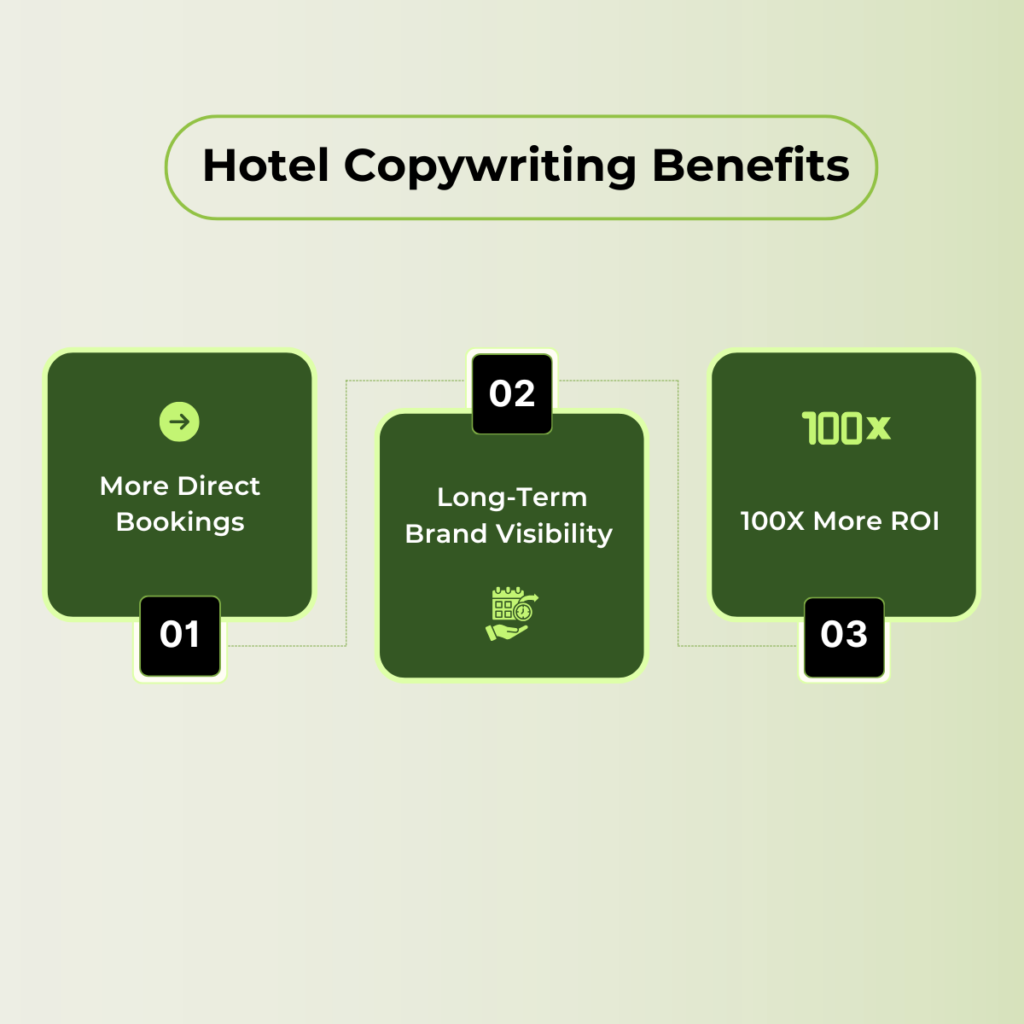
Hotels that move their direct-booking share stop treating the blog and the website as separate projects. The SEO content and the website copy have to be briefed, written, voiced, and measured as one operation.
The sequence that actually produces direct bookings
A destination blog post ranks for a high-intent query. A traveler lands on it, reads enough to trust the hotel’s voice, and clicks an internal link to a room page that matches their planned trip. The room page converts because it was written for that exact traveler in the same voice they just read.
Three things break when the work is siloed
When the content has no proper strategy and structure, these three things will fall apart.
- Internal linking gets neglected. Blog posts end in a generic “book now” footer button instead of a contextual link to the relevant room or offer.
- Voice drifts. The travel-guide tone of the blog doesn’t match the corporate tone of the room pages. The reader feels the shift.
- Measurement is misaligned. The team tracks session volume, rather than the direct-booking conversion rate, by landing page. Traffic that doesn’t book isn’t a win.
One team, one voice, one measurement plan
Whether you hire a freelancer or an agency, always make sure that they own the blog content, the website copy, and how they link together. Two vendors on two calendars rarely work.
Your Hotel Type Decides the Priority Order
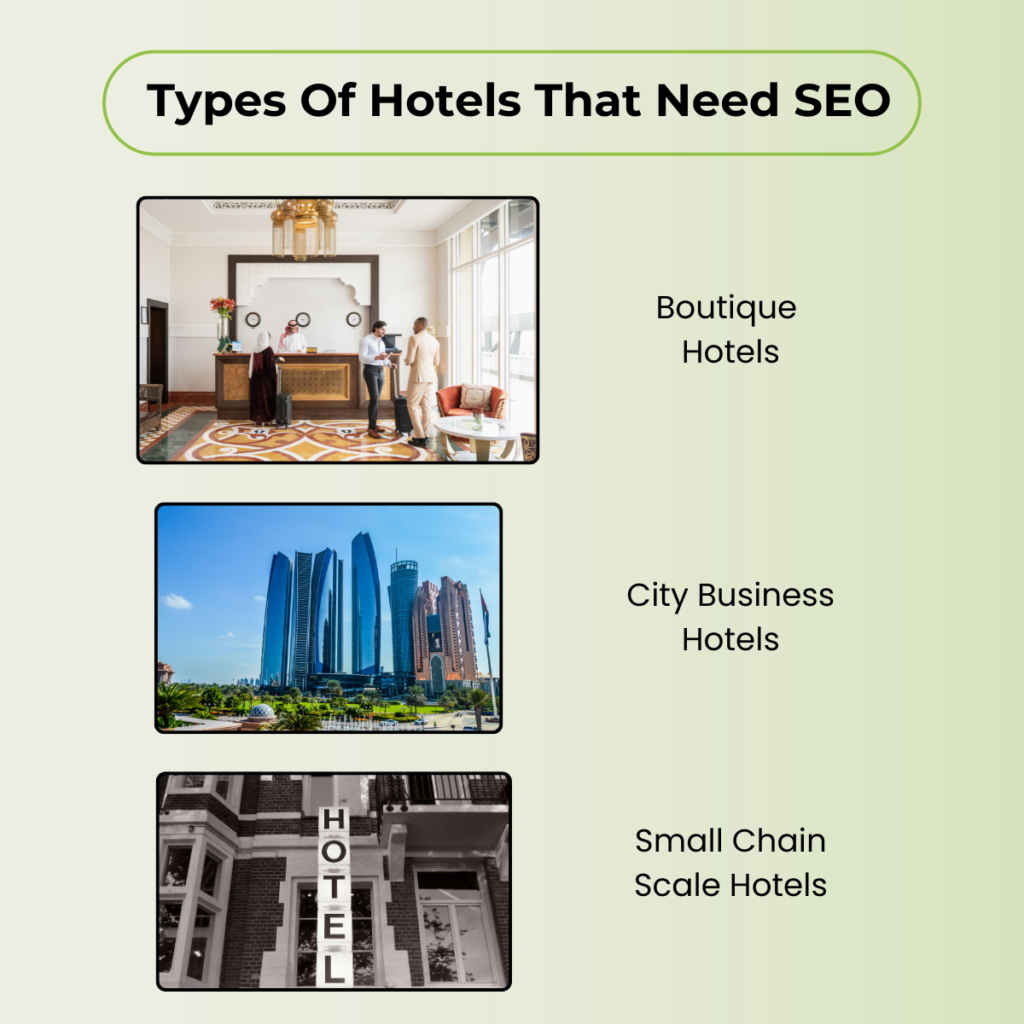
The same system, when applied to different hotels, produces different priorities. The three categories I work with most often each have a different pressure point.
Independent and boutique hotels lean on voice and destination authority
Your strongest asset is a distinctive voice paired with destination authority. You can’t outspend the brands, but you can out-specific them. A neighborhood pillar post plus room-page rewrites usually moves direct-booking share faster than any other investment a boutique can make in a single quarter.
City business hotels rely on local SEO to do the heavy lifting
Business travelers search for “hotel near [conference center]” and “[city] hotel with workspace.” Your Location page, Amenities page, and room-page keyword strategy matter more than long-form blog content. The direct-booking share is won on the commercial pages, not in the editorial.
Small chains scale without losing specificity
For 3 to 10 properties, each one needs its own Location page, its own room-page voice, and its own destination content. But the brand voice has to carry across all of them. This is where content agencies usually earn their fee, because producing property-specific copy at this volume with an in-house team rarely holds quality past two quarters.
Where AI Helps With Hotel Content and Where It Costs You Bookings
Hotels across every segment are experimenting with AI-written content right now. Some of the experiments are helping. Most are quietly eroding conversion.
Where can AI help in the SEO content process?
AI can help with;
- Keyword research and clustering
- Competitor outline summaries
- Internal writer briefs
- First-draft scaffolding that a human writer rewrites into real prose
Used at those stages, AI speeds up the research-and-outline work without ever touching what gets published.
Where AI fails for hospitality content
AI totally fails for;
- Sensory, property-specific room descriptions
- Voice consistency across 40 pages of a site
- Destination nuance that only comes from local research
- The experience and expertise signals Google uses to evaluate travel content
Hospitality is a sensory, lived-in category. Generic AI prose reads as such. Generic. Guests scroll past it. Search engines do too.
The practical rule for hotel marketing managers
Use AI to accelerate the research and briefing stages. Don’t ship AI-written property copy or destination content without a heavy human rewrite. A bad room description isn’t free. It’s the direct booking that didn’t happen.
What Hotel Content Marketing and Copywriting Actually Cost
The cost for hotel content marketing depends on many factors. But I can give you average ranges.
(NOTE: The table below is created in May 2026 guidance based on what independent hotels, city business hotels, and small chains typically pay)
| Service | Freelancer (generalist) | Freelancer (hospitality specialist) | Agency |
| SEO blog post (1,200 to 1,800 words) | $80 to $150 | $120 to $250 | $200 to $500 |
| Core web page (Rooms, Amenities, Location) | $200 to $350 | $250 to $400 | $350 to $500 |
| Full website copywriting (8 to 15 pages) | $800 to $2000 | $1500 to $3500 | $2000 to $8000+ |
| Monthly retainer (4 blogs + maintenance) | $600 to $1000 | $800 to $1800 | $1000 to $3000+ |
Three things worth knowing about this pricing
- Hospitality specialists charge more because they write sensory, property-specific copy that a generalist usually can’t. You’re paying for the difference between a room page that’s compared and one that’s booked.
- Agencies charge more because they provide strategy, SEO research, and editorial oversight in addition to the writing. You’re not paying for words. You’re paying for a system.
- Retainers almost always outperform one-off projects on cost per booking. SEO content compounds between months 6 and 12. One-offs don’t get enough time to pay back.
The wrong question is “what’s the cheapest option?” The right question is “which option shifts direct bookings enough to cover its own cost within 12 months?”
For most independent properties and small chains, that answer is a hospitality specialist or a small agency on retainer.
Choosing Between In-House, Freelancer, or Agency
The best decision is not what you make based on your budget. The best option depends on your business goals, scope, continuity, and whether you need writing or a system.
| Option | Best fit | What you get | What you don’t |
|---|---|---|---|
| In-house | 50+ keys, multiple properties, existing marketing team | Voice control, fast turnaround, institutional memory | SEO strategy depth, writing breadth, ability to scale without hiring |
| Freelancer | Single property, 2 to 4 posts per month, defined scope | Lower cost, direct communication, specialist voice if chosen well | Strategy layer, website copy scope, continuity if they leave |
| Agency | Multi-property, or any brand that wants SEO content + website copy + strategy as one build | Strategy, SEO research, writing, internal linking, editorial oversight, scale | The lowest absolute cost per deliverable |
A simple decision rule
If you want blog posts, hire a freelancer. If you want a direct-booking system that connects SEO content writing and website copywriting into one operation, work with an agency.
You Might Have These Questions About Hotel Content Marketing
Content marketing is the umbrella. It covers SEO blog content, website copy, email, social, and paid. Website copywriting is the conversion layer, the copy on your core web pages that turns the traffic into direct bookings. They’re not competing disciplines. They’re two parts of the same system.
Room-page and core-page rewrites usually show conversion lift within 60 to 90 days. SEO content writing compounds more slowly. Rankings typically take 4 to 9 months, and the real payback window is 6 to 12 months after launch.
AI can handle keyword research, outlines, and first drafts. It can’t extract your property’s voice, write sensory room copy, or produce destination content that ranks on E-E-A-T-weighted queries. For any page that has to convert, AI output needs significant human rewriting before it goes live.
A realistic annual range is $10,000 to $40,000 for an independent or boutique property. That covers a full website copy rewrite in year one plus 24 to 36 blog posts and quarterly refreshes. Small chains run 2 to 4x that, depending on property count.
Hire a freelancer if your scope is defined and you only need writing. Hire an agency if you want strategy, SEO research, website copy, and blog content built as one system. Freelancers are cheaper per deliverable. Agencies are cheaper per booking when the system works.
Fix the Copy First. The Bookings Will Follow.
Most hotels trying to shift their direct-booking share start with more blog posts. That’s the last place to start. Here’s the prioritized order that actually works:
- Audit your five most-visited pages. Score each for copy that sells versus copy that describes. Most hotels discover two or three are conversion killers.
- Rewrite your room pages with the feature, advantage, benefit framework. This is usually the fastest direct-booking lift you can make in a quarter.
- Build one destination-authority pillar post per quarter. Not ten thin posts. One piece you can own on the SERP for three years.
- Tie every blog post to a specific room page or offer, and include contextual internal links. Never end a post with a generic footer CTA.
- Measure the direct-booking conversion rate by landing page. Traffic that doesn’t book isn’t a win. It’s just traffic.
If you want this built and written as one operation, the SEO content, the website copy, the internal linking, and the system behind it, that’s what Saiqic delivers for hospitality brands. Book a call or read the service in detail, and we’ll show you exactly what it would look like for your property.
