
You are an awesome home service provider. You’ve got reviews and customers, but when a homeowner searches on Google or asks AI for the work you do, you never show up.
That gap between how good your work is and how invisible you are online comes down to one thing: the content on your website.
We’ve audited 100s of home services websites across HVAC, roofing, plumbing, pest control, and cleaning. The problem is almost always that their copy sucks. It reads as if a robot wrote it with 1 prompt.
In this blog, you will walk away understanding how exceptional copywriting for home services drives high-quality organic leads.
Why Generic Contractor SEO Website Copy Fails in Local Search
The competitors who’re getting leads, have dedicated service pages for every job they handle, blog posts that answer the questions homeowners actually ask, and location pages that target every city they serve. If your website reads like a general brochure with “quality service” and “customer satisfaction” promises, search engines have nothing meaningful to work with.
Here is what that content gap typically looks like on a contractor website:
- Your service pages say “we do plumbing” instead of addressing specific problems like emergency pipe repair or water heater replacement
- Your homepage leads with a stock photo and a tagline instead of a clear message about what you do and where you do it
- Your blog is empty, outdated, or filled with posts that never targeted a real search query
- You have one “service areas” page instead of individual pages for each city or neighborhood you cover
Every one of those gaps is a missed opportunity for a booked job. The fix starts with understanding what kind of content your website actually needs.
SEO Copywriting vs SEO Content Writing for Home Service Businesses
Your home service website needs two distinct types of content working together: core web content and SEO content. Most contractors either lack one or the other or have weak versions of both.
When you understand how both work, you know where and when to focus.
| SEO Copywriting (Conversion Engine) | SEO Content Writing (Traffic Engine) |
| Turns Visitors Into Calls | Attracts Early-Stage Searches |
| Service pages + homepage copy | Blog posts + location content |
| Speaks to urgent problems | Answers questions homeowners ask |
| Drives calls, bookings, inquiries | Builds visibility and topical authority |
Your website needs both to work together. Most contractors either lack one or have weak versions of both. When you understand how each one functions, you know where to focus first.
SEO Copywriting for Home Services Is What Converts Visitors Into Calls
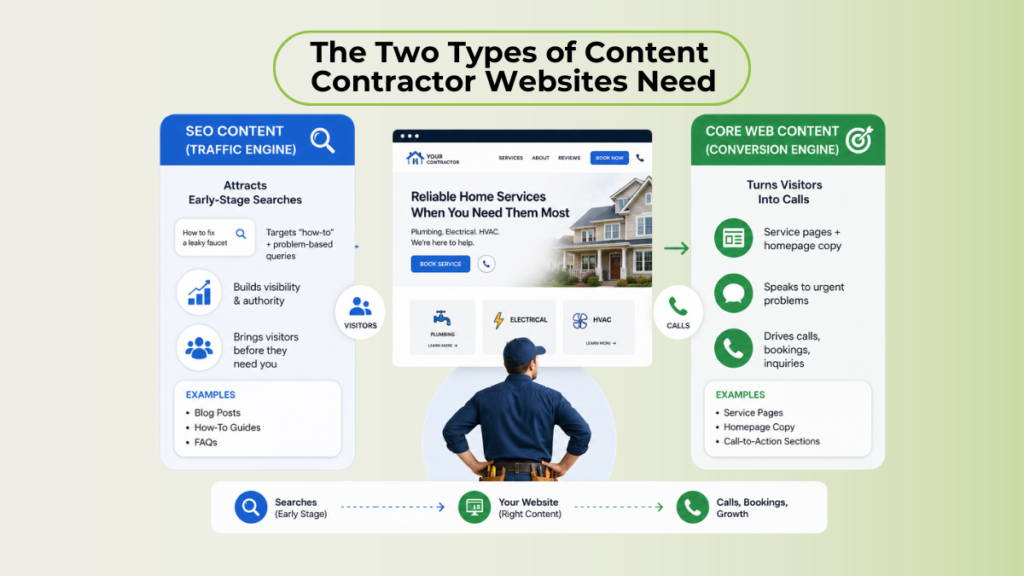
This is the copy on your service pages, homepage, and about page. Its job is conversion. When a homeowner is comparing three contractors in three browser tabs, your service page copy is what makes them pick up the phone or close the tab.
Good home service SEO copywriting is direct, specific, and built around one problem and one outcome. It makes the reader feel like you understand their exact situation: a burst pipe at midnight, a furnace that quit in January, a termite report before closing day.
SEO Content Writing for Contractors Is What Makes You Visible in Search
This is the HVAC SEO content that builds topical authority and keeps your business showing up for informational and seasonal queries. When a homeowner searches “how often should I service my AC” or “signs of a roof leak,” your blog content is what gets you in front of them months before they need emergency service.
This content feeds your pipeline over time. It puts you in front of potential customers while they are still in research mode, long before they pick up the phone. Without it, you only exist online when someone already knows your name.
Most Important Pages on a Home Service Website from an SEO Copywriting Perspective
You don’t have to rank for 100s of pages. There are only limited pages that needs your attention.
Your Service Pages Are Where the Decision Happens
Each service you offer needs its own dedicated page with copy that speaks to one specific problem and one specific outcome. “We do plumbing” does not convert. “Emergency pipe burst repair in [city]” does.
Here is what strong service page copy does for a contractor:
- Targets one specific service per page instead of listing everything on a single page
- Speaks directly to the homeowner’s situation and the outcome they need
- Includes location-specific details so the reader knows you serve their area
- Gives a clear next step (call, book online, request a quote) above the fold
This is also where location pages fit into your content strategy. If you serve multiple cities or neighborhoods, individual pages built with local SEO for contractors in mind are how you show up in those areas. One page that says “we serve the tri-state area” cannot compete with pages optimized for each of your highest-value service zones.
Your Homepage Sets the First Impression in 3-5 Seconds
The homepage is not a brochure. It is a filter. Its job is to tell the visitor three things immediately: you are in the right place, we do exactly what you need, and here is why we are the right call.
Most contractor homepages waste this with a stock photo of a van and a tagline about being “family owned since 1998.” That tells the visitor nothing about what you actually do, who you do it for, or why you are any different from the company they just looked at.
Your About Page Builds the Trust That Closes the Deal
Homeowners hire people, not company names. The about page is where your story, experience, licenses, and personality should come through. It is the page that turns “this company looks fine” into “I want these people working on my house”. Most contractors skip the about page entirely or write it in third person like a press release nobody asked for. First person works. Specifics work. “I’ve been doing HVAC work in [city] for 18 years, and I still go to every first call myself” lands harder than “Our team of trained professionals is committed to excellence.”
How Content Needs Differ Across Home Service Trades
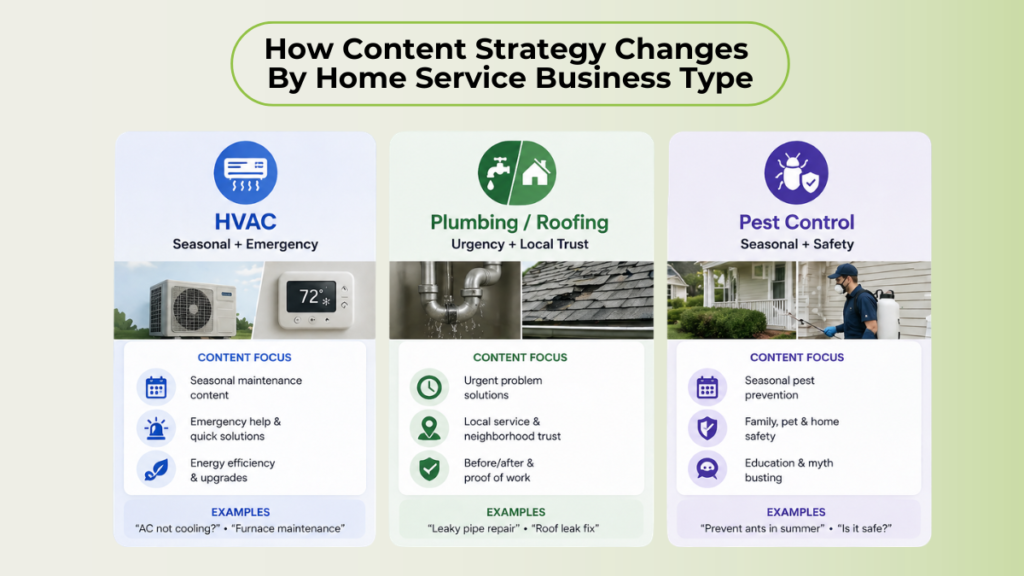
HVAC, plumbing, roofing, pest control, electrical, and cleaning companies all get lumped together under “home services.” But the content strategy for each vertical looks completely different.
HVAC Companies Need Seasonal Content and Emergency Response Copy
HVAC content follows a clear seasonal rhythm. Spring AC tune-up guides, fall furnace-prep checklists, summer energy-efficiency tips. This predictable cycle creates a content calendar that drives organic visibility year-round through HVAC blog writing.
But HVAC businesses also need emergency response copy. When a furnace dies at 2 AM in January, the homeowner searching “emergency furnace repair near me” is making a decision in under 60 seconds. That service page needs to convert fast. Urgency, availability, and trust signals all need to hit above the fold.
HVAC copywriting also has to account for the differences between commercial and residential messaging. A facility manager evaluating a commercial HVAC maintenance contract reads very differently from a homeowner whose AC just stopped working.
Plumbing and Roofing Businesses Rely on Urgency and Local Trust
Plumbing and roofing are emergency-first trades. The content has to lead with urgency because that is the emotional state of the person searching. “Water is flooding your basement” is the reality your copy needs to meet.
But urgency alone is not enough. Homeowners also need trust signals immediately.
Licensed, insured, local, years in business. Roofing content writing and plumbing copy both need to balance “we can be there fast” with “and you can trust us with your home.” Location pages matter even more here because these trades are hyperlocal. The homeowner wants someone close.
Pest Control Content Targets Seasonal Cycles and Health Concerns
Pest control content writing follows a different emotional trigger. A homeowner dealing with pests feels invaded, not just inconvenienced. The content needs to acknowledge that.
Seasonal content drives the calendar (termite season, mosquito season, rodent entry in fall and winter). But the messaging has to address health, family safety, and prevention without sliding into fearmongering.
A parent searching “are carpenter ants dangerous” needs a clear, honest answer, not a scare tactic designed to pressure a booking.
What Bad Contractor Copy Looks Like (and What Good Copy Does Instead)
Everyone tells contractors they need “better copy.” Rarely does anyone show them the difference. Let me explain this with some examples;
| What Most Contractor Websites Say | What Actually Converts |
| “We are a family-owned business dedicated to providing quality service to our community.” | “We’ve fixed over 3,000 AC units in [city] since 2009. If your system is down, we can usually get to you same-day.” |
| “Our team of experienced professionals is here to help with all your plumbing needs.” | “Burst pipe at 2 AM? We answer emergency calls 24/7. Licensed, insured, and in your area within an hour.” |
| “We offer a wide range of pest control services for residential and commercial properties.” | “Termite season in [region] starts in March. If you have not had an inspection this year, here is what to look for and when to call.” |
So you see, the first column is filler. It could be about any company in any trade in any city. The second column is specific. It names a number, a timeframe, a location, a situation. Specificity is what makes a homeowner feel like they have found the right contractor.
The point is that if your website copy could belong to any competitor in your area without changing a word, it is not working for you.
When to Write Copy Yourself and When to Hire a Professional Copywriter
Copywriting for contractors is an investment, and like any investment, you want to put money where it has the highest return. So there’s some pages/content that you can Some content you can handle. Some you should not.
What most contractors can handle themselves:
- Google Business Profile posts and updates
- Basic social media captions
- Short blog posts if you have a natural voice for writing (some contractors are great at this)
- Customer response templates and review replies
What should go to a professional:
- Service pages (these are your highest-conversion pages, and bad copy here costs you real money)
- Homepage copy and messaging
- Location pages built for local SEO
- Blog content strategies tied to seasonal search patterns and lead generation for home services
- About page storytelling
Content that directly affects whether a homeowner books the job or bounces to a competitor is not the place to cut corners. Content that keeps your online presence active and visible is worth doing yourself if you have the time.
You Might Have These Questions About Home Service Copywriting
Freelance copywriters typically charge $150 to $500 per page, depending on scope. Agencies that include SEO strategy and content planning in their services charge more. Pricing varies widely by depth and deliverables.
A service page copy refresh can improve conversion rates within weeks. SEO blog content typically takes 3 to 6 months to gain organic traction. Both operate on different timelines to achieve different results.
AI can draft, but it cannot capture your specific service area expertise, your customer stories, or the trade-specific nuance that makes copy trustworthy. The result is content that sounds like everyone else, which is exactly the problem you are trying to solve.
Yes. Individual location pages optimized for each city or neighborhood are how you rank in those areas. One generic “we serve the greater metro area” page cannot compete with individually built local pages.
A general copywriter can write well. A copywriter who specializes in home services knows what homeowners search for, what makes them trust a contractor online, and how to write copy that ranks locally. The difference is strategy, not just sentence quality.
Awesome SEO Copywriting = More Leads From Your Site
Most contractor websites function like digital business cards. They exist, they have your phone number, and they confirm you are a real company. That is about it.
The businesses that consistently book the jobs they actually want have something different. Their service pages speak directly to the homeowner’s problem. Their blog content shows up months before the emergency. Their location pages put them in front of the right people in the right neighborhoods.
The bottom line is that you need to have the right content on the right pages. The content should honestly speak to your ideal homeowners.
When you are ready to see what that looks like for your specific trade and service area, read how Saiqic approaches content writing for home service businesses or book a call to talk through your content gaps.
