
“We need someone to write our website.” That’s how most dealership marketing managers start the conversation. Then I ask what’s on the site right now, and the answer is almost always the same. Manufacturer-supplied vehicle descriptions, a homepage that could belong to any dealer in the state, and a blog that hasn’t been touched since the last agency quit.
Meanwhile, 92% of car buyers are researching online before they ever step onto a lot. But the ranking pages are from AutoTrader, CarGurus, Cars(.)com, and every other dealer in your metro running the same OEM copy you are.
That’s the problem this blog is about. Not “how to find a writer” but how to find the right one, someone who understands why dealership content is different from every other kind of copywriting.
Your Dealership Site Probably Has the Same Website Copy as Hundreds of Other Dealers
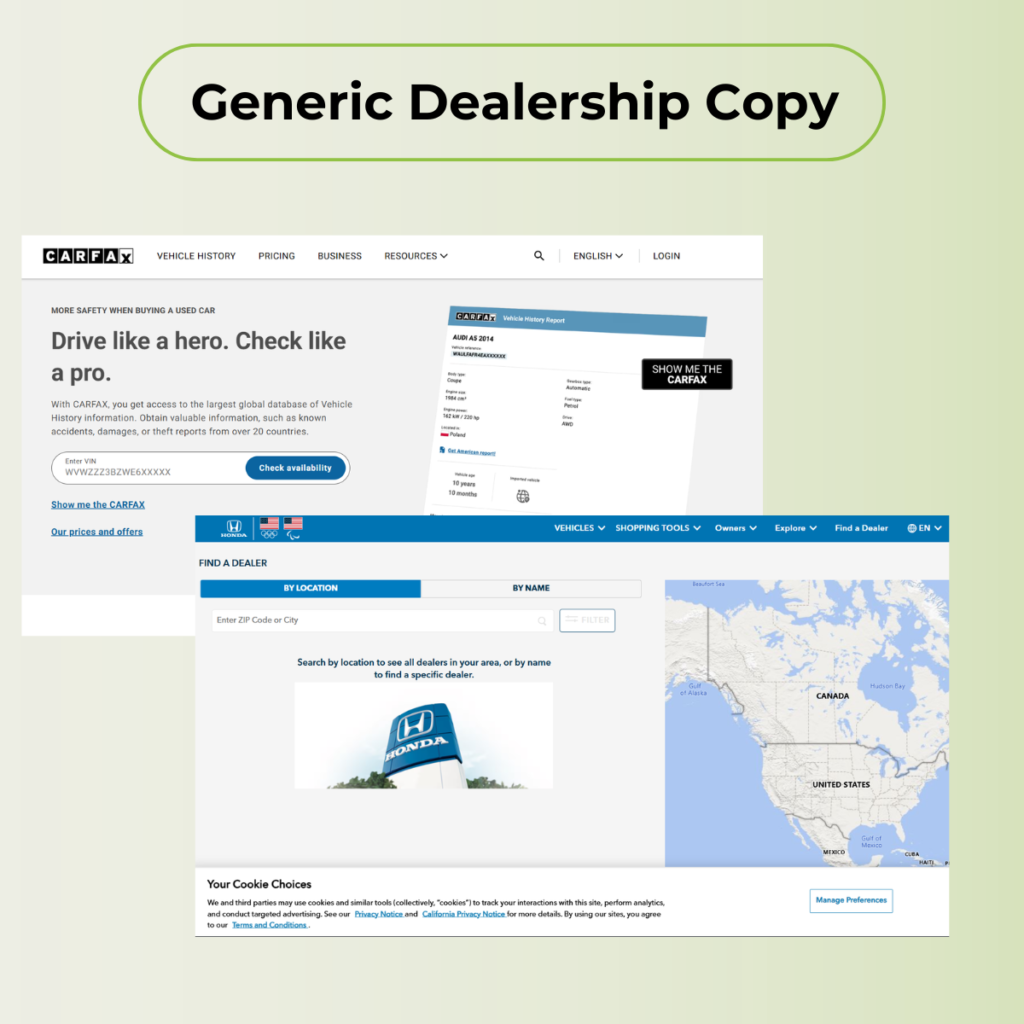
This is the automotive content problem most dealership marketing managers don’t realize they have.
When a new model launches, the manufacturer distributes copy describing the model to every authorized dealer. Most dealers paste it straight into their CMS. That means the 2026 Camry description on your site is character-for-character identical to the one on 300 other Toyota dealer sites across the country.
Google sees this. It has no reason to rank your version over any other. So it picks whichever site has the strongest domain authority, the best backlink profile, and the most original supporting content. For most independent and mid-size dealers, that’s not their site.
The duplicate content problem goes deeper than VDPs
Most dealer homepages open with the same OEM-approved brand language. Service pages list the same maintenance items with the same wording.
“About Us” pages read as if they were written by the same franchise compliance officer, because, in many cases, they were.
The result is a website that Google treats as disposable and buyers treat as interchangeable. If nothing on your site reads differently from the dealer three miles away, the buyer has no reason to choose your showroom over theirs.
The weak content & copy is the reason your cars are still parked in your lot
A dealership that doesn’t rank for its own model + location queries (“2026 Honda CR-V Dallas” or “used SUVs near Plano”) is invisible on Google and to the buyers most likely to walk in. Those are high-intent, geo-specific searches. Losing them to a competitor or to a third-party listing platform means losing showroom visits you’ll never know about.
What Makes Automotive Copywriting a Different Discipline
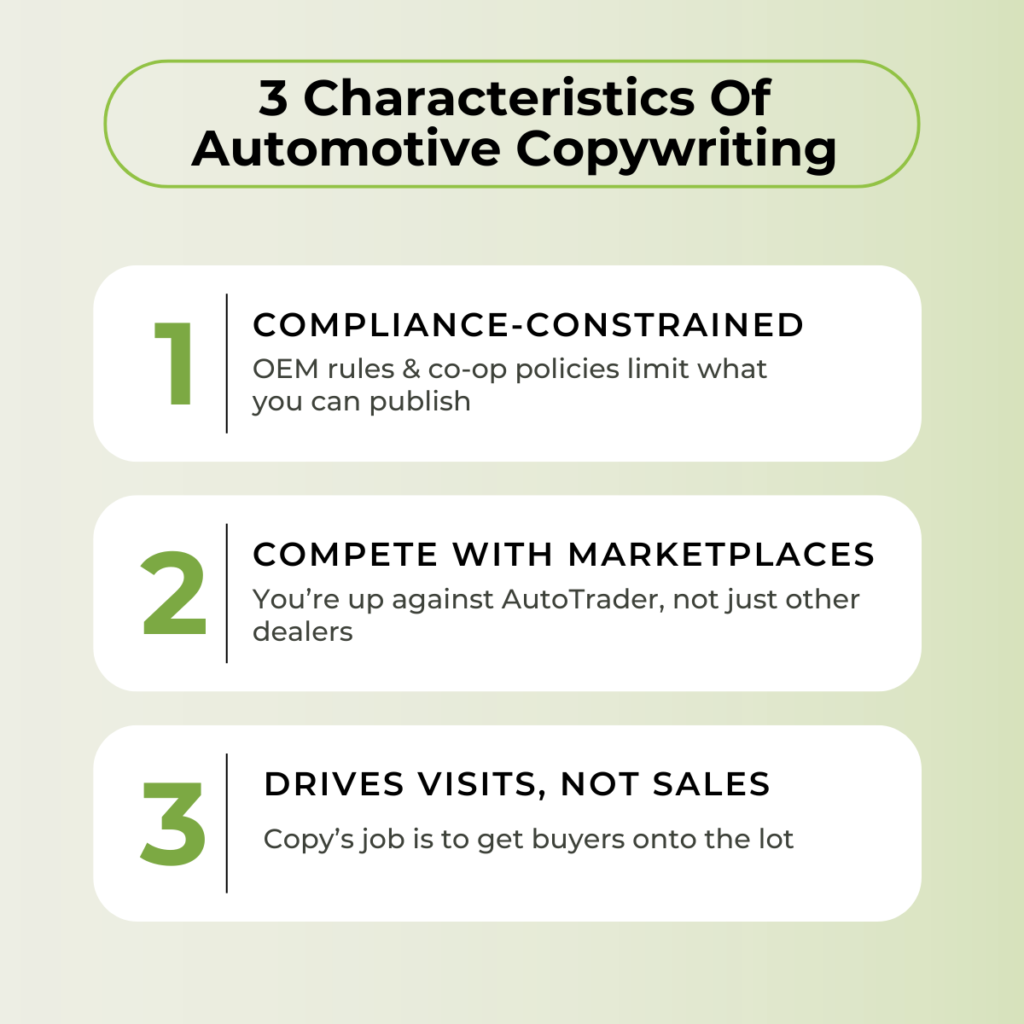
Hiring a good writer is not the same as hiring a good automotive writer. The automotive retail space has unique constraints and patterns of buyer psychology that don’t exist in most other industries.
OEM compliance rules shape what you can and can’t publish
Most franchise dealerships operate under brand guidelines that dictate logo placement, approved language, and sometimes even which CMS platforms they can use. Some OEMs require pre-approval before any marketing creative goes live.
Co-op advertising funds, which reimburse dealers for a portion of their ad spend, often come with strict compliance requirements that extend to website copy.
A writer who doesn’t know this will deliver a copy that the dealership can’t use. Or worse, a published copy triggers a compliance review and costs the dealer their co-op reimbursement. If the writer has never heard the phrase “co-op compliance,” ask how they’d handle brand-restricted content before you assign the first page.
The buyer isn’t choosing between your website and a competitor’s. They’re choosing between your website and AutoTrader.
This is the part most “how to hire a copywriter” advice misses entirely.
A photography client comparing two photographers’ websites is choosing between Photographer A and Photographer B. A car buyer is choosing between your dealership website and a third-party platform that aggregates inventory from every dealer in one search.
That means, AutoTrader, Cars.com, and CarGurus already have the buyer’s attention. They have massive SEO authority, clean UX, and comparison tools your site probably can’t match. The only things they can’t replicate are your dealership’s voice, your story, your local expertise, and the specific reasons a buyer should come to your lot rather than the one listed next to yours in a CarGurus search result.
That’s what your website copy has to deliver. Not better specs. A better reason.
The copy’s job isn’t to sell the car online. It’s to get the buyer onto the lot.
Despite all the online research, 86% of car buyers still want to see the vehicle in person before purchasing. The hybrid shopping model, heavy digital research followed by an in-person visit, is dominant.
This changes what the copy needs to do. It’s not closing a sale. It’s bridging the gap between “I’m researching options on my phone” and “I’m driving to that dealership this Saturday.” Every page on your site should push toward that bridge, whether it’s a vehicle detail page, a blog post, or the service department landing page.
The Pages on Your Automotive Site Where Copy Makes or Breaks the Lead
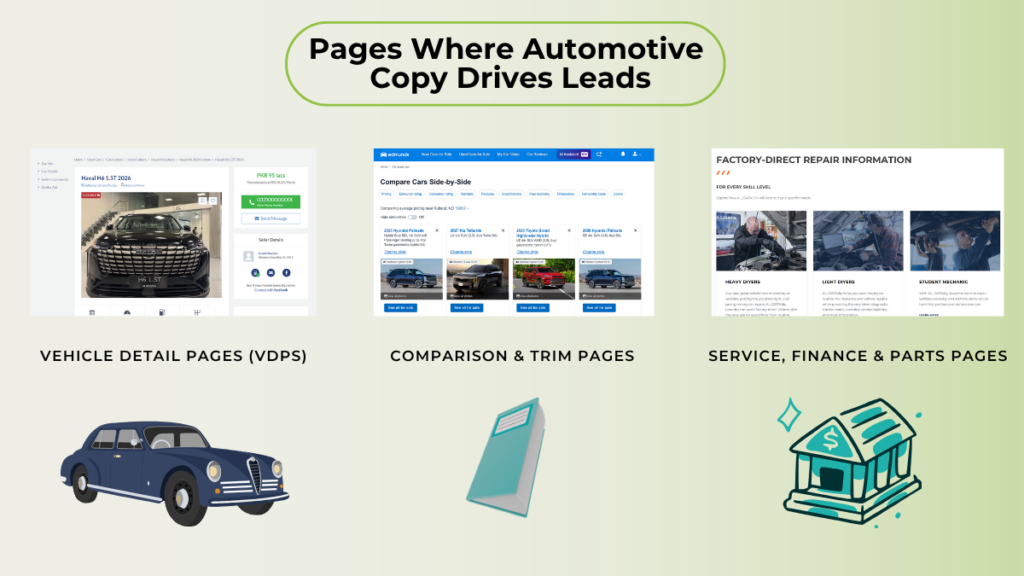
Not every page on a dealership website needs a $500 rewrite. But the pages below are where weak copy directly costs you leads, and where a skilled automotive copywriter earns back their fee fastest.
Vehicle Detail Pages (VDPs) are your highest-converting content, but many don’t pay attention to them
I have seen websites where VDPs are just spec sheets. But these are the pages with the highest purchase intent. A buyer on a VDP has already narrowed their search to a specific vehicle or model. So if your VDP is unique, has descriptive content, and rich media, you’ll easily outperform listings that copy and paste manufacturer copy.
The difference between a VDP that converts and one that doesn’t usually comes down to three things.
- First, a description written for that specific vehicle, not the model in general.
- Second, copy that connects the vehicle’s features to the buyer’s actual life (“the third-row fold-flat seats give you the cargo space for a Costco run and two soccer bags” is not the same as “60/40 split fold-flat third-row seating“).
- Third, a clear next step, whether that’s scheduling a test drive, checking availability, or calling the sales desk.
If your dealership moves 80 to 150 vehicles a month and every VDP reads like a factory brochure, the copywriter’s first job should be to build a VDP description framework that your team can scale.
Model comparison and trim-level pages capture buyers mid-research
“Honda CR-V vs Toyota RAV4.” “2026 Camry LE vs SE, what’s the difference.” These are queries buyers type during those 14 hours of research, and they’re queries most dealership websites completely ignore.
A single well-written comparison page can rank for dozens of long-tail variations and pull in buyers who are actively deciding what to buy. The dealership that ranks at that position in the local SERP owns the buyer’s first impression. And the internal link from that comparison page to the relevant VDP is one of the shortest paths to a showroom visit.
Service, parts, and finance pages are local SEO assets that most dealers neglect
Service department pages rank for queries like “oil change near me,” “brake repair [city],” and “tire rotation cost [brand].” These searches have strong local intent and attract customers who may also be in the market for their next vehicle. Finance and trade-in pages rank for “trade-in value [city]” and “car financing options near me.”
Most dealers either leave these pages blank or fill them with manufacturer-supplied boilerplate. A copywriter who understands local automotive SEO will treat each of these pages as a ranking opportunity, not an afterthought.
The “About Us” and dealership story page is the trust signal for a high-stakes purchase
Buying a car is the second-largest purchase most people make. The buyer wants to know who they’re buying from. A dealership’s About page that reads like a franchise template (“We are committed to providing excellent customer service and a wide selection of vehicles“) does nothing to build trust.
The About page should answer one question for the buyer. Why should I trust this specific dealership with a $ 30,000-to-$60,000 decision? That answer usually involves the dealership’s history, the people who run it, the way they handle problems, and what makes their buying experience different. A good automotive copywriter will pull that story from the dealer principal or GM and turn it into copy that the buyer actually believes.
Blog Content That Actually Drives Lot Traffic vs the Posts Nobody Reads & Google Ignores
Most dealership blogs are ghost towns. When they do publish, it’s usually manufacturer news repackaged, inventory announcements, or generic “5 reasons to buy from us” posts that no buyer is searching for.
The dealerships that get real organic traffic from their blog publish content that intercepts buyers’ research journeys. Research shows that dealerships with active blog content generate significantly more organic traffic than those without. And that traffic is defensible. Unlike paid ads, it doesn’t disappear when you pause the budget.
Content types that compound for dealerships
According to exposure, these types of content really work best for automotive websites and dealership
- Model comparisons and “vs” posts. These intercept the buyer during the decision phase. “Civic vs Corolla 2026,” “Best midsize SUV for families,” “Camry hybrid vs regular, is it worth it.” Every one of these is a real query with real buyer intent.
- Buying guides. “Best time to buy a used car,” “How to negotiate at a dealership,” “What to know before leasing vs buying.” These attract top-of-funnel traffic from buyers who haven’t yet decided where to shop. Your dealership becomes the helpful source, and the internal links on those posts point them to your inventory.
- Maintenance and ownership content. “How often should you rotate tires,” “When to replace brake pads,” “What does the check engine light mean.” These rank for service-intent queries and bring in customers who already own a vehicle, the same customers who will buy their next one from the dealership that’s been helpful.
- Local destination and event content. “Best road trips from [city],” “Where to park for [local event],” “[City] weekend guide for car enthusiasts.” This content earns backlinks from local publications and builds the dealership’s topical authority in its market.
Content that wastes budget
Press releases about new model arrivals (the manufacturer’s site already ranks for this). Generic “why choose us” posts (nobody searches for this). Industry think pieces about the future of EVs are written for other marketers, not for buyers. Thin 300-word posts are published for the sake of publishing frequency.
None of it ranks. Most of it never gets indexed. And the marketing manager who approved four of those per month for a year has nothing to show for the spend.
How to Evaluate an Automotive Copywriter When You’ve Never Hired One
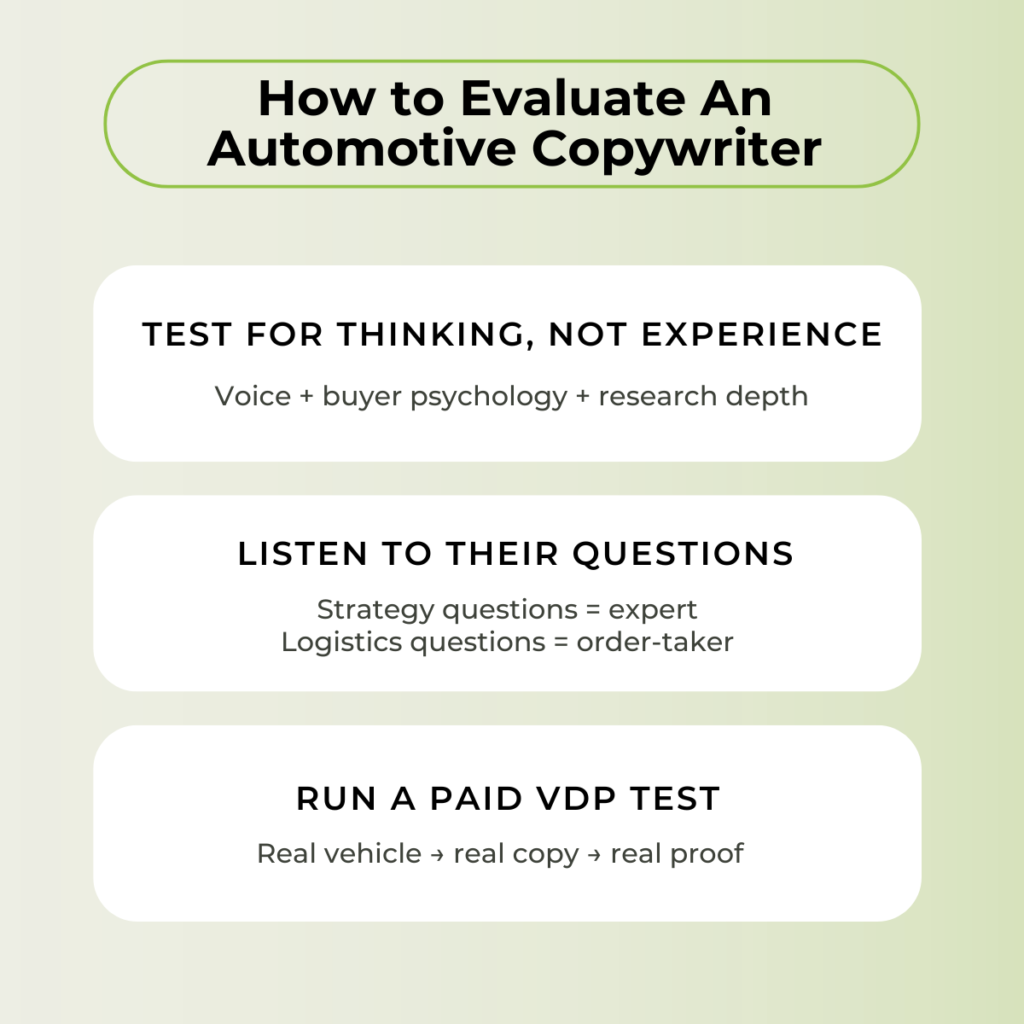
Here’s the uncomfortable truth. You will probably not find a copywriter with a portfolio full of automotive dealership work. It’s a narrow niche, and most writers who have worked with dealers have done so through an agency, which means the samples may not be shareable.
That doesn’t mean you can’t evaluate them. It means you have to test for the right things.
Test the candidate for research depth and buyer psychology.
Ask for the work they’re most proud of, in any industry. You’re looking for three things.
- Does the copy have a real voice, or does it sound like it could have been written by anyone?
- Does the writer show they understand the reader’s psychology, not just the product?
- And is there evidence that the writer researched the topic deeply enough to say something the reader can’t find on the first three Google results?
A writer who demonstrates these three qualities in their best healthcare or real estate work will outperform someone who’s written 50 identical dealer blog posts from templates.
The questions that separate a serious writer from a content mill
Get the candidate on a call. Pay attention to what they ask before you even discuss pricing.
A serious automotive copywriter will ask about your top-selling models, your geo-market, and which dealers you compete with locally, your OEM brand restrictions and co-op requirements, your CMS setup, what your current content looks like and what isn’t working, and who the typical buyer is for your dealership (family SUV buyers are a completely different audience from performance car shoppers).
If the first questions you hear are about word count, turnaround time, and whether you have a brief ready, that’s a content order-taker. Not a strategist.
Run a paid VDP test before committing to anything larger
One vehicle description page. Paid, not free. Pick a vehicle that’s currently on your lot with a manufacturer-supplied description.
The test reveals everything. Did the writer ask you about the vehicle’s features, the target buyer, and how the VDP fits into the site? Did the final copy read differently from the manufacturer’s version? Did it connect the specs to the buyer’s life? Did it include a clear next step?
If the VDP test lands, you’ve found your writer. If it reads like a lightly reworded version of the OEM description, you haven’t.
What Dealership Copywriting and Blog Writing Typically Cost
Pricing for automotive content depends on what you need and who’s doing it. A VDP description is fundamentally different from a 1,500-word model comparison blog post, and both are distinct from a full website copy overhaul.
| Service | Freelancer (generalist) | Automotive-niche writer | Agency |
| VDP description (per vehicle) | $25 to $75 | $75 to $150 | $100 to $250 |
| Core web page (Homepage, About, Service) | $200 to $500 | $500 to $1,000 | $800 to $2,000 |
| Blog post (1,200 to 1,800 words) | $150 to $400 | $400 to $800 | $600 to $1,500 |
| Full website copy (10 to 20 pages) | $2,000 to $5,000 | $5,000 to $10,000 | $8,000 to $25,000+ |
| Monthly retainer (4 blogs + VDP support) | $1,000 to $2,500 | $2,500 to $5,000 | $3,500 to $12,000+ |
The VDP pricing question dealers always ask
“Can we pay per-vehicle for VDP descriptions at scale?” Yes. Most writers and agencies offer volume pricing for VDP packages, typically 20 to 50 vehicles at a time, with a turnaround of 1 to 2 weeks. The key is to make sure the writer first creates a voice and a description framework, then scales it, rather than writing 50 descriptions from scratch without consistency.
Why retainers outperform project-based work for dealerships
Dealership content isn’t a one-time job. Inventory changes weekly. New models launch quarterly. Seasonal campaigns (end-of-year clearance, tax refund season, summer sales events) need fresh blog content. A retainer gives the writer enough time with your brand to develop a consistent voice and enough context to produce content that actually compounds in rankings month over month.
You Might Have These Questions About Hiring an Automotive Copywriter
They write the website copy (homepage, vehicle pages, service pages, about page) and blog content (model comparisons, buying guides, maintenance articles) that helps the dealership rank in local search and convert online researchers into showroom visitors.
Industry-specific experience helps but isn’t required. What matters more is the writer’s ability to conduct in-depth research, understand buyer psychology, and adapt to OEM compliance constraints. A strong writer in any niche can learn automotive. A weak writer with a dealership portfolio is still a weak writer.
Core page rewrites (homepage, VDPs, service pages) can improve conversion within 60 to 90 days. Blog content takes longer to compound. Rankings typically build between 4 and 9 months, with meaningful traffic gains in the 6 to 12-month window.
AI can generate a first draft and handle keyword research. It cannot write VDP copy that differentiates your vehicle from the identical listing on 200 other dealer sites. It cannot produce the local knowledge, buyer psychology, or brand voice that makes a reader choose your dealership. For any page that has to convert, AI output needs significant human rewriting.
Hire a freelancer if you have a defined scope (VDP rewrites, a set number of blog posts per month) and can manage the content calendar yourself. Hire an agency if you need strategy, keyword research, blog content, core page copy, and VDP support as one system. Freelancers cost less per deliverable. Agencies cost less per lead when the system is working.
Original Content Is the Only Advantage Your Dealership Website Has Over AutoTrader
AutoTrader has more inventory listings. CarGurus has better comparison tools. Cars.com has decades of SEO authority.
What none of them have is your dealership’s voice, your local knowledge, your staff’s expertise, and a reason for the buyer to come to your lot specifically. That’s what original content delivers, and it’s the only thing a third-party platform can’t replicate.
The dealership that rewrites its VDPs, publishes buying guides that local buyers actually search for, and owns its model-comparison queries in the local SERP is the one that turns 14 hours of online research into a Saturday showroom visit.
If you want that content built as one operation, the website copy, the blog content, the VDP framework, and the SEO strategy behind it, that’s what Saiqic delivers for automotive brands. Book a call or read the service in detail, and we’ll show you exactly what it looks like for your dealership.
