
LEADS! Ohh, who doesn’t love an extra $$ pipeline? And yes, it is possible through blog posts (or stuff you can post on your site’s blog section), that’s why you’re here. Even if you’re just starting the website, you don’t need to wait for 6-9 months so that your site picks up momentum, and then the leads will come. If your strategy is smart, and you know what to publish, it’s easy to get qualified leads from blogs/articles.
So in this blog, I will share my best approaches and strategies that I have learned and used in the past 4+ years. And that still works like magic in the post-AI era.
Take your notes, because I’m sure you won’t get this stuff for free out there.
Let’s go.
Kill Your ‘Target Audience’ Mentality & Think About Your Prospects
In your niche, you might have 2-3 or maybe more types of target audience. They could be your fellow business owners, your competitors, or random researchers on the internet. But a prospect is the ONLY type of person who is going to/will buy something from you. Let me clarify this scenario a bit more.
Audience
- Curious, browsing, or learning about a topic
- Low or unclear buying intent
- Searches broad, generic, informational queries (e.g., “What is SEO?”)
Prospects
- Problem-aware and actively looking for a solution
- High buying or decision-making intent
- Searches specific, commercial queries (e.g., “SEO agency for SaaS startups”).
If your goal is leads, who should you focus on more? Prospects. Yes. No matter if you are JUST starting your website or it’s a decade old. If you want leads, you need to serve your targeted prospects. That’s it.
Start With Prospect-First Keyword Strategy (Not Tool-First)
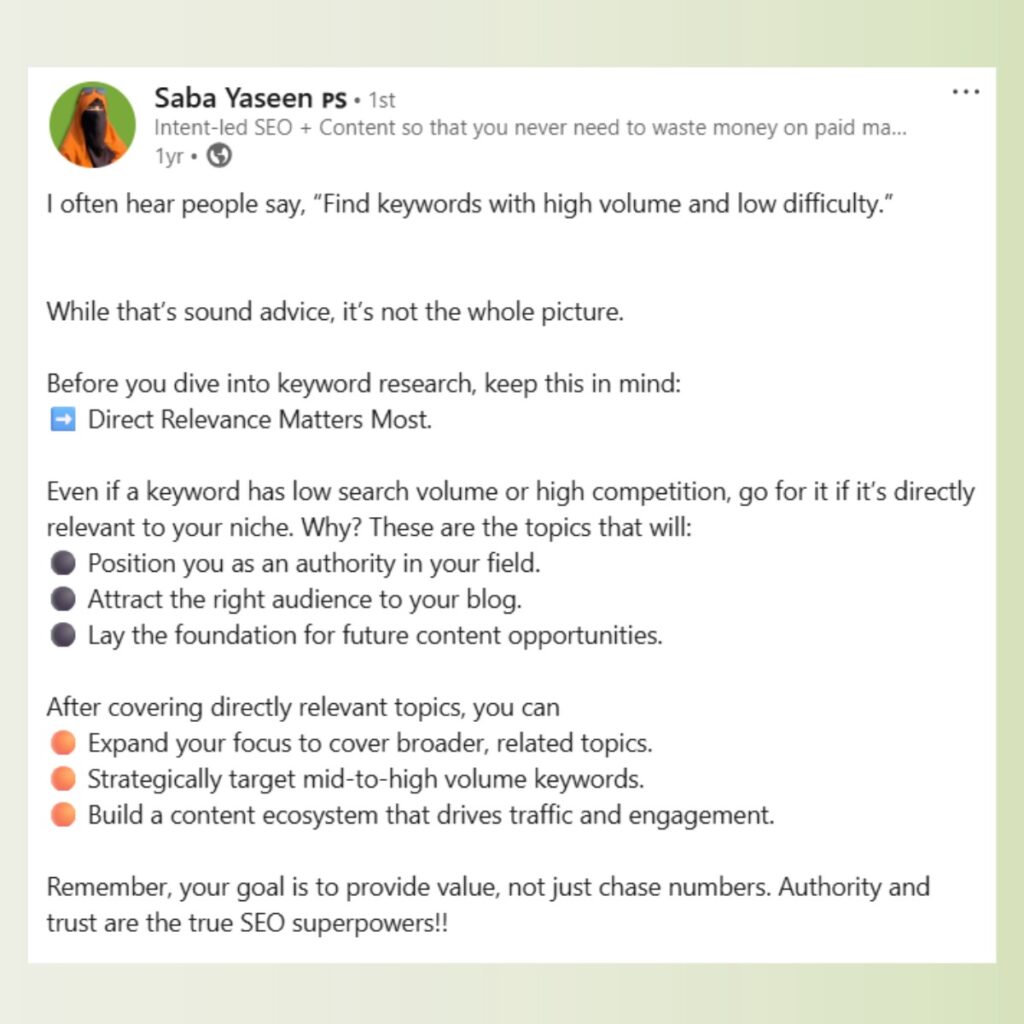
ANYONE on the internet searching for/doing something broadly comes under these three categories;
1. informational (curious/causally browsing),
2. Investigational/navigational (comparing options),
3. Transactional (ready to act).
Your prospects fall under the 2nd and 3rd categories. And that’s what you need to cover.
I call it a prospect-first content strategy. Before you touch any keyword research tool, you need to tap into your prospects’ minds (or hearts if that’s what you love).
For that, you need to ask these questions;
- What problem makes them search at 2 AM?
- What phrase would they type if money were at stake?
- What alternatives are they comparing?
- What objections stop them from buying?
An interesting thing here is that if you think about your prospects like this, you come up with some phrases. And those phrases are what we know as long-tail keywords.
And Long-Tail Keywords = High Conversion
And this helps you automatically narrow down your competition. When your competition is narrow, and you’re targeting a specific person, you get more qualified inquiries.
BOFu Content System That Generates Leads For You
Your goal isn’t random traffic for the sake of traffic. Your goal is leads.
That’s an entirely different game, and it requires a completely different content strategy.
BOFu (Bottom of Funnel) content targets people who are already problem-aware, are evaluating solutions, and are already close to a decision. These are your prospects. And there are five specific content categories that do this job better than anything else.
Category 1: Problem-Solution Content (Pain-Driven)
This is content built around a specific, painful problem your prospect is actively trying to fix. Don’t write on a broad educational topic. Target a real, frustrating, costs-me-money problem.
For example, if you are a personal finance coach, you won’t publish posts like “What is personal finance?” You will go for topics like “Why Your Debt Payoff Plan Isn’t Working (And How a Coach Fixes It)”.
You get the idea.
But coming up with such topics is not that hard. You can run a prompt in GPT and get a list of topics you can cover. The secret conversion sauce lies in HOW you cover the topic. How deeply you understand your reader (aka prospect) and how smoothly you can weave in your services as a solution.
I can give you a rough structure of how Saiqic content writers tackle such a blog post.
- Open with the problem (make them feel seen)
- Show the cost of ignoring the problem/inaction
- Walk through your solution framework
- Soft pitch at the end (without forcing the solution(
- Avoid fluff, what’s obvious, or what they already know, like “in this article we will explore.” Hit the hidden pain, show the fix, connect it to what you do.
Category 2: Service-Intent Blogs To Support Core Services
Some searches are closely tied to your service but don’t fit a dedicated service page either because they’re too specific or hard to convert directly. That’s where you need service-intent blogs. They bring you high-intent traffic and often act as pseudo-service pages to support your main offering.
For instance, in the case of a personal finance coach, you will go for topics like “Money Coaching for Couples and Families.”
You see, that’s a specific use case blog topic.
Treat these posts like a sales conversation and clearly explain.
- What the service includes
- Expected results
- Who it’s for and who is not
That last point filters poor-fit leads and attracts serious buyers.
Use these blogs to build depth around one core service first (ideally the one that generates the most revenue or the one where you have the strongest expertise).
Make content BOFu cluster as;
- A core service pillar
- Supporting blogs (pain points, objections, comparisons)
- Proof content like case studies
Search engines and LLMs reward focused topical depth. Strong service clusters improve rankings, positioning, lead quality, and AI visibility at the same time.
Category 3: Comparison & Alternatives Content (High Buyer Intent)
Your prospects start searching days before a purchase decision. Someone comparing two options/alternatives is not doing this just for the sake of research. They’re ready to decide. They’ve already accepted they need a solution. Now they’re figuring out which one.
So again, if you’re a personal finance you’ll publish posts like ‘Personal Finance Coach vs Financial Advisor vs Financial Planner’:
And remember, honesty is THE best policy. If a situation genuinely calls for a competitor or an alternative approach, say so. That honesty builds trust and makes people more likely to hire you.
Category 4: Case Studies & Proof Content (Trust Accelerators)
At some point in the buyer journey, your prospect stops asking “can this work?” and shifts to questions like “has this worked for someone like me?” Case studies answer that question directly.
I will keep that personal finance coach business as an example here. Post case studies like How a Client Paid Off $45,000 in Credit Card Debt in 14 Months.”
Never EVER brag about anything in your case study. It’s a before-and-after with context and proofs. What was the situation, what was broken, what did you do, what happened, and how did you get the intended results? Use specific numbers with real constraints and honest timelines. Be honest. And the reader must get value from your case study…something implementable to their business, even if they don’t hire you. . This approach is really important to build trust.
Apart from case studies, you can also publish lead magnets. The free value you give ALWAYS pays you back. You can publish checklists, templates, frameworks, how-to-guides, etc. You can also offer free audits or share personal tools that you use in your business operations for free. When someone sees proof and immediately gets a useful resource tied to that topic, conversions increase naturally without aggressive selling.
Category 5: Cost, Pricing & ROI Content (The Highest-Intent Content)
This section makes many business owners nervous: “What if they find my prices too high?” So you need to be clear about what you’re offering for that price and why your service is worth it. Break down the deliverables, the process, and the value behind the cost so prospects understand what they’re actually paying for.
For instance, publish blog posts like ‘How Much Does a Personal Finance Coach Cost? (Full Pricing Guide)’ :
If you don’t answer these questions, your competitor will… and they’ll get the lead. Show the numbers, explain the variables, and be transparent about what drives cost up or down. The people who can’t afford you will filter themselves out, and the ones who can will trust you more because you were clear from the start.
How to Turn Blogs Into Sales Pages Without Being Salesy
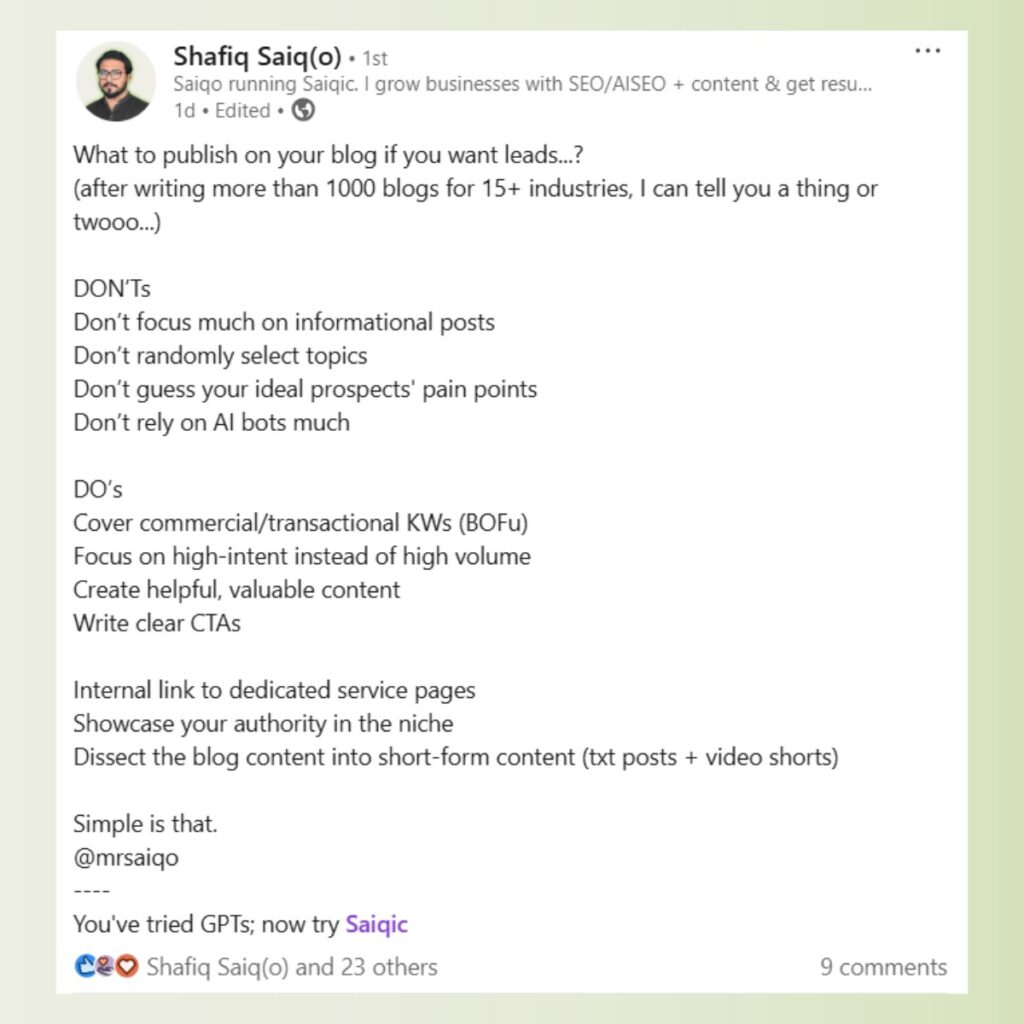
Don’t treat your BOFU content as a promotional long-form ad. I’ve seen people forcefully inserting features, using hard CTAs, and over-explaining the product. When team Saiqic says to publish BOFU content, most people get it wrong.
That’s the wrong structure.
A high-converting BOFU blog doesn’t “sell.” It proves and positions. And guides naturally towards sales.
Here’s the structure we’ve seen work and what we’ve been applying for clients for years.
1) Pain-Focused Hook
Your first paragraph has one job: make the right person feel seen. If someone reads your opening and thinks, “okay this is exactly my situation,” you’ve already done 50% of the conversion work.
2) Authority Positioning (Why Listen to You)
When you’re an expert in what you do, your content speaks for you. All you need to do is generously share what you know. Don’t gatekeep anything. You can add client results, years of experience, or a specific insight that only someone who’s done the work would know.
3) Tactical Value (Not Generic Advice)
Give real, specific, usable, experience-based insight. Don’t write like “you should save/invest money,” but how exactly you approach it, what you care for, what you ignore, and why. Specificity separates content that converts from content that people will skim.
4) Proof & Credibility Signals
Use proofs naturally. Case studies, real numbers, specific situations you’ve gone through. Not a bolted-on testimonial section, embed proof inside the actual advice.
5) Strategic CTA (Soft > Hard)
Don’t wait until the end to mention what you do. Drop soft CTAs mid-content, contextual links to your services, and a relevant lead magnet. Then close with a clear call to action. Avoid generic CTAs like ‘Book Now’, ‘Contact Us’, etc.
Blogs Will Fail to Bring Leads If They Exist in Isolation
You can write the best post in your niche… perfectly structured and targeting the right prospect. But if your domain has no authority and no distribution, it disappears into the void.
It’s hard for new sites to rank just by publishing. And even if you do rank and get traffic, you still need authority to generate leads. You need to show up in multiple places so that when a prospect lands on your blog, they already feel like they know you.
Devise a Content Distribution Strategy
You need a proper strategy to repurpose your blog posts into short text and video posts. Even if you hate socials, if you run a business, you are going to need them to distribute your content. Otherwise, no matter how smart your content strategy is, you’ll fail it.
Here are some ideas for how you can turn 1 blog post into 4-5 short content pieces;
- Turn the core insight into a LinkedIn post.
- Pull one framework or stat into a short video.
- Curate a newsletter addition..
- Drop a relevant excerpt into Reddit threads or niche communities.
- Use it as the basis for a guest post or podcast talking point.
This backs up your overall SEO/AISEO authority on Google & LLMs.
Here’s How You Can Devise The Leads-First Blog Strategy
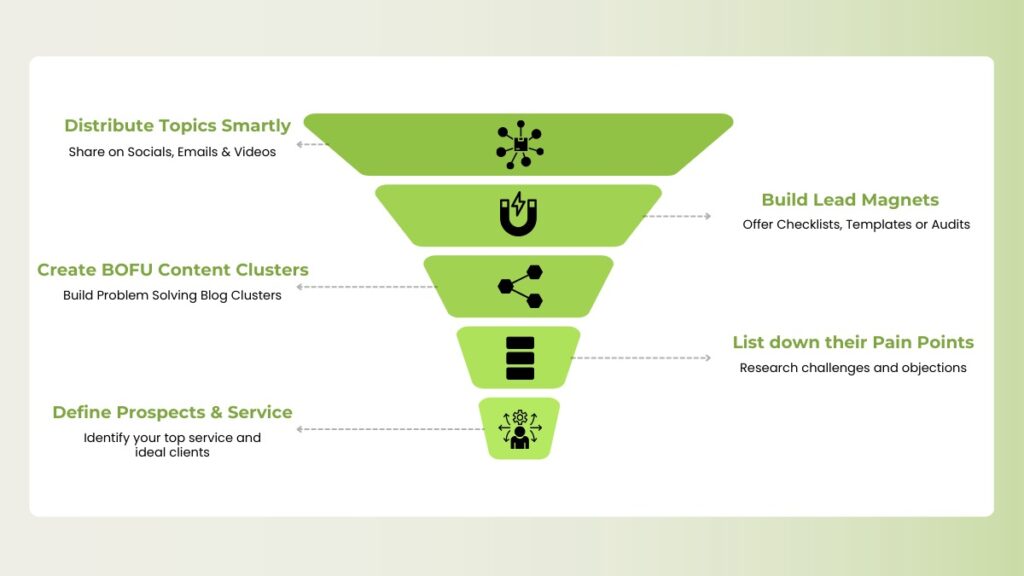
Here’s the crux of everything we talked about above. Let’s discuss it in steps.
Step 1: Define Your Prospects + Your Service
Before keywords, post ideas, or a content calendar, think about your service and your prospects. If you offer more than one service, pick the one that generates more revenue for you/are is in demand.
Step 2: List Down All Your Prospects’ Pain Points
Step away from keyword tools. Use sales call notes, client conversations, and objections. What do people ask before hiring you? What makes them hesitate? What do they compare you against? Research your prospects. You will get enough long-tail keywords. .
Step 3: Create BOFu Content Clusters
Find 3-4 most pressing core problems your prospects face. These core problems will be your content pillars. Around each pillar, strategize 8-10 blog posts.. Cover your core service from every buyer angle: pain points, objections, comparisons, proof, and pricing. Interlink them so they feel like a complete resource.
Step 4: Build Lead Magnets (aka Offer Free Value)
For each content pillar, create one lead magnet that feels like the natural next step: It could be a checklist, template, framework, or audit offer.
Step 5: Distribute Each Topic Content Smartly
Every post goes through the distribution flywheel: LinkedIn, newsletter, video, and community. Don’t publish and pray. Publish and push.
Serve Your Prospect = Get Leads.
Yes, this is the simple equation. Stop thinking about how you’ll get leads. Start helping your prospects. If your free content solves their little problem, they’ll come running to you when they face a bigger problem. They won’t hesitate to pay you their hard-earned money.
Secondly, if you know that the service you offer is legit and really helpful, then you only need to present it the right way, leads will follow naturally.
The world has not yet invented any other better way/option to talk about/help your prospects than blog posts. Only if you know how to treat blogs smartly.
If you’re still figuring out which topics will actually move the needle for your specific business, that’s exactly what team Saiqic can do for you. Book a call, and we’ll map out what to publish first.
