
You’re frustrated because it seems like your ‘fine’ SEO content strategy has failed. The top-ranking pages are no longer ranking anywhere. The bounce rate is hilarious, traffic is random, and leads are nowhere to be seen.
What if I tell you that it’s nothing scary? This happens to people, and Saiqic has worked with such clients and successfully revived their content strategy.
After reading this blog post, you’ll understand why your content strategy failed after the initial spike and what you can do about it.
How To Fix A Declining SEO Content Strategy After Early Success
Most of the time, an SEO strategy fails because of the ‘typical SEO Gurus’ advice;
- Choose a low difficulty keyword.
- Create surface-level, unstructured content
- Back it up with a bulk of linking & stock images
- Hit publish, forgot and keep praying to Google & AI gods to notice your content.
This was good in maybe 2020, but that’s not how it works in 2026…the game has changed. Below is how you can revive your dying SEO content strategy
Perform A Comprehensive SEO/GEO Audit.
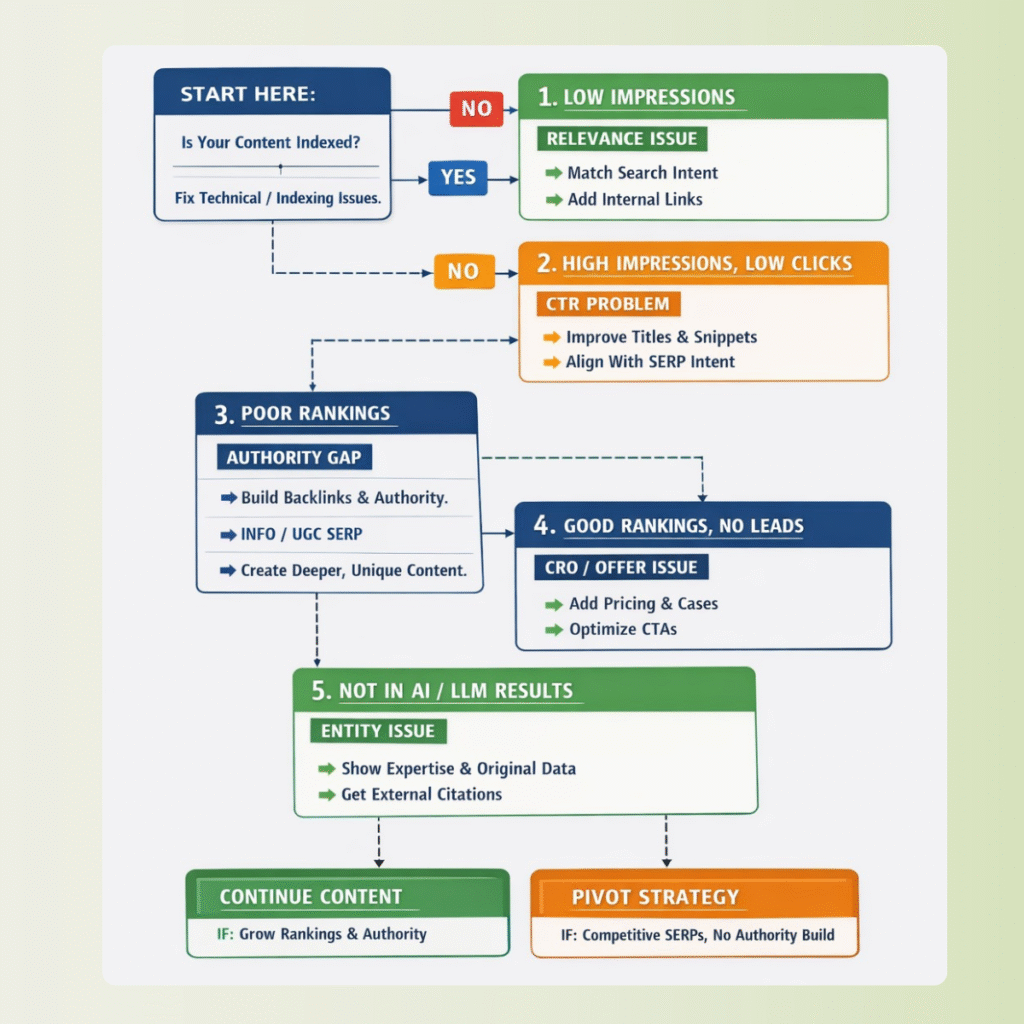
Before you touch anything on your website or go mad on your SEO guy, perform a comprehensive SEO/GEO audit. You can use any audit tool. Our SEO strategist prefers using Google Search Console (GSC) or Google Analytics 4 for this purpose.
Here’s what you need to look for in the audit;
- Indexing & Coverage: Are key pages indexed, or blocked by no index, duplicates, or technical errors?
- Impressions vs Clicks: High impressions but low CTR (click-through rate) usually indicates an intent mismatch or weak titles.
- Query–Page Alignment: Are the wrong pages ranking for important queries? That’s an internal linking and architecture issue.
- Ranking Drops: If competitors overtook you, it’s likely an authority or topical depth problem. Even if your content is high-quality, you lack authority.
For GEO or AI search/AI visibility audit, you can use dedicated tools like SEMrush AI Visibility Toolkit. These are just some of the main things I discussed. But you get the gist. An in-depth SEO/GEO audit will help you decide whether to fix content, build authority, or pivot strategy. If you’re not an SEO nerd yourself, hand this to someone who knows how to look at graphs, numbers, and rankings, or use our SEO audit services.
Stop Chasing High Search Volume (SV), Low Difficulty Keywords Randomly.
If you’re hunting for high search volume and low difficulty keywords randomly, stop it. Those sweet keywords aren’t bad, but if you’re only doing that, you’ll never get topical authority, as you don’t have a compact SEO content strategy. Your topic selection is based on those ‘good-looking’ keywords. And this is tanking your traffic right now after an initial spike.
I’m not against high SV and low KD, as long as I can find some that suit my content strategy.
I don’t treat keywords as my first priority. My first priority is always the business objective (of my clients) and what their target audience would be looking for. Then I create content pillars/funnels, and within those pillars, our SEO specialist conducts keyword research.
Here’s A Better Keyword Research Approach.
Go to your website, look at your service pages and blogs, and see whether they’re serving (or written for) your targeted ideal visitors. If not, change your keyword research approach. Reverse-engineer your target audience’s search behaviour and consider what they need from you OR how well you can serve them.
And these days (post-AI search era), zero-volume keywords work well too, which means that SV isn’t a deal-breaker if you think the phrase is really important to cover from a business/audience needs perspective.
Stalk SERP (Search Engine Result Page) and See If A Competitor Took Your Place.
You’re not Google’s favorite kid. That means if someone outperforms you, your SERP position will be compromised. You won’t stop getting all the traffic, but you’ll see a significant drop. No need to panic, though. This is not your fault. Google tests new entries on the topic to see how visitors react to them. Just closely observe your competitors, their website authority & domain, and how well they covered the topic. What did you miss? Can you identify any gaps in your content and theirs that you can fill? And so on…
That’s where you basically need to keep your content fresh. Even if no one’s beating you yet, you need to update your content to make sure no one dares to touch your level.
And sometimes I’ve seen that at the time of writing & publishing a topic, the SERP is sinnable…smooth playground, no big giants there. But after some time, when a well-established brand/site publishes the same topic, you get pushed down.
Devise a Content Distribution Strategy
Google gives new/fresh content a chance to rank (as you saw in the previous heading). So you initially get a ranking position, but when you don’t have ‘enough authority on & beyond Google, you lose your position. I have seen this happening with my previous clients. Our newly published blog would rank in the top 3 for a few days, then it would vanish. The reason (apart from competitors outperforming us) will most of the time be a lack of a clear content distribution strategy. No content distribution = no authority.
And when I talk about content distribution, I usually mean these types of distribution;
- Internal Distribution: Are the blogs linked from money pages, hubs, and navigation, or are they orphaned posts? Internal links are your first ranking signals.
- Social Distribution: Is every high-value post repurposed into LinkedIn posts, threads, carousels, or videos? Social platforms drive discovery, branded searches, and backlink opportunities.
- Authority Distribution: Are the insights shared via guest posts, newsletters, podcasts, or industry communities? External mentions build entity trust for SEO and GEO.
- Audience Distribution: Is the content being pushed to email subscribers or remarketing audiences to generate engagement signals?
- LLM Visibility Signals: Are the frameworks, data, and opinions being cited outside the site? AI engines loved the brands that exist across the web.
So when you’re building a content strategy, build a content distribution strategy as well. And then with time, your site will get authority, and you’ll be the absolute boss in your niche.
Don’t Rely On AI Content-Generating Tools.
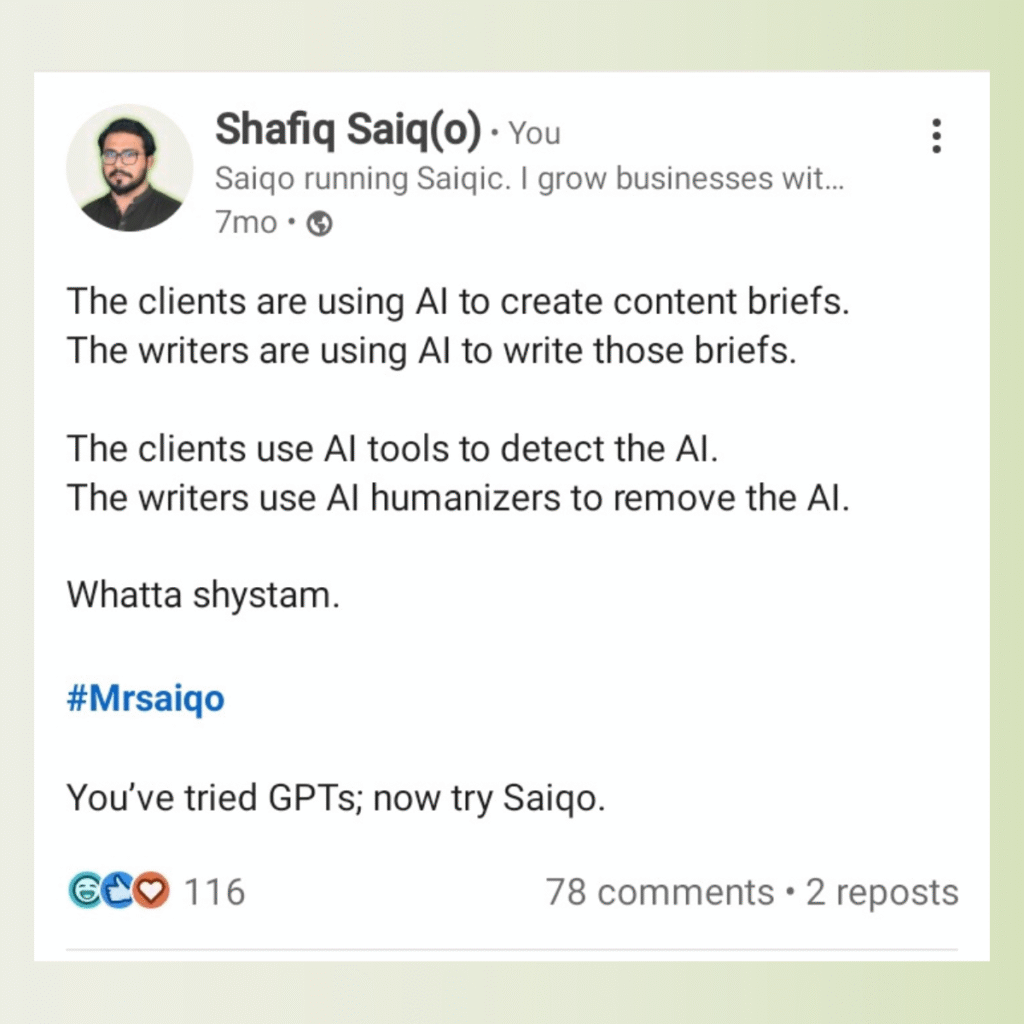
AI is as good as you are. If you know nothing about content research, strategy, and writing, and you hand over everything from title to end draft to an AI tool, you’ll be in trouble. You will get generic gibberish that will do no good for you and your end user.
And for this ‘generic’ AI output, I kind of hate it. I know this will waste visitors’ time and damage the brand’s reputation.
But how is this responsible for a declining content strategy?
Very much. You get an initial spike for the AI-generated content because Google thought you’re going to add something new to ‘already existing’ content. But from user behaviour, the Google bots get to know that you’re not adding anything new, so you get a punch in the face, and your content is no longer ranking anywhere.
Now it’s up to you. You know how expert you are in your field, and know better than GPT (or any AI), or you know nothing, and you’ll be reliant on AI. If you think you’ll be reliant on AI, then better not to use it and do your research and strategy with your own bare fingers.
Update & Audit Your Existing Content Thoroughly.
If you have more than 100 blogs (or content pieces, including your service pages) and have seen a sudden drop in your rankings, you need to revisit your content inventory.
I’ve already talked about thin content and content gap fulfillment (if your competitors are outperforming you). If everything is good (content is not thin and competitors have not taken your place), then it means;
- Either your content is not satisfying your visitors’ search intent OR some of the topics are no longer relevant
- Or you haven’t done proper on-page SEO for some time, so Google isn’t crawling & indexing your new pages at the previous frequency.
In the first scenario, update the topics that are not satisfying search intent…rewrite them. And if they’re no longer relevant than delete/remove them.
In the second scenario, update your meta tags (title, description, and URL). You will get all the data for on-page SEO actions in the SEO audit.
DO NOT publish new content if you’ve seen drops in rankings and your site has more than 100 content pieces.
SEO Content Audit Checklist for Stagnant Organic Traffic
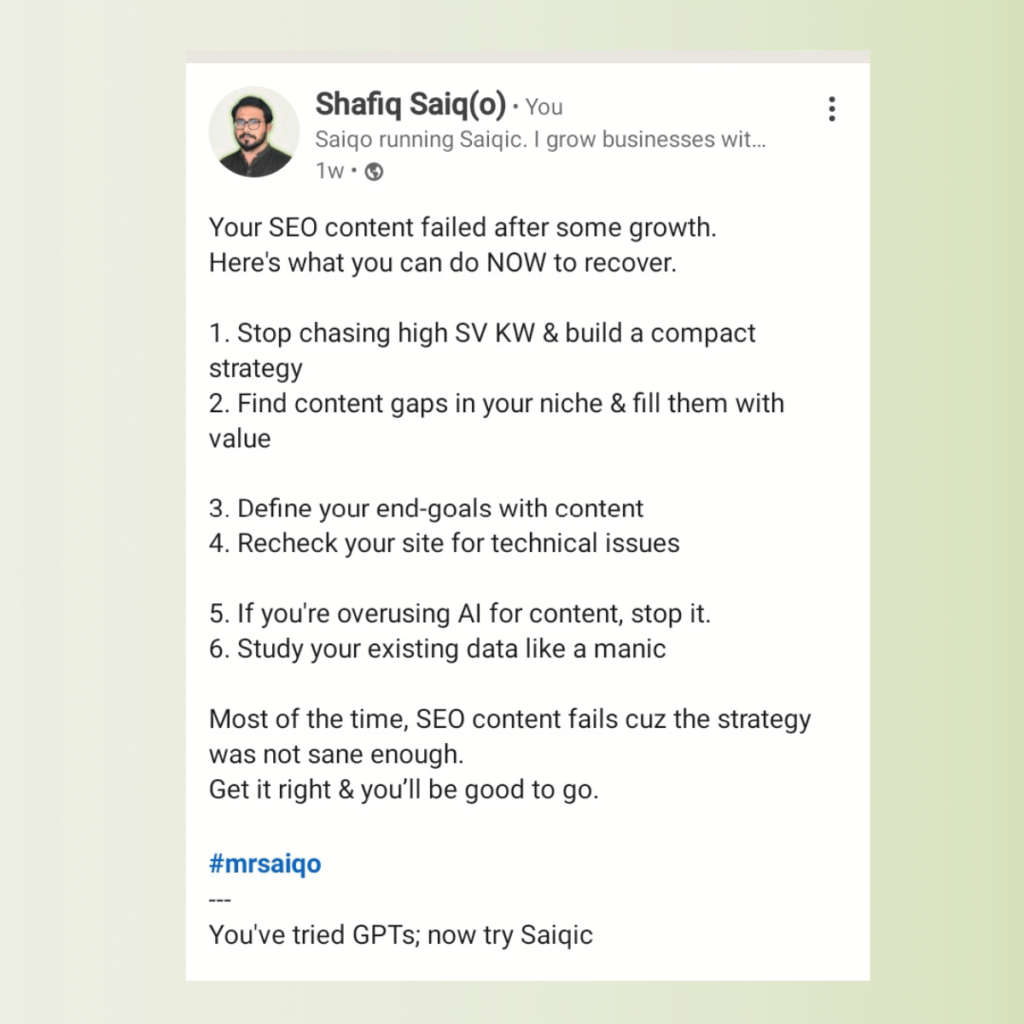
Now you know all the possible issues that may have affected your traffic and rankings. Here’s the checklist we use for Saiqic clients to revive their dying content strategy or treat stagnant organic traffic.
1) Identify the Problem Pages (GSC + GA4)
You need data for what to prioritize and fix so;
- Export URLs with organic traffic, impressions, average position, and conversions from GSC.
- Flag pages with high impressions but low clicks (CTR problem).
- Flag pages with traffic but a high bounce rate or low engagement (intent mismatch).
- Extract keywords ranking positions 5–20—these are your fastest growth opportunities.
- Use Screaming Frog to map index status, word count, internal links, and duplication.
Here you go. You have a list of pages that need to be prioritized and fixed.
2) Content Relevance & Intent Audit
Look at the flagged pages and ask yourself;
- Does the content match the dominant SERP intent (informational, transactional, navigational)?
- Is the answer complete, structured, and decision-ready (not surface-level)?
- Is the content fresh and updated with current stats, tools, and examples?
- Does it demonstrate EEAT (experience, expertise, authority, trust) with author bios, case studies, or original insights?
- Is the content thin or bloated? (Depth > word count, but shallow content won’t rank.)
You need to rewrite the pages that do not satisfy the intent. If the structure/format is the problem, reframe that page. If a page has no EEAT alignment, inject some.
3) Keyword & Topic Gap Analysis
Extract the data for all of your primary keywords and;
- Identify secondary keywords and subtopics competitors rank for, but you don’t.
- Expand clusters around core topics instead of isolated blogs.
- Add supporting sections, FAQs, comparisons, and use-case content.
You can use tools such as Moz and Ahrefs for this.
4) On-Page SERP Optimization
Check every priority page for:
- Title tag: Outcome-focused, intent-aligned, not just keywords.
- Meta description: Clear value prop, not generic summary.
- Heading structure: Logical H1 → H2 → H3 hierarchy for scannability.
- Visuals: Relevant images, charts, screenshots with descriptive alt text.
The goal here should be to improve CTR and user comprehension.
5) Link & Authority Distribution Audit
- Internal links: Are blogs linked to money pages and hubs? Or orphaned?
- Backlinks profile: Are they relevant, authoritative, and growing?
- Broken links or spammy domains? Clean them.
No distribution = no authority = ranking decay.
6) Technical, Engagement & Content Actions
- Mobile usability and page speed (PageSpeed Insights).
- Validate schema (FAQ, Article, Product) to enhance SERP and AI visibility.
- Analyze engagement: low time-on-page = intent or clarity issue.
- Optimize CTAs for search intent (don’t sell on informational queries).
This is pretty much it. Check all the boxes from this audit list, and you’ll be good to go.
Declining/Failing Content Strategy Is Curable
Google (or any search engine) has no personal grudges with you. If you see a decline in traffic or rankings, there is something wrong, and you need to take care of it.
This also does not mean you need to rebuild the strategy from scratch.
Iterations and tweaks in strategy are part of the game. So, without blaming anyone or anything, get your hands dirty and rescue your content strategy.
If you’re busy with other important stuff, then hand over your website to Saiqic.
