
Key Takeaways (TLDr)
1. Start SEO before you launch your site. And when your site goes live, you should have strong ‘trust’ signals across the internet. Like showcase your expertise on the About Us page, link your socials, etc. All of this helps you form a powerful first impression and Google crawl & index your site quickly.
2. When your site is live, you should have a proper SEO + content strategy for at least 3 months. You must have a content calendar to follow so that you post consistently without any delay.
3. Exact timing for starting SEO also depends on the type of industry/niche you’re in. For instance, if you’re into service-based business, you can start at the time of launch. If you’re into eCom, then SEO starts from the day you plan your products…and so on.
But one thing is crystal clear: no matter the niche/industry, you need to start planning SEO before you launch your site. And the bottom line is, the earlier you start SEO, the better results you get.
Now read the whole blog to understand all the aspects in detail.
Why SEO Should Start Before Your Website Goes Live
You’re excited to start a new website. You want to launch fast and see it live. You know that the website will get visitors and grow your business. I can feel it, but the truth is that SEO takes time to get you your dream results. You need to plan every aspect properly. And when the site is live, you should be done with the planning. That’s 50% of the job.And if you’re thinking, “I’ll handle SEO once the site is up,” you’re already putting your website in a weaker position from day one.
Let me explain why.
Google Is Judgmental These Days, and It Judges Your Site Based on First Impression
SEO/AISEO is fast these days. Google doesn’t wait months to figure out your site. The moment your website goes live, Google crawls it and immediately decides:
- What your site is about
- Which searches should it appear for
- Whether the experience is useful
- If it deserves visibility
If the content on your site is weak, the structure is messy, and the site takes minutes to load, your site is ‘cringe’ in Google’s eyes. And this impression of your site stays with Google for LONG.
To fix this impression, you’ll spend more money and time. Now you need months to convince Google that you’ve changed. So why not get it right from day one?I’ve seen this with clients who came to Saiqic after launch. Their rankings were stuck because Google had already categorized them as “thin,” “irrelevant,” or “slow.” We fixed it, sure. But it took way longer than it would’ve if we’d been involved before launch. This is where a structured post-growth recovery approach becomes critical to regain momentum.
New Sites Get Preference in Their Niche (But It’s a Test)
New websites often get a temporary visibility boost. We (Saiqic Crew) call it it the honeymoon period.
Google gives you a chance and tests you.
During this phase, Google observes:
- How users behave on your site
- Whether they stay or leave immediately
- If your content actually satisfies their search intent
If users bounce quickly, struggle with slow pages, or don’t explore beyond the homepage…your rankings drop, Fast.
So when Google gives you that initial push, be ready with solid content, a clear structure, and a smooth experience.
If you miss that window, you’ll be fighting uphill for months.
SEO Timing Depends on the Type of Website
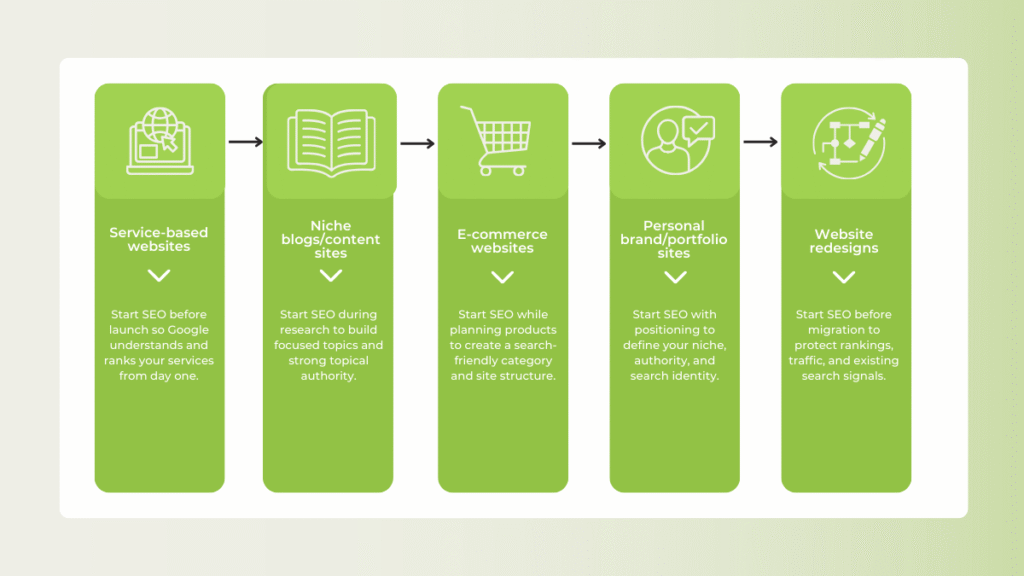
SEO starts before launch, but even before that, there are different stages where it should begin. The exact timing depends on the type of website and what you’re building.
For instance;
For Service-Based Websites, Start SEO Before The Launch
SEO should begin at the pre-launch stage. When your services are finalized but the site hasn’t gone live yet.
You need:
- Service pages ready and optimized
- Keyword grouping that matches what your audience searches
- Clear site hierarchy so Google understands your offerings immediately
Launching without this means Google doesn’t know which service to rank you for…and you lose early momentum.
For Niche Blogs / Content Sites, Start SEO in the Research Phase
SEO starts at the research stage, before you even buy a domain.
Focus on:
- Niche research (is there demand? & & if the competition is low)
- Topic selection (what will you cover?)
- Audience problems (what are they searching for?)
- Content clusters (how will topics connect?)
If you are thinking of publishing your first 10 articles, observe and then doing SEO? That’s backwards. You’ll end up with scattered content that doesn’t build topical authority.
I’ve worked with bloggers who wrote 50+ posts before doing any competitors’ analysis and keyword research. We had to prune half of them and rewrite the remaining. Don’t be such a person.
For E-commerce Websites, Start SEO When You’re Planning Products
SEO begins before you design the site or upload the products.
You need to work/plan:
- Category structure (how products are grouped)
- Product hierarchy (set products and their sub products)
- Crawl paths (how Google will discover your pages)
If you fix these after launch, it will be technical, time-consuming, and expensive. So get E-commerce SEO right in the blueprint stage.
For Personal Brands / Portfolio Sites, SEO Starts With Positioning
Your personal brand is all about your target audience. So you need to get your positioning right before you launch or write a singe word on your site. You need clarity on:
- Your niche (what you’re known for)
- Authority areas (what you can speak on)
- Search identity (how people will find you)
- Market research and your USPs ( what makes you different from what’s already out there)
Launching a portfolio without this means confused signals that lead to no rankings.
SEO When You Want To Redesign Your Existing Site
If you’re redesigning an existing site, SEO timing is critical. Start before migration.
You need to:
- Audit current rankings and traffic sources
- Map old URLs to new ones (301 redirects)
- Preserve content that’s already ranking
- Fix technical issues during the rebuild.
I’ve seen this happen with our recent client. They came to us after a redesign with nearly a 60% drop in traffic. During the initial discussions and SEO audit, we clearly saw that they didn’t involve SEO before launch. They missed key redirects, some high-performing pages had been removed, and internal linking was broken. The new site looked better visually, but search signals were disrupted.
That’s exactly the kind of situation you want to avoid.
Launching Without SEO Creates Long-Term Problems
When you skip pre-launch SEO, here’s what typically happens:
- Wrong pages get indexed (or none at all)
- Irrelevant keywords start ranking (if any)
- Google stores thin content in its index
- Site direction feels messy and unclear
Then you spend months in repair mode. Rewriting pages, fixing structure. submitting sitemaps again and again, and requesting re-crawls.
All of that could’ve been avoided.
What SEO/AISEO Experts Actually Do Before Launch
We (Saiqic Team) do the following things if we need to launch a site from scratch:
1. Audience Research
We identify who’s searching, what they need, and how they place queries.
2. Competitor Analysis
We study what’s already ranking, find gaps, and spot opportunities.
3. Search Intent Clarity
We map content to intent types (informational, transactional, commercial or navigational).
4. Site Structure Planning
We design hierarchy, categories, and crawl paths that make sense to Google and Users.
5. Core Pages Content Preparation
We write or optimize the homepage, service pages, and high-priority content before launch.
6. Technical SEO Setup
Our technical SEO specialist handles meta tags, schema markup, XML sitemaps, robots.txt, and crawl settings.
7. Speed Optimization
We compress images, enable caching, and test mobile performance.
8. Internal Linking Planning
We create a linking structure that guides users and Google through the site logically.
Then the website goes live.
And when it does? Google sees a complete, optimized, ready-to-rank site.
The Earlier You Start SEO, the Easier Growth Becomes
Google doesn’t wait for you to “figure things out.” It evaluates your site immediately and makes decisions that shape your rankings for months.
If you want to grow instead of repair, involve SEO before launch. Whether that’s during research, planning, or pre-launch optimization depends on your site type, but the timing matters, ALWAYS.
So if you’re planning a new website, redesigning an existing one, or just wondering why your month-old site isn’t ranking…now you know.
And if you need help getting it right from the start? Book a call with Saiqic and let us handle all this stuff for you.
