
SEO + content industry has changed 180 degrees. Traditional SEO has almost died. The search ecosystem has evolved, and Google is no longer the only search engine. There are new terms like AISEO, LLM visibility, GEO, SGE, AIOs, etc., and you’re scratching your head and thinking how to keep up with all of this. Your site traffic is down, and you’re not getting any leads/sales.
And that’s when you came up with the idea of updating and optimizing the old blog posts so your content can align with the evolved search behavior.
That’s actually a wise thought, and you clicked the right blog. By the end of this blog, you’ll know exactly how to update & optimize your content to revive/improve your site’s traffic.
Let’s get in.
Before You Update Anything, Figure Out Which Situation You’re Actually In
Every website has a different problem. That means every website needs a custom fix. And honestly, there’s no one-size-fits-all formula. The Saiqic team has reviewed/updated/optimized 100s of sites. On average, there are three distinct situations when it comes to updating/refreshing a site’s content. I’m sure you’ll fit into one of these three situations.
Situation 1: You Have 50-100+ Posts, But They’re Underperforming
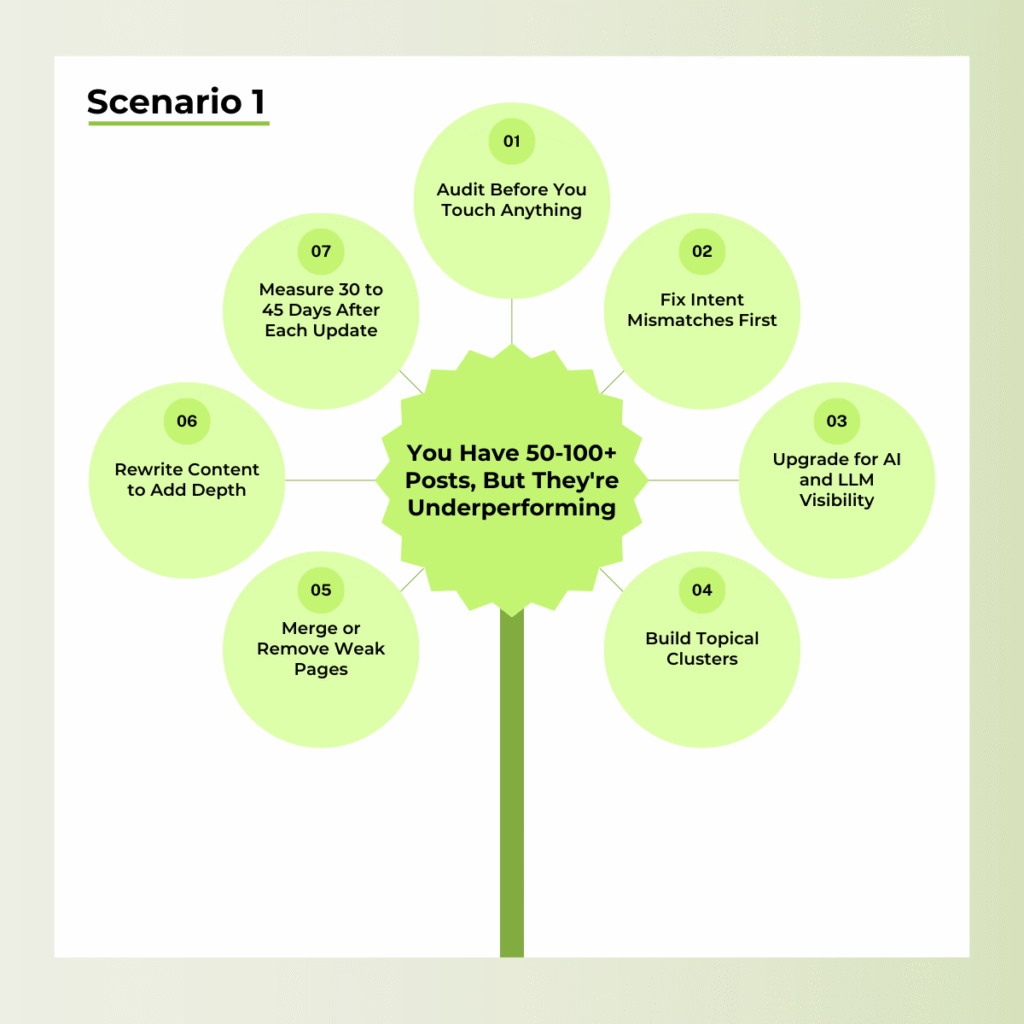
If you have fewer than 50 posts, focus on publishing first. Test different formats, angles, and content types to understand what actually works in your niche.
But if you have around 50 to 100+ posts and still aren’t seeing the intended results, stop publishing more and shift your focus to updating what already exists.
At this stage, some blogs may be misaligned with current search intent, some may be outdated, and some may simply be invisible to both Google and AI systems. That’s what you need to identify and then update/rewrite/optimize accordingly.
Here’s how you can do it step by step.
Step 1: Audit Before You Touch Anything
Open a spreadsheet and add every post with its URL, target keyword, current ranking, traffic over the last 6 to 12 months, and search intent type. Then split everything into four buckets:
- If your blog is ranking between 5 and 20, it’s a quick win and usually just needs some optimization.
- If it’s ranking between 21 and 60, there are structural issues and the post needs a proper rewrite.
- If it’s not ranking at all, the topic might not match what people are searching for or the content is too thin.
- If traffic is declining, the post is likely outdated or has been outranked by stronger competitors.
This audit tells you what to prioritize first, and stops you from wasting time on the wrong posts.
Step 2: Fix Intent Mismatches First
Search your target keyword and study what Google is actually showing on SERP. Observe whether the top results are guides, listicles, comparison posts, or service pages. If your format doesn’t match what’s ranking, fix that first.
For example, if you wrote a blog called ‘Do I Need a Buyer’s Agent?’ but people are mostly looking for posts like ‘How to find a good agent quickly,’ your post won’t really help them. You need to change the way you write it to match what people want.”
Step 3: Upgrade for AI and LLM Visibility
Most blogs are invisible to AI LLMs because they don’t have proper structure and clarity. When rewriting, make sure each post includes:
- A clear definition or direct answer in the first 100 words
- Structured H2 and H3 subheadings that mirror real search queries
- A FAQ section with genuine questions your audience asks
- Supporting data, stats, or references where relevant
- An author credibility block that shows experience and expertise
Step 4: Build Topical Clusters
Random blog posts spread across unrelated topics signal noise to Google. Identify your main topics and map supporting posts around each one, then interlink them intentionally:
- Every supporting post should link to the main topic page
- The main page should link back to 3 to 5 closely related posts
- Use descriptive anchor text, not generic phrases like “click here”
For example, if your main topic is real estate lead generation, then posts like ‘how to get more buyers from social media,’ ‘tips for following up after a showing,’ or ‘easy ways to collect contacts at an open house’ all help your main page when linked together.
Step 5: Merge or Remove Weak Pages
If a post has no traffic, no backlinks, and no clear search intent, it’s pulling your site down. Identify posts that are too similar or too thin, merge them into one comprehensive guide, and set up 301 redirects from the old URLs.
Step 6: Rewrite Content to Add Depth
Adding 200 words to an old post is not an update. A real update means rewriting the introduction with stronger positioning, expanding weak sections, closing gaps that competitors on SERP are covering, improving formatting for readability, and refreshing any outdated stats or examples.
Step 7: Measure 30 to 45 Days After Each Update
After updating, track ranking movement, impression growth, CTR changes, and AI Overview appearances where relevant. If nothing moves even after 45 days, then the issue is likely domain authority or backlinks, not the content itself. Then you would need to change the strategy entirely.
Situation 2: You Stopped Publishing for 6 to 18 Months and Now Need to Restart
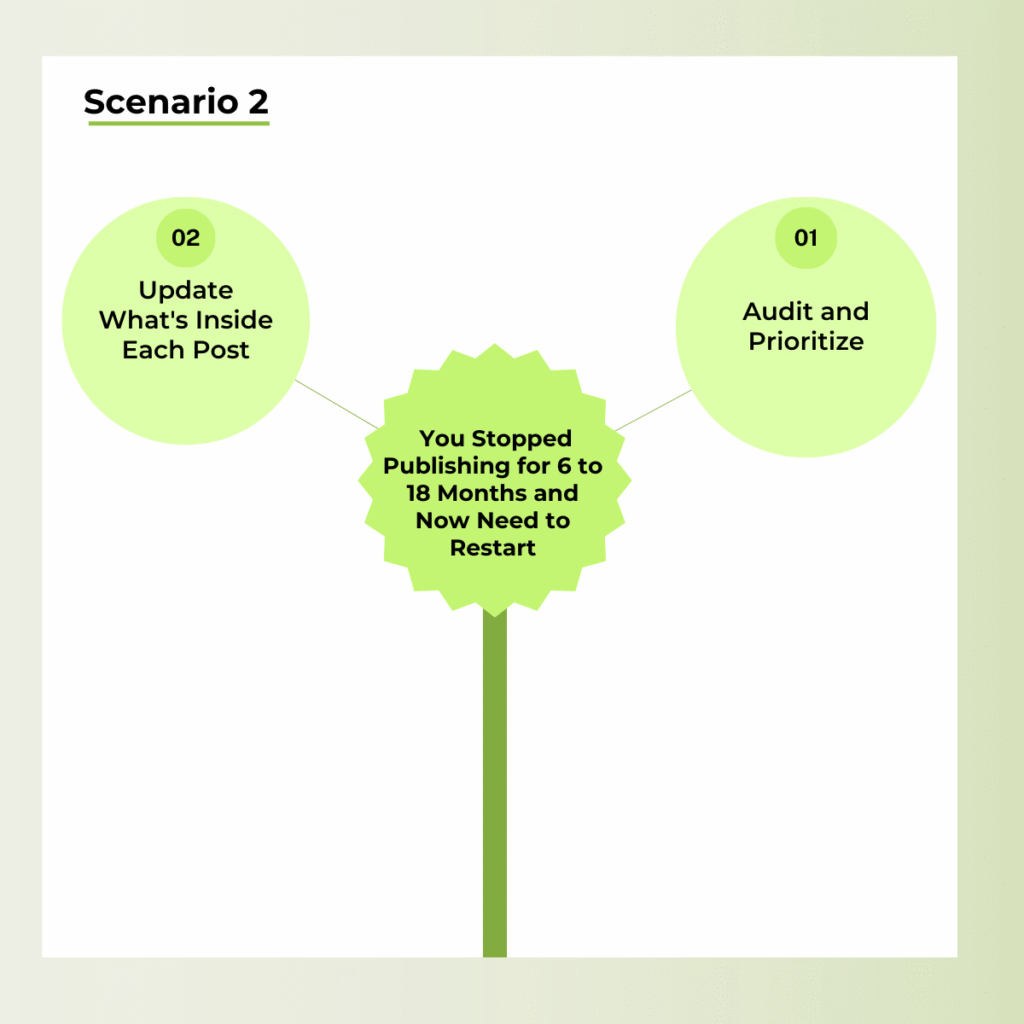
You took a break, and your site traffic and rankings dropped. AI Overviews started answering questions your blogs used to rank for. Now the question is what to fix first in the posts already sitting there.
Publishing new content without fixing existing posts means your new content has no strong internal structure to land in. So, fix the foundation first.
Step 1: Audit and Prioritize
Split your existing posts into four buckets and work from there:
- Still getting traffic = refresh and protect these first
- Ranking page 2–3 = these are closest to a win, push them to page 1
- Zero traffic but strong topic = reposition with an updated angle and structure
- Outdated or irrelevant = merge with a related post or delete entirely
Step 2: Update What’s Inside Each Post
Check for Intent Shift
The search intent + behavior of your target audience has changed during the period you’re missing in action. Over 6 to 18 months, search intent changes. So search for your primary keyword and compare what’s ranking now with what was ranking when you wrote the post. For instance, if you published a text guide on “how to generate real estate leads” 18 months ago and the top results today are dominated by tool-based comparisons and step-by-step video-style guides, your format needs to shift before anything else. If your structure no longer matches what Google is showing, restructure first.
Rewrite the Introduction
Instead of opening with a generic statement or outdated fact about your topic, mention what has changed recently in your industry. Address the current reader mindset and signal clearly that this content reflects where things stand today. Add freshness from the start.
Add E-E-A-T Signals
Google prioritizes proof over generic advice, especially for service-based businesses. Add an author name with a short bio, include a real example or observation from your own experience, reference credible data, and link internally to relevant service pages. A short “what we observed/experienced” section with genuine insight builds trust in a way generic content cannot.
Expand Thin Sections
Look for sections under 200 words that cover important subtopics. Expand them with examples, comparison tables, or updated statistics, but only where it adds genuine value. Adding words for the sake of length is not an update.
Optimize On-Page Elements
Go through each post and update the title tag with a stronger hook and current year if relevant, sharpen the meta description with a clear benefit and a soft call to action, restructure H2s to mirror how people search today, add a FAQ section with schema markup, compress images with proper alt text, and add short definition-style answers under key headings, these are what AI Overviews pull directly from your content.
Remove What’s Dragging It Down
Sometimes improving a post means subtracting. Delete outdated statistics, remove broken links, cut repetitive paragraphs, and strip irrelevant internal links. A tighter, more focused post consistently outperforms a bloated one that tries to cover everything loosely.
Step 3: Republish as You’re Publishing Now
A silent edit does nothing for visibility. After updating, change the “Last Updated” date, resubmit the URL in Google Search Console, add internal links from two or three higher-authority pages, and reshare through your newsletter or social channels. Treat every updated post as a new one.
Step 4: Work in Phases, Not All at Once
With 50-100 posts, trying to update everything simultaneously leads to inconsistent work and unclear results. Work in focused phases instead:
- Weeks 1-2 → Fix the top 10 posts driving the most impressions
- Weeks 3-4 → Push page 2–3 ranking posts onto page 1
- Month 2 → Merge weak overlapping posts into strong pillar pages
This approach builds momentum and gives you measurable signals before you go deeper into the rest of your content.
Situation 3: You’ve Been Doing Traditional SEO, but Search Behavior Has Changed
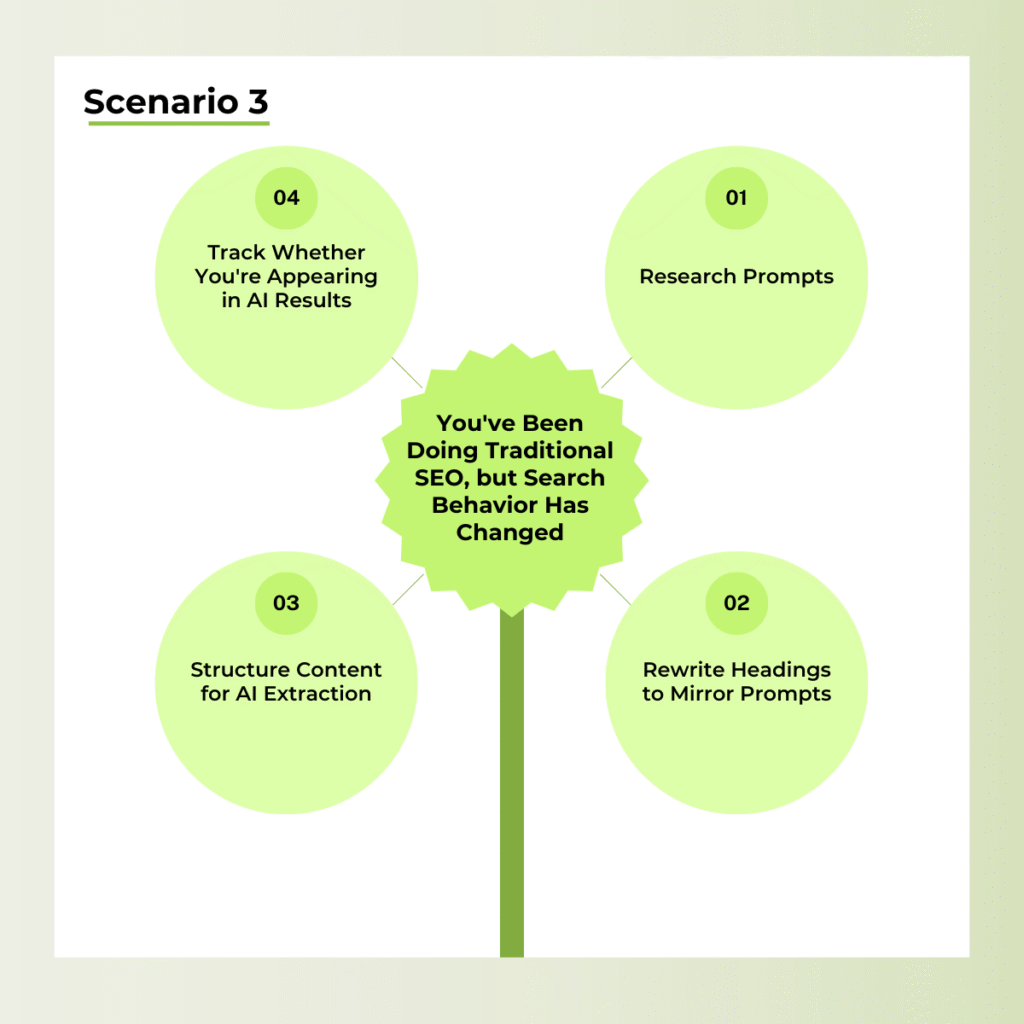
You’ve been doing traditional SEO properly. You did the keyword research, topic clustering, on-page + off-page SEO, and consistent publishing. Now there’s AISEO in the mix, and you need to take care of your AI visibility to stay relevant. But the old structure of existing content is not suitable for the new search ecosystem.
That’s when you need to update your old content for the new search era. Here’s what you need to do.
Step 1: Research Prompts
Keyword tools are now just the foundation of your research. But their insights are limited; they can’t show you what people are asking AI systems. That’s when you need to add prompt research to your process.
Open ChatGPT, Gemini, or Perplexity and ask what questions your target audience asks before deciding on your niche, or use tools like Otterly.ai. For instance, for a real estate audience, ask what first-time home sellers want to know before hiring an agent, what objections buyers raise when comparing agents, or what factors agents consider when choosing a CRM. Include beginner and advanced variations and follow-up questions.
Also, use tools like AlsoAsked and AnswerThePublic to extract question-based and comparison searches. Search directly for People Also Ask results on Google and study phrasing in AI Overviews. This shows how AI systems interpret queries and how to structure your answers.
Step 2: Rewrite Headings to Mirror Prompts
Convert H2s from keyword-optimized phrases into prompt-style questions. AI systems extract answers from content that matches how questions are asked.
Instead of “Real Estate CRM Features,” write “What Features Should a Real Estate CRM Have for a Small Team?”
Instead of “Real Estate Lead Generation Cost,” write “How Much Should a Real Estate Agent Spend on Lead Generation Monthly?”
This improves AI citation likelihood and featured snippet eligibility.
Step 3: Structure Content for AI Extraction
AI systems extract structured, specific, clearly organized information. Every post you update should follow a format built for extraction:
- A clear definition or direct answer in the first 100 words
- A dedicated direct answer section near the top
- Comparison sections with a clear structure
- Pros and cons where relevant
- A decision framework or recommendation
- A FAQ section with schema markup
- A concise summary at the end
Step 4: Track Whether You’re Appearing in AI Results
Most businesses don’t know whether they’re being cited in AI Overviews or LLM responses. Start tracking manually.
Build a spreadsheet with 20 high-intent prompts relevant to your niche. Test each monthly across ChatGPT, Gemini, Perplexity, and Google AI Overviews. Note whether you’re cited, whether competitors are cited, and whether phrasing resembles your content.
As tracking matures, tools like Profound, Otterly.ai, and Peec AI can automate monitoring brand mentions, citation frequency, and AI share of voice against competitors. Also watch analytics for referral traffic from chat.openai.com and Perplexity.ai … signals that your content is surfaced and clicked from AI platforms.
What NOT to Do While Updating Your Old Blog Posts
Some updates make things worse. These moves consistently backfire:
- Changing URLs without 301 redirects. You lose all ranking history and backlink equity.
- Deleting content to make posts shorter. Cutting depth removes ranking signals. If you remove a section, replace it with something better.
- Changing only the published date. Google doesn’t reward fake freshness.
- Updating everything at once. Stagger updates to measure impact.
- Over-optimizing for AI at the expense of readability. Structure for AI, but write for humans.
How to Know If Your Updates Are Working
Rankings are one signal. In 2026, they aren’t the only ones worth tracking.
Track weekly:
- Keyword ranking movement for updated posts; well-executed updates show movement in 2 to 6 weeks
- CTR changes in GSC; title and meta updates often move CTR before rankings
Track monthly:
- For AI visibility, manually test your brand and core topics in ChatGPT, Perplexity, and Google AI Overview. Are you being cited? Are competitors appearing instead?
- Time-on-page and engagement in GA4; low time-on-page after an update means content isn’t satisfying intent. Go back and figure out what’s missing.
Realistic Timelines:
- Moderate-competition posts on established sites can show movement in 2 to 4 weeks
- More competitive posts on newer sites can take 2–3 months
- Results are not always instant; don’t panic and start changing things again after two weeks
How to Update Without Disrupting New Content
If you’re updating alongside new publishing, keep these in mind:
- Check for cannibalization before every new post. Update existing content instead of creating competing pages.
- Treat updates as a separate workflow. One dedicated update session per week produces better results than squeezing them between new posts.
- Connect old and new content through internal links. Every new post should link to at least one older post, and updated posts should link forward to new content.
Make Your Old Blog Posts Your Competitive Advantage
Google has no personal grudge against you. Neither does ChatGPT. If your content isn’t performing like it used to, something specific is wrong and it’s fixable.
The brands winning in search right now have the most relevant, current, and credible content. They pay attention to updating things according to changing search behaviors.
You’ve already built the foundation. The work now is maintaining it and making it better.
So, figure out which situation you’re in. Prioritize your updates. Get to work. And if you’d rather hand it to someone who does this every day, let’s do a quick meeting with Saiqic and we’ll tell you exactly where to start.
